






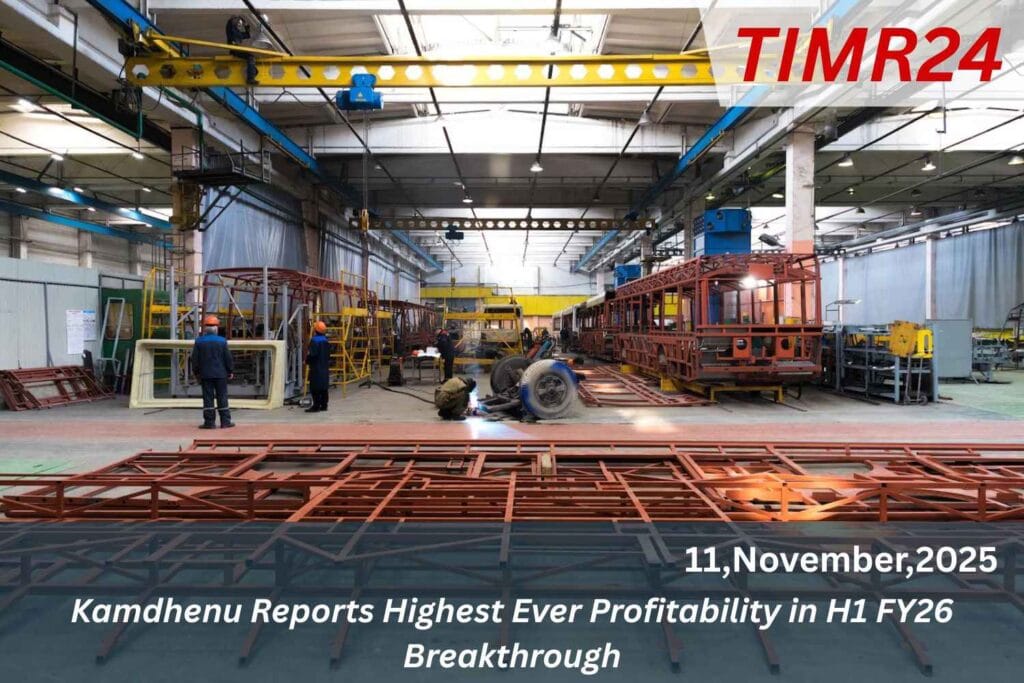
Kamdhenu, India’s leading TMT bar manufacturer, reported its highest profitability for H1 FY26, with revenue growth of 3% year-on-year to Rs 3.86 billion and a profit before tax (PBT) increase of 33% to Rs 540.3 million. The Q2 FY26 revealed a marginal revenue rise to Rs 1.91 billion and a 23% PBT increase to Rs 250.7 million, resulting in a PBT margin of 13.5%. A notable 27% growth in royalty income to Rs 860 million, bolstered by a one-time receipt, illustrated the strength of its asset-light model. Despite short-term impacts from weather and softer steel prices, Kamdhenu remains well-positioned to leverage ongoing infrastructure investment and construction activity for sustained growth.
When Kamdhenu Ltd announced its unaudited results for the half-year ended 30 September 2025 (H1 FY26), the company declared its strongest profitability to date. Revenue from operations climbed approximately 3 % year-on-year to around ₹ 3.86 billion, while profit before tax surged 33 % to about ₹ 540.3 million. The PBT margin rose to 14.0 % from 10.9 % a year ago. Profit after tax came in at roughly ₹ 400.1 million, up 28 % on the previous period What makes this result stand out is not only the growth in the bottom line but the shift in margin and earnings quality. The company’s profitability improvement has been driven by a combination of higher royalty income from its franchisee network, stronger.
Business Model & Royalty Income
Cost discipline in its own manufacturing operations, and the favourable demand backdrop for TMT bars and structural steel amid robust infrastructure and construction activity in India. Kamdhenu operates a hybrid model comprising in-house manufacturing (via its own facility in Bhiwandi, Rajasthan) alongside a franchisee network. The royalty income component has emerged as a critical growth lever. As the company notes, royalty income recorded growth of 27 % to about ₹ 860 million, supported by a one-time royalty receipt, underscoring the strength of its asset-light franchise model In H1 FY26, revenue from own manufacturing was about ₹ 3.01 billion (sales volume ~ 61,400 MT).
While franchise volumes rose 8 % year-on-year to about 1.8 lakh MT The franchise route allows Kamdhenu to extend its brand reach across India without proportionally large capital expenditure, enabling leverage of brand, distribution and scale. A prior investor presentation shows that as of FY25, the company had production capacity via its franchisees of 40 lakh MT for rebar, ~2.5 lakh MT for structural steel, and colour-coated profile sheets as well The mark of this half-year result is margin improvement. In Q2 (ended 30 Sept) the PBT margin improved to 13.5 % versus 11.0 % a year ago; for H1 it moved to 14.0 % vs 10.9 %. Gross profit margin also rose, reflecting.
Demand, Pricing And Macro Environment
Despite a marginal growth in top line (only ~3 %) largely on account of marginal change in ASPs (average selling prices) of TMT bars due to a softer steel price environment and unseasonal weather/rainfall affecting operations in key markets the company has managed to improve volumes modestly and boost franchise contributions The broader backdrop remains favourable: India’s infrastructure push, housing and construction cycle, railway-metro expansion, and general capex revival provide tailwinds for TMT bars, structural steel and allied segments. With its established brand, wide dealer-distributor network (over 8,500+ dealers, 250+ distributors across India) and franchise footprint, Kamdhenu is well placed to capture this
What does this result mean strategically? First, the shift towards royalty and brand licensing is significant it transitions a traditional steel-manufacturer toward a more asset-light model with better scalability and margin profile. Second, with debt virtually nil (as noted in investor data) (Stocks Update) and working-capital discipline improving, the balance‐sheet strength gives the company flexibility to invest, scale franchisees, and capture growth Third, the margin expansion suggests that even if topline growth is modest (due to pricing softness or volume headwinds), the company can increasingly rely on structural advantages (brand, franchise royalties, cost control) to drive earnings growth.
Fourth, rising franchise volumes give the company optionality brand-led growth with limited incremental capex, which is attractive in a commodity sector From a market perspective, these results may enhance investor confidence in a steel company that is less exposed to commodity swings and more focused on branded, value-added manufacturing and distribution. The stock may also benefit from improved visibility of earnings. According to screening data, Kamdhenu has delivered profit growth of ~18.8 % CAGR over the last five years, debt-free status, and improving working-capital metrics.
Risks & What To Watch
While the momentum is positive, there are several risks and watch-points. The steel business remains cyclical raw‐material (scrap, sponge iron) and finished steel price fluctuations, foreign-exchange impacts (if any imported inputs) and regulatory/ environmental shifts can affect margins. Kamdhenu itself noted that unseasonal weather/rainfall weighed on volumes and realisations in key markets for the quarter Also, the growth of royalty income and franchise volumes needs to be sustained. If franchisees encounter local cost issues, logistics or input inflation, the royalty growth could slow. Monitoring ASP trends in TMT/structural steel is also critical.
If steel prices soften further, the benefits of volume growth may be offset. Another factor: competitive intensity from local/regional TMT manufacturers where price competition remains acute For readers wanting deeper context, you may refer to our previous analysis of Kamdhenu’s asset-light model and Q1 performance in our article “Kamdhenu Q1 FY26 – Asset-Light Model Fuels Earnings”. This gives background to how the company has transformed its business structure. Also, see our sector-overview article on “India Steel & TMT Bar industry trends and outlook” for how Kamdhenu’s results fit in the broader market.
Ultimately, Kamdhenu’s record H1 FY26 profitability is a strong vote of confidence in its strategic direction shifting from a higher-capex steel producer toward a brand-led, franchise-powered business model with scalable margins. The modest revenue growth, when coupled with margin (India) expansion and stronger royalty income, underscores the structural shifts. For stakeholders whether investors, analysts or distributors this result signals that Kamdhenu is not only riding the infrastructure wave but doing so with improved efficiency and financial strength. The next leg of growth will hinge on how effectively franchise volumes expand, the company sustains royalty income growth.
Q1. What’re the key H1 FY26 numbers for Kamdhenu Ltd?
Revenue from operations grew ~3 % year-on-year to ~₹ 3.86 billion; profit before tax rose ~33 % to ~₹ 540.3 million; PBT margin improved to ~14.0 % (from ~10.9 %). Profit after tax stood at ~₹ 400.1 million, up ~28 %.
Q2. What drove the improved profitability?
The main drivers were a strong increase in royalty income from the franchise network (~27 % growth) and improved cost discipline/margin control in own manufacturing operations. The asset-light model is key.
Q3. How is Kamdhenu’s business model structured?
Kamdhenu uses a hybrid model: it has its own manufacturing (plant at Bhiwandi) plus an extended franchise network. The royalty income from franchisee sales contributes disproportionately to profitability growth.
Q4. What are the risks for Kamdhenu despite the strong results?
Risks include cyclicality in steel prices/raw materials, unseasonal weather/logistics issues affecting volumes, sustaining franchisee network growth, and competition from regional/smaller TMT players which could pressure ASPs and margins.
Q5. What should investors/watchers look out for going forward?
Key things to monitor: growth in royalty income and franchise volumes, margins on own manufacturing, breakdown of revenue by segment (TMT vs structural steel), any raw-material cost shocks, updates on the brand/distribution expansion, and how ASPs fare in a potentially soft steel-price environment.