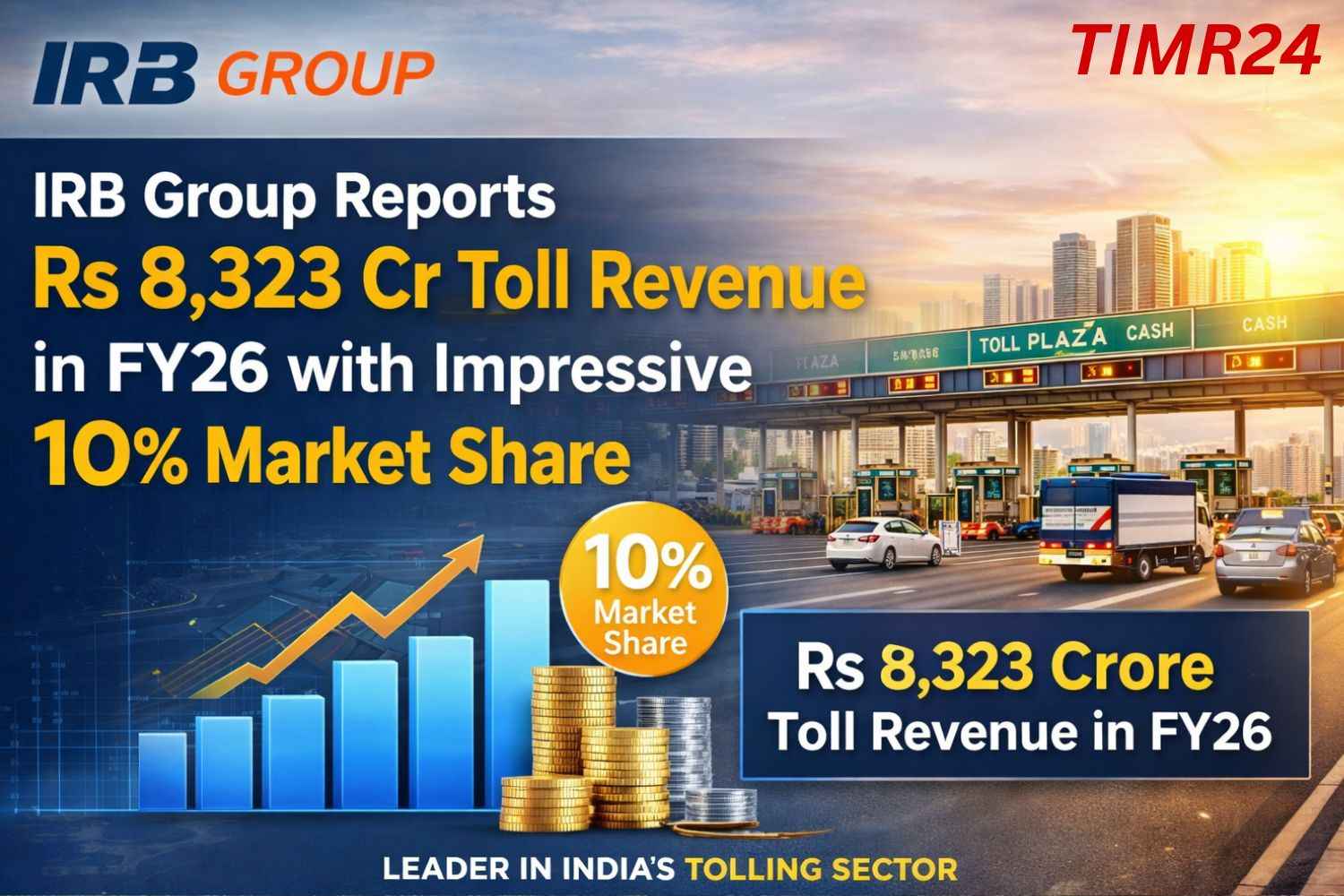










India’s IRB Infrastructure Developers Ltd and Infrastructure Trust reported an 8% increase in toll revenue for Q1 FY26, reaching ₹1,680 crore. Despite the early onset of the monsoon, both entities recorded a combined toll collection of ₹545 crore for the month, indicating sustained traffic growth despite seasonal headwinds. The positive growth trajectory is expected to continue with the completion of ongoing projects in the company’s portfolio.
Steady Financial Performance
Infrastructure Developers Ltd. reported a notable 8% year-on-year growth in toll revenue for Q1 FY26, reaching ₹1,680 crore. This consistent growth highlights the company’s ability to maintain momentum across its diversified portfolio of Build-Operate-Transfer (BOT) and Hybrid Annuity Model (HAM) projects despite macroeconomic headwinds. The uptick in revenue is largely attributed to higher traffic volumes across major corridors and operational efficiency measures adopted over the past few quarters. It reinforces strong financial fundamentals and growing investor confidence in its long-term asset performance.
Traffic Growth and Project Diversification
One of the primary drivers behind this robust toll revenue growth is the improved traffic flow across key highways operated by including the Mumbai-Pune Expressway and several other stretches under its BOT and TOT (Toll-Operate-Transfer) models. These projects, particularly in high-density corridors like Maharashtra, Gujarat, and Rajasthan, have recorded steady growth in vehicular movement. This can be attributed to post-pandemic recovery in logistics and increased inter-state commerce. IRB’s consistent investments in technology-led tolling systems and road safety improvements have also enhanced road user satisfaction and repeat usage. For more on IRB’s long-term project pipeline and strategic infrastructure push, you can explore. IRB Infrastructure’s Project.
Focus on Asset Monetization and Invite Platform
Beyond toll collections, IRB has strategically diversified its revenue channels by expanding its Infrastructure Investment Trust (Invite) platform. The IRB Invite Fund has allowed the company to recycle capital from operational assets, which in turn has helped fund new greenfield projects without overstretching the balance sheet. This model has proven efficient in maintaining liquidity while ensuring long-term value creation for stakeholders has also attracted notable global investors such as GIC and Cintra (Ferro vial Group), which reinforces international trust in the company’s governance and asset quality. Learn more about how IRB uses the Invite model for growth at NHAI FAS Tag initiative
Outlook for FY26 and Beyond
Looking ahead, is expected to maintain steady revenue momentum, supported by new project wins, favourable government policies, and a robust pipeline of infrastructure developments under India’s Baramulla Pariyojana and Gati Shakti initiatives. With a renewed focus on digitized tolling, asset upgrades, and expansion into new corridors in South and Central India, the company is well-positioned to capitalize on the next wave of infrastructure-led economic growth.
Strong Financial Growth Amidst Sectoral Momentum
Infrastructure Developers Ltd., a key player in India’s highway infrastructure landscape, has reported an 8% year-on-year increase in toll revenue for the first quarter of FY26, reaching ₹1,680 crore. This performance marks a stable financial trajectory for the company, which has continued to benefit from rising traffic movement and economic recovery post-COVID. The revenue bump also reflects effective toll collection mechanisms and enhanced operational efficiency across its managed stretches.
Boost from High-Traffic Corridors and Logistics Expansion
A major factor contributing to this growth is the revival of long-haul logistics traffic across IRB’s operated corridors, especially in states like Maharashtra, Uttar Pradesh, Rajasthan, and Gujarat. Projects like the Mumbai-Pune Expressway and the Ahmedabad-Vadodara corridor have consistently shown high vehicular density, indicating increased movement of goods and passengers. As logistics demand surges in line with e-commerce and supply chain expansion, IRB’s expressways are witnessing accelerated toll revenues.
Technological Integration and Toll Automation
In recent quarters, IRB has emphasized integrating Fasting-based toll collection and real-time monitoring systems across its networks. These tech-driven interventions have reduced leakage, enhanced transparency, and improved the overall user experience. This has also led to a rise in commuter satisfaction, encouraging recurring usage of IRB-managed routes.
Q1. What was IRB Infrastructure’s toll revenue in Q1 FY26?
IRB reported toll revenue of ₹1,680 crore, marking an 8% year-on-year growth.
Q2. What contributed to IRB’s revenue growth in Q1 FY26?
Higher traffic volumes on key expressways and operational efficiency were major drivers.
Q3. Which projects supported this revenue increase?
High-density corridors like the Mumbai-Pune Expressway and Ahmedabad-Vadodara stretch played a key role.
Q4. How is IRB leveraging its Invite model?
The Invite model helps IRB monetize mature assets and reinvest in new highway projects.
Q5. What is IRB’s growth outlook for FY26?
With a strong project pipeline and national infrastructure push, IRB expects continued growth.