




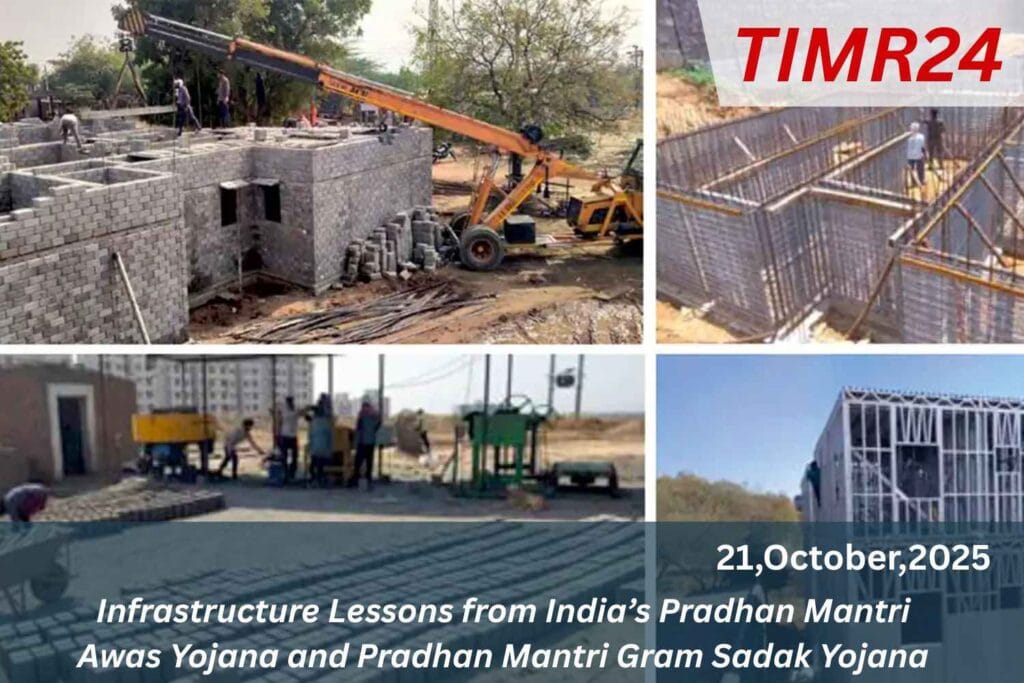
India’s infrastructure initiatives, such as the Pradhan Mantri Awas Yojana (PMAY) and the Pradhan Mantri Gram Sadak Yojana (PMGSY), have delivered around 30 million rural homes, 9 million urban homes, and 784,000 kilometres of roads by August 2025. However, the cement used in these projects contributes nearly 300 million tonnes of CO2 annually, posing a significant challenge to India’s commitment to achieving net-zero emissions by 2070. Low-carbon concrete presents a viable alternative, as it incorporates supplementary cementitious materials such as fly ash and slag, innovative binders like calcined clay and alkali-activated systems, and emerging.
Technologies like CO2-sequestering and bio-based concretes. These approaches have demonstrated the potential to reduce emissions by 20-50%, lower costs by 10-20%, and enhance resilience of built structures against climate-induced stresses This study critically examines barriers to large-scale adoption, including cost implications, material availability, and performance validation. It further highlights enabling mechanisms such as advanced testing protocols and targeted subsidies. The Indian experience provides important lessons for the global community, underscoring pathways to reconcile rapid infrastructure growth with environmental sustainability.
Low-carbon concrete offers a promising pathway to reduce emissions from large-scale construction by minimizing or replacing the use of ordinary Portland cement while maintaining strength, durability, and cost-effectiveness in buildings and roads. This study examines the application of these alternatives within the Pradhan Mantri Awas Yojana (PMAY) and the Pradhan Mantri Gram Sadak Yojana (PMGSY), drawing upon real-world data and pilot projects from 2025. The main question addressed is whether it is possible to meet the pressing demand for housing and rural connectivity while simultaneously reducing the carbon footprint of construction. The Pradhan Mantri Awas Yojana (PMAY).
Aims to provide affordable housing at a cost of around USD 1,500-2,000 per unit, with designs designed to withstand regional hazards. Conventional cement-based concrete faces challenges such as high costs, transportation to remote locations, and emissions from production. Pilot (Mantri Awas Yojana) projects in 2025 demonstrated that low-carbon concrete alternatives can mitigate these limitations by reducing emissions and overall costs Alternative binders include fly ash blended concrete, GGBS-based concrete, limestone calcined clay cement, alkali-activated concrete, and CCU concrete. Local and plant-based materials were explored to reduce dependence on conventional cement and aggregates.
Compressed Stabilized Earth Blocks, Rice Husk Ash Blended Concrete, Bamboo-Modified Concrete, and recycled aggregate concrete were used to reduce emissions and costs Community batching at the construction site significantly reduced emissions and costs, with small-scale mixers employing small-scale mixers to produce fly ash concrete for approximately 500 PMAY homes. Decentralized concrete production at the construction site also reduced transportation-related CO2 emissions by ~80%, lowered construction costs by nearly USD 900 per unit, and generated ~200 local jobs per mixer deployed Low-carbon concrete demonstrated improved resilience to.
Environmental stressors, with GGBS- and LC3-based concretes exhibiting ~20% lower water permeability, making them suitable for flood-prone regions. Bamboo-reinforced (BCIL) blocks provided enhanced ductility under seismic loading, while rice husk ash blends improved thermal comfort by lowering indoor temperatures in hot climates The outcomes of India’s pilot projects highlight the feasibility of applying low-carbon concrete to affordable housing at scale, with similar regions in Africa and Latin America potentially adopting these approaches. Low-carbon concrete is transforming construction practices in India, with pilots demonstrating that it can reduce emissions by 20-50%.
And lower costs by 10-20%. However, large-scale adoption requires consistent quality testing, affordable equipment, and reliable supply chains. India’s experience provides a strong case study for other countries, highlighting that low-carbon construction can deliver both environmental and social benefits. Engineers and policymakers must strengthen standards, support research, and encourage international collaboration to ensure performance and scalability. The key challenge remains: are we building only for the present, or are we preparing for a more sustainable future? The Ministry of Housing and Urban Affairs, the Ministry of Rural Development, and the Building Materials and Technology Promotion Council are supporting the development of low-carbon concrete.
Q1. What is the primary goal of the Pradhan Mantri Awas Yojana (PMAY)?
The main aim of PMAY is to provide affordable pucca houses to all urban and rural poor families, ensuring “Housing for All.”
Q2. How does the Pradhan Mantri Gram Sadak Yojana (PMGSY) improve rural life?
PMGSY connects previously unlinked villages with all-weather roads, improving access to healthcare, education, and markets, thereby boosting rural economies.
Q3. Are PMAY and PMGSY connected with other government schemes?
Yes. PMAY is linked with Jal Jeevan Mission, Ujjwala Yojana, and Saubhagya Yojana, while PMGSY works alongside MGNREGA for rural employment and infrastructure.
Q4. What are some technological innovations in these schemes?
Both schemes use digital tools like AwaasSoft and GeoPMGSY for tracking progress, ensuring transparency and real-time data updates.
Q5. How do these schemes promote sustainability?
By incorporating green materials, renewable energy features, and environmentally friendly construction practices, both PMAY and PMGSY support sustainable infrastructure.