




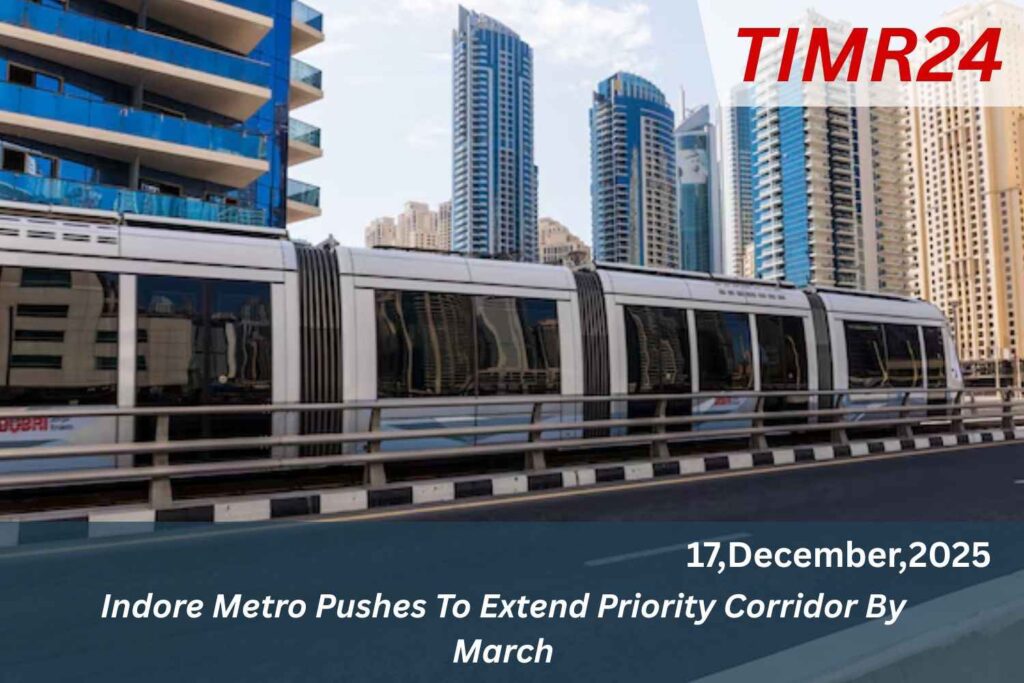
As the Bhopal Metro launch on December 21 approaches, attention is now on Indore’s Metro expansion. The Madhya Pradesh Metro Rail Corporation (MPMRC) aims to extend the current 6 km ‘Super Priority Corridor’ to a 17 km ‘Priority Corridor’ by the financial year-end to boost passenger numbers, which are currently under 500 weekly. Since its launch on May 31, the Indore Metro has served about 0.247 million passengers, primarily in the first month due to initial interest and lower fares. Construction on the next 11 km from SC-03 Station to Radisson Square is over 80% complete, with the corridor anticipated to enhance connectivity significantly.
Minimize Disruption Approval
A review by Chief Minister Mohan Yadav will address project progress and considerations for realigning an underground segment to minimize disruption. Approval from state and central authorities will be necessary for any alignment changes, and final timelines for the (India) extended section are expected to be established soon, with an aim for an early launch next year Indore push to extend its priority corridor by March marks a crucial milestone in the city’s urban transport journey and reflects the growing urgency to modernize public mobility systems in rapidly expanding Indian cities. As Madhya Pradesh’s commercial capital continues to experience.
Population growth and rising vehicle density, the project has become central to Indore’s long-term infrastructure planning. The proposed extension of the priority corridor is not merely a construction update but a strategic move aimed at delivering early benefits to commuters while reinforcing confidence in mass rapid transit systems. This phase is expected to enhance connectivity, reduce surface traffic pressure, and support Indore’s broader vision under integrated urban development initiatives The priority corridor concept has been adopted across several Indian metro projects to ensure that a functional stretch becomes operational even as work.
Synchronize Civil Work Completion
Continues on the remaining network In Indore’s case, this approach allows authorities to test systems, train staff, and familiarize citizens with metro travel before full commissioning. By targeting a March timeline for extension, planners aim to synchronize civil work completion with signaling, electrification, and safety approvals. This phased execution model reduces operational risk and ensures smoother transitions into commercial services From an urban mobility perspective, extending the priority corridor carries significant implications for traffic management and environmental sustainability. Indore has witnessed steady growth in private vehicle ownership, contributing to.
Congestion and air quality concerns. rail offers a high-capacity, low-emission alternative capable of shifting a large number of daily commuters away from roads. The extension will likely connect key residential and commercial zones, enabling smoother daily commutes and reducing average travel times. This aligns strongly with national transport planning goals outlined by the Ministry of Housing and Urban Affairs, which promotes metro systems as pillars of sustainable city design The economic dimension of the Indore Metro extension is equally important. Infrastructure projects of this scale generate employment during construction while also stimulating.
Economic Ripple Effect Strengthens
Long-term economic activity through improved accessibility. Better connectivity increases the attractiveness of business districts, supports retail growth, and encourages transit-oriented development along metro corridors. As the priority corridor extends, land values near stations (Solar) are expected to rise, encouraging planned urban densification rather than unregulated sprawl. This economic ripple effect strengthens Indore’s position as a regional growth hub and supports the city administration’s development roadmap Technological integration remains a defining feature of modern metro systems, and Indore Metro is no exception.
The extension of the priority corridor involves advanced signaling systems, energy-efficient rolling stock, and passenger information technologies designed to deliver a reliable commuting experience. These systems are being implemented in accordance with national metro rail standards, ensuring interoperability and safety compliance. The use of regenerative braking, efficient power management, and digital ticketing solutions further enhances operational sustainability Another critical aspect of the corridor extension is its role in strengthening Indore’s Smart City ambitions. Integrated transport is a cornerstone of the Smart City Mission, which emphasizes seamless.
Broader Population Segment Public Response
Movement, reduced congestion, and citizen-centric planning. The metro extension complements other smart mobility initiatives such as intelligent traffic management, feeder bus services, and pedestrian-friendly infrastructure. By improving first- and last-mile connectivity, the extended corridor ensures that metro services are accessible to a broader population segment Public response and commuter anticipation also play a role in shaping the success of the metro extension. As construction milestones are achieved, public awareness campaigns and trial runs help build familiarity and trust. The March extension target sends a strong signal of administrative intent and project momentum.
Reassuring citizens that timelines are being actively pursued. Transparency in progress updates, safety trials, and fare policies will be essential in sustaining public confidence as services expand In the broader national context, Indore Metro’s corridor extension reflects India’s accelerating investment in rail-based urban transport. With multiple cities adopting metro systems, shared learnings and standardized practices are helping projects move faster and more efficiently. Indore’s experience contributes to this collective knowledge base, demonstrating how phased commissioning can deliver early mobility benefits without compromising long-term network goals.
Step Toward Transforming
As cities continue to grapple with congestion, emissions, and urban sprawl, metro rail remains a critical solution within India’s sustainable development framework the push to extend Indore Metro’s priority corridor by March is a decisive step toward transforming the city’s mobility landscape. Beyond infrastructure completion, it represents a commitment to efficient governance, sustainable (India) transport, and improved quality of urban life. The extension will not only ease daily commutes but also catalyze economic growth, environmental benefits, and smarter city planning. As Indore moves closer to realizing its full metro network, the priority corridor stands.
Q1. What is the Indore priority corridor?
The priority corridor is the first operational stretch of Indore designed to enable early metro services before full network completion.
Q2. Why is the extension planned by March important?
The March extension target helps fast-track public transport benefits, reduce congestion, and build commuter confidence in the metro system.
Q3. Which authority is implementing the Indore Metro project?
The project is implemented by Madhya Pradesh Metro Rail Corporation Limited under state and central government coordination.
Q4. How will the extension benefit daily commuters?
It will shorten travel time, improve reliability, and reduce dependence on private vehicles within the city.
Q5. Is Indore Metro linked to India’s Smart City Mission?
Yes, the metro aligns closely with Smart City goals of sustainable, efficient, and technology-driven urban mobility.