

















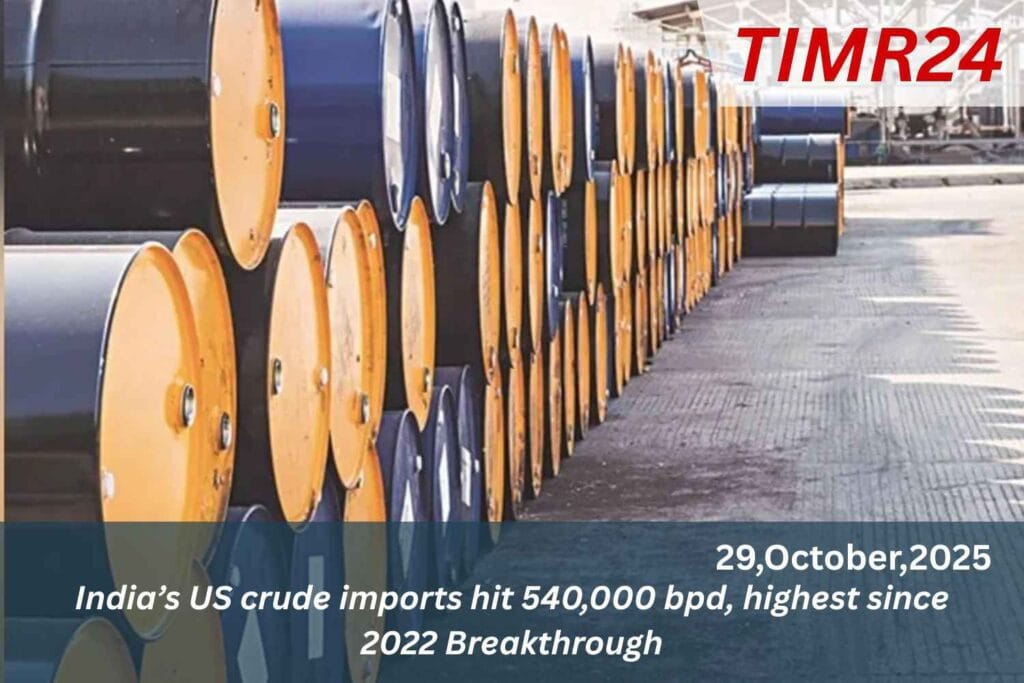
India’s crude oil imports from the United States reached 540,000 barrels per day in October, the highest since 2022. This surge is attributed to favourable market conditions, including a strong arbitrage window and a wider Brent-WTI price spread. Although the US is increasing its crude exports to India as part of a diversification strategy, Russia remains India’s largest supplier. The trend may be temporary due to potential challenges such as higher freight costs and recent US sanctions on Russian oil companies. There are concerns about the sustainability of this increase in imports.
India, the world’s third-largest consumer of oil, has reached a new milestone by importing 540,000 barrels per day (bpd) of crude oil from the United States, marking the highest level since 2022. This sharp surge in imports underlines India’s strategic diversification of its energy supply, amid shifting geopolitical and economic dynamics. The development not only strengthens India’s position in the global oil trade but also reflects its focus on securing stable, cost-effective, and sustainable energy sources India’s rapid industrial growth, expanding transportation network, and urbanization have significantly increased its energy consumption. The country imports over 85% of its crude oil needs.
Making energy security a national priority. The increase in imports from the US, which has emerged as a major global crude exporter due to its shale boom, reflects India’s intent to reduce dependency on traditional suppliers like the Middle East, particularly Iraq and Saudi Arabia. This diversification helps India manage supply chain risks and gain favourable pricing options amid global fluctuations With the international oil market undergoing constant disruptions due to geopolitical conflicts, especially the Russia-Ukraine war, India has strategically leveraged opportunities to import discounted crude from various suppliers, including Russia and now, increasingly.
The Surge in US Crude Imports
From the US This move underscores India’s commitment to maintaining flexibility in sourcing energy while ensuring that refining operations remain steady and cost-effective According to industry data, India’s crude imports from the US have risen sharply in 2025, averaging 540,000 bpd, a level not seen since late 2022. The rise is attributed to strong demand from private refiners such as Reliance Industries and Nayara Energy, as well as state-run refiners including Indian Oil Corporation (IOC) and Bharat Petroleum Corporation Limited (BPCL). The attractiveness of US crude lies in its quality, pricing structure, and availability amid reduced freight costs.
Indian refiners have been particularly interested in light sweet crude grades from the US, which are well-suited for producing high-value products like petrol and jet fuel. Moreover, as global shipping routes stabilize and freight rates drop, the cost-effectiveness of importing from the US Gulf Coast has improved significantly, contributing to the surge in shipments into India’s refining strategies.
Shifting Global Energy Dynamics
The sharp increase in India’s US crude imports also reflects broader shifts in global energy trade. The United States, once a major importer, has become a top exporter thanks to its shale revolution and growing production from regions like the Permian Basin. This has allowed the US to expand its footprint in Asia, especially in countries like India and South Korea, where refiners seek stable long-term contracts and varied crude blends For India, the move towards American crude helps balance geopolitical equations. While Russian imports remain high due to discounted rates, diversification towards the US sends a message of strategic neutrality and resilience.
By purchasing from a wide mix of suppliers, India ensures that global sanctions, supply disruptions, or diplomatic pressures have minimal impact on its energy security Furthermore, India’s Ministry of Petroleum and Natural Gas has emphasized that the diversification of supply (Godrej) chains is part of the government’s Energy Transition and Security Policy, which aims to balance fossil fuel imports with investments in renewable energy and cleaner technologies.
Economic and Strategic Implications
The economic implications of this import surge are multifaceted. On one hand, increased US crude imports support India’s refining sector, which is geared toward not only meeting domestic demand but also exporting refined products to Asia and Africa. Refining margins remain robust, supported by global demand recovery and India’s advanced refining infrastructure On the other hand, the move helps India negotiate better deals with other oil-exporting nations. Having multiple supply options enhances bargaining power and price flexibility. Additionally, this trend aligns with India’s goal to strengthen energy ties with Western economies, especially amid growing.
Trade cooperation between New Delhi and Washington under frameworks like the US-India Strategic Clean Energy Partnership (SCEP) This growing energy partnership is expected to pave the way for greater collaboration in LNG (Liquefied Natural Gas) trade, hydrogen production, and carbon reduction technologies. Such initiatives not only improve India’s energy resilience but also support its long-term climate goals under the Paris Agreement To explore the ongoing bilateral initiatives Private refiners such as Reliance Industries, which operates the world’s largest refining complex in Jamnagar, have played.
A crucial role in expanding the share of US crude in India’s import basket. Reliance’s ability to process varied crude grades, including light and heavy blends, gives it an edge in adapting to market conditions. Similarly, Nayara Energy, backed by Russia’s Rosneft, continues to optimize (US) crude procurement strategies to balance costs and output quality State-run refiners like IOC and BPCL have also participated in term deals and spot purchases from the US, leveraging competitive freight rates and long-term contracts that ensure supply stability. These refiners are instrumental in supporting the government’s vision of an “Atmanirbhar Bharat” (self-reliant India) in energy.
The Road Ahead Balancing Imports and Energy Transition
Where securing affordable crude sources is key to economic stability While the surge in US crude imports marks a significant milestone, India’s long-term strategy involves gradually transitioning towards renewable and alternative energy. The government is promoting solar, wind, and green hydrogen projects to reduce carbon intensity. However, crude oil will remain central to India’s energy mix for at least the next two decades, as demand from transportation, manufacturing, and petrochemical industries continues to rise India’s 2030 vision focuses on achieving energy security through diversification, technological advancement, and sustainability.
The increased partnership with the US complements this vision, ensuring both short-term stability and long-term innovation. Moreover, with global oil demand projected to peak around 2035, India’s proactive engagement with new suppliers positions it as a key player in the evolving global energy map India’s record import of 540,000 bpd of US crude represents more than just a trade statistic it signifies a major step in reshaping the nation’s energy landscape. The move strengthens bilateral relations with the United States, enhances energy security, and provides refiners with cost-effective, high-quality feedstock options. As India continues to balance its crude.
Imports between traditional Middle Eastern producers, discounted Russian barrels, and now a growing US share, it is laying the groundwork for a more resilient and diversified energy future To stay updated on related developments.
Q1. Why are India’s US crude imports increasing?
India is importing more crude from the US to diversify its energy sources, gain pricing flexibility, and ensure a stable supply amid global geopolitical tensions.
Q2. How much crude oil does India import from the US currently?
India’s crude imports from the US reached 540,000 barrels per day (bpd), the highest level since 2022.
Q3. Which companies are leading the imports?
Reliance Industries, Nayara Energy, Indian Oil Corporation (IOC), and BPCL are key importers of US crude in India.
Q4. How does this import surge affect India’s economy?
It supports refining margins, strengthens the rupee’s stability, and enhances India’s global trade balance by optimizing import costs.
Q5. What is India’s long-term energy goal?
India aims to balance fossil fuel imports with renewable energy development and achieve net-zero carbon emissions by 2070.