
















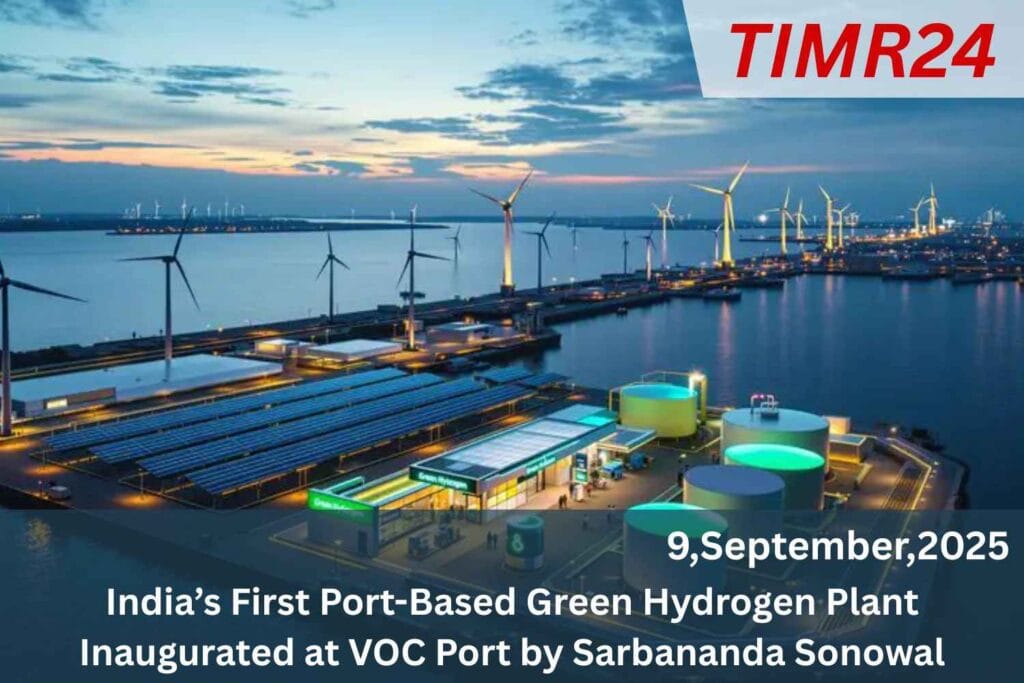
India’s Union Minister of Ports, Shipping and Waterways, Sarbananda Sonowal, inaugurated India’s first-based green hydrogen pilot project at V.O. Chidambaranar (VOC) in Tuticorin. The 10 Nm³/hr facility will produce green hydrogen to power streetlights and an electric vehicle charging station within the port colony. The project, developed at a cost of ₹3.87 crore, will also establish VOC as a major green bunkering hub in South India. Other projects launched include a 400 KW rooftop solar power plant, a link conveyor connecting Coal Jetty-I to the stack yard, a 6 MW wind farm, a ₹90 crore multi-cargo berth, a 3.37 km four-lane road, and the Tamil Nadu Maritime Heritage.
Museum The projects aim to generate thousands of jobs, attract global investments, and position Tamil Nadu as a key contributor to India’s economic aspirations. The inauguration of India’s first-based green hydrogen plant at in Tamil Nadu by Union Minister for, Shipping and Waterways Sarbananda Sonowal marks a defining moment in the nation’s clean energy transformation. The project highlights India’s determination to become a leader in sustainable maritime operations and green fuel adoption while directly supporting the National Hydrogen Mission. Positioned at a strategic gateway on the south-eastern coast, VOC is emerging as a hub.
Understanding the Role of Green Hydrogen in Energy Transition
Where renewable energy production, hydrogen technology, and global trade converge, creating opportunities that go far beyond Tamil Nadu and extend into India’s broader energy and export economy. Green hydrogen is produced through electrolysis powered by renewable energy sources like solar and wind. Unlike grey hydrogen, which relies on fossil fuels and emits carbon, green hydrogen is entirely carbon-free, making it a revolutionary clean fuel option. Its importance lies in its versatility it can decarbonize industries such as steel, cement, and fertilizers, as well as act as a green bunker fuel for ships. With the maritime industry responsible for nearly 3% of global greenhouse gas.
Emissions, hydrogen-based fuels are considered a crucial enabler of decarbonization. According to the hydrogen could account for up to 12% of global energy demand by 2050, which positions projects like VOC as vital stepping stones in the global clean energy movement. Located in Tuticorin, Tamil Nadu, VOC Port has long been a significant gateway for India’s international trade. With this project, the is expanding its scope from being a logistics hub to becoming an energy transition leader. The green hydrogen plant at VOC is designed to support green bunkering facilities.
Enabling ships to refuel with green hydrogen or derivatives such as ammonia and methanol. This aligns with global efforts by to cut shipping-related emissions by at least 50% by 2050. By positioning itself at the forefront of maritime sustainability, VOC strengthens India’s maritime infrastructure and signals to global shipping companies that Indian ports are ready for a low-carbon future The launch of this green hydrogen facility directly contributes to India’s National Hydrogen Mission, which aims to produce five million metric tonnes of green hydrogen annually by 2030. The mission envisions India as a global hub for hydrogen production, usage, and export. By integrating a hydrogen.
Plant within a major port, India demonstrates how hydrogen can be embedded into everyday infrastructure to drive decarbonization. Ports like (JNPA) are also planning similar initiatives, which collectively will make Indian competitive in the global race for green hydrogen adoption. This interconnected strategy ensures that India not only fulfils domestic energy needs but also strengthens its presence in the international clean energy supply chain.
Economic Benefits and Job Creation
One of the most notable aspects of the green hydrogen plant at VOC is its economic potential. By leveraging Tamil Nadu’s abundant renewable energy resources, particularly in wind and solar, the project creates a strong base for large-scale hydrogen production. This is expected to attract significant private sector investments and open new employment avenues in technology, operations, and logistics. The transition to hydrogen is not just about sustainability; it is also about creating a new industrial ecosystem that can generate economic growth. The development of hydrogen hubs across will provide opportunities for research, skill development, and entrepreneurship, strengthening India’s clean-tech economy.
VOC green hydrogen project has immediate and long-term environmental implications. In the short term, it reduces the carbon footprint of port operations, including cargo handling and auxiliary services. In the long term, the adoption of hydrogen as a fuel source will help cut emissions from shipping and heavy industries across Tamil Nadu. The state’s strong renewable energy sector, which already contributes significantly to India’s renewable power capacity, offers an ideal ecosystem for scaling hydrogen production. This synergy between renewable power and hydrogen technology ensures that Tamil Nadu continues to play a leadership role in India’s green energy transition.
Integration with India’s Wider Green Energy Initiatives
The project at VOC is not an isolated development but part of a larger ecosystem of clean energy projects. The and (Solar Energy) are driving nationwide renewable energy adoption, from solar parks to offshore wind projects. Hydrogen plants like the one at VOC are complementary to these efforts, as they provide a storage and conversion mechanism for renewable power. This integration ensures that renewable electricity, which can often be intermittent, finds a reliable pathway into long-term energy solutions through hydrogen production. The synergy between renewable energy projects and hydrogen infrastructure will help India achieve its target of 500 GW of renewable energy capacity by 2030.
Inaugurating the first port-based green hydrogen plant is more than a local achievement it sends a global signal of India’s intent to lead in hydrogen technology and sustainable shipping. The project enhances India’s reputation as a responsible energy player, aligned with international climate agreements and sustainability goals. It also strengthens ties with nations investing in hydrogen imports, such as Japan, Germany, and South Korea, creating potential export markets for India’s green hydrogen. This positions Indian ports not just as cargo gateways but as energy gateways to the future.
The green hydrogen plant at VOC, inaugurated by Sarbananda Sonowal, is a milestone that represents India’s commitment to marrying economic growth with environmental stewardship. By embedding green hydrogen within port infrastructure, India demonstrates how traditional trade hubs can be reimagined as clean energy centers. This project contributes to the National Hydrogen Mission, supports international decarbonization goals, and enhances Tamil Nadu’s renewable energy leadership. More importantly, it provides a blueprint for how across India can transition into sustainable energy hubs. As other ports join the movement.
The ripple effects of VOC initiative will spread across the maritime sector, industry, and global trade. The plant is not just a symbol of innovation but a functional step into a future where India’s ports fuel the world’s clean energy economy.
Q1. What is the significance of India’s first port-based green hydrogen plant at VOC ?
This plant is a milestone in India’s renewable energy journey, positioning VOC Port as a leader in sustainable port operations and green shipping.
Q2. Who inaugurated the VOC Green Hydrogen Plant?
The Union Minister for, Shipping and Waterways, Sarbananda Sonowal, inaugurated the plant.
Q3. How will the green hydrogen plant benefit India’s ?
It will reduce carbon emissions, enable green bunkering for ships, and strengthen India’s position in the global clean energy economy.
Q4. What role does VOC Port play in India’s clean energy roadmap?
VOC Port is becoming a hub for renewable energy integration, focusing on hydrogen, offshore wind, and clean fuels.
Q5. How does this project align with India’s National Hydrogen Mission?
The plant directly supports India’s target of becoming a global hub for green hydrogen production and export by 2030.