










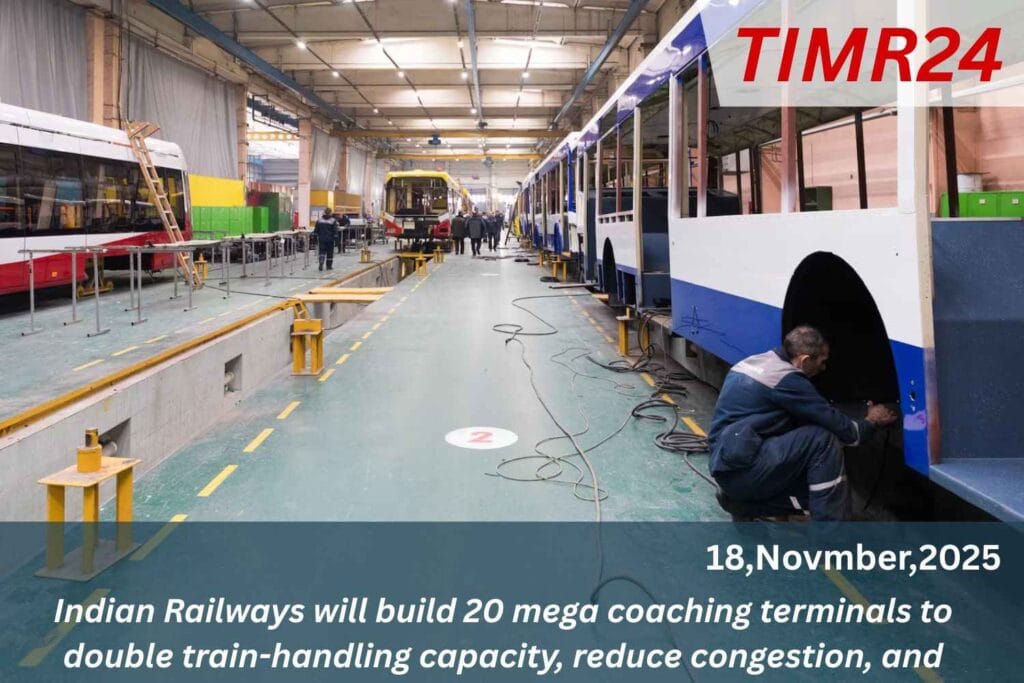
Indian Railways plans to develop Mega Coaching Terminals in 20 major cities to alleviate congestion and enhance train-handling capacity. Key cities like Delhi, Mumbai, Chennai, Kolkata, and Ahmedabad are prioritized due to high train volumes. A terminal in Ahmedabad’s Vatva area is under construction, expected to manage nearly 150 services, up from 45 currently. A new terminal in Surat is also planned to accommodate increasing demand. This initiative is part of a broader effort to modernize passenger rail operations and improve station infrastructure across India. Indian Railways is embarking on a landmark expansion by planning Mega Coaching Terminals in 20 cities across India, a move that may fundamentally reshape how the network handles its growing passenger and train-traffic demands.
This initiative is rooted in a critical operational need: existing stations in high-demand metros and regional hubs are under increasing pressure, particularly during busy seasons and festivals. The upcoming terminals are set to double train-handling capacity at key locations, thereby offering more reliable schedules, greater frequency, and reduced delays. At its core, a Mega Coaching Terminal is not just another railway station. It is a purpose-built facility, designed to integrate coach maintenance, cleaning, and train stabling in a single, efficient hub. This means trains starting or ending their journeys will no longer compete for limited pit lines at already crowded stations.
Cities Chosen, Major Metropolises
But it will instead be serviced in a dedicated environment. Such specialization is critical for modern rail operations, especially when scaling up capacity without compromising on punctuality or the health of the rolling stock. Among the 20 cities chosen, major metropolises like Delhi, Mumbai, Chennai, Kolkata, and Ahmedabad figure prominently. In Gujarat, specifically, Ahmedabad is already seeing on-the-ground work that the Vatva terminal will feature 10 pit lines, which are maintenance tracks where trains can be serviced, and is expected to increase originating train capacity from 45 to nearly 150 trains. For a city like Ahmedabad, this expansion is a game-changer.
Enabling not just more trains but also more reliable operations. But the benefits of these terminals are not limited to Gujarat. Indian Railways’ vision includes easing congestion, increasing train frequency, and offering enhanced passenger experiences in densely overburdened stations across the country. This is not just about train volume; it’s about operational efficiency. By segregating the high-maintenance operations into specialized hubs, regular stations can focus on passenger flow, recovery, and throughput. One compelling example of the push for such infrastructure is in Bengaluru. The Ministry of Railways has green-lighted a final location survey for a mega.
Proposed Terminal is Expected
Coaching terminal near Devanahalli, on the Yelahanka–Devanahalli–Chikkaballapur corridor area, is strategically important: Bengaluru’s existing terminals are already stretched to their limits, managing dozens of originating and terminating trains every day. The proposed terminal is expected to bring relief by adding maintenance capacity and reducing the load on existing infrastructure. Railway Minister Ashwini Vaishnaw has articulated the vision behind this: to build a network of coaching hubs that not only address maintenance and turnaround but also elevate the service level, reduce train delays, and ensure that trains can be introduced more aggressively in response to demand.
In the long run, when these 20 terminals are fully functional, the capacity increase could be transformative, enabling Indian Railways to run more trains, more reliably, especially during festivals, peak travel times, and in regions where waiting lists and congestion have historically been huge issues. Moreover, the design of these terminals is expected to be modern and integrated. In the case of Ahmedabad, the plan includes not just pit lines but also three additional platforms, connected by a concourse-roof plaza, foot overbridges, and an elevated road linking the ends of the station. This is not merely an expansion of old infrastructure; it is an attempt to build.
NDTV, Mega Coaching Terminals
Stations that think like modern transport hubs, prioritizing flow, efficiency, and passenger convenience. Another vital aspect is the maintenance and cleanliness of coaches. With dedicated terminals, Indian Railways can clean, service, and repair trains in a more focused environment, (Solar) improving the reliability and hygiene of rakes. According to NDTV, mega coaching terminals will improve coach maintenance, cleaning, and turnaround operations, which in turn can reduce train lateness and enhance the passenger experience. For passengers, this means fewer delays, better-maintained coaches, and possibly a smoother, more predictable journey. From an operational standpoint.
These terminals also represent a capacity and resource optimization strategy. Rather than stretching existing station infrastructure to its breaking point, Indian Railways is investing in purpose-built assets. This strategy aligns with a broader modernisation roadmap, where separate hubs for coach maintenance free up prime station real estate for passenger operations and high-frequency services. There are economic and social ramifications, too. Building mega coaching terminals will create jobs for maintenance staff, cleaners, engineers, and administrative personnel. It will also likely drive local economic activity, especially during construction phases.
Beyond that, better train operations and reduced delays can indirectly boost tourism, commuter convenience, and regional connectivity in the selected cities. However, while the vision is grand, the execution will be challenging. Land acquisition, environmental clearances, funding, and coordination across railway zones are non-trivial hurdles. As seen in Bengaluru, even the survey for Devanahalli cost Rs 1.35 crore. These steps are essential but time-consuming, and the process must be managed carefully to ensure that the terminals are not just announced but also delivered on schedule. Critics may argue that such terminals might not fully solve congestion.
If integration with local networks is weak, or if passenger infrastructure at the terminal is not up to the mark. To be truly effective, these mega terminals must not only handle maintenance but also offer seamless connectivity via road, foot overbridges, parking, and passenger amenities. In addition, there is also a question of prioritization. While 20 cities are planned, which ones will go first, and how quickly will they be built? Some projects like the Ahmedabad terminal are already underway, while others are still in survey or planning stages. The sequencing will matter a lot in terms of impact and return on investment.t To learn more about this initiative from an authority.
Sources, you can refer to the detailed coverage by The Indian Express for a broader understanding of rail infrastructure modernization. Websites like Swarajya also offer insightful commentary on Indian Railways’ expansion strategy. The plan to build Mega Coaching (Solar) Terminals in 20 cities is one of the most ambitious steps by Indian Railways in recent years. It promises to alleviate congestion, double handling capacity, and modernize.
Maintenance operations. If implemented well, it could significantly improve how trains are managed, cleaned, and deployed, benefiting both passengers and the railway system’s efficiency. But the road ahead is complex: land, funding, design, and integration all matter. The success of this vision will depend not only on construction but on creating truly modern, integrated hubs that support the future of rail travel in India.
Q1. What are Mega Coaching Terminals?
Mega Coaching Terminals are large railway hubs designed to handle train maintenance, cleaning, and turnaround in one place, easing pressure on regular stations.
Q2. Why is Indian Railways building them in 20 cities?
To double train-handling capacity, particularly in high-demand cities, and ensure smoother operations during peak travel seasons.
Q3. Which cities are likely to get these new terminals?
Some of the cities selected include Delhi, Mumbai, Chennai, Kolkata, Ahmedabad, Surat, and Bengaluru.
Q4. How will these terminals improve train operations?
By providing dedicated pit lines (maintenance), reducing platform congestion, speeding up turnaround, and enabling more originating/terminating trains.
Q5. What is the status of these projects?
Construction has already started in Ahmedabad (Vatva) with 10 pit lines planned. A survey has also been approved for a terminal near Devanahalli, Bengaluru.