
















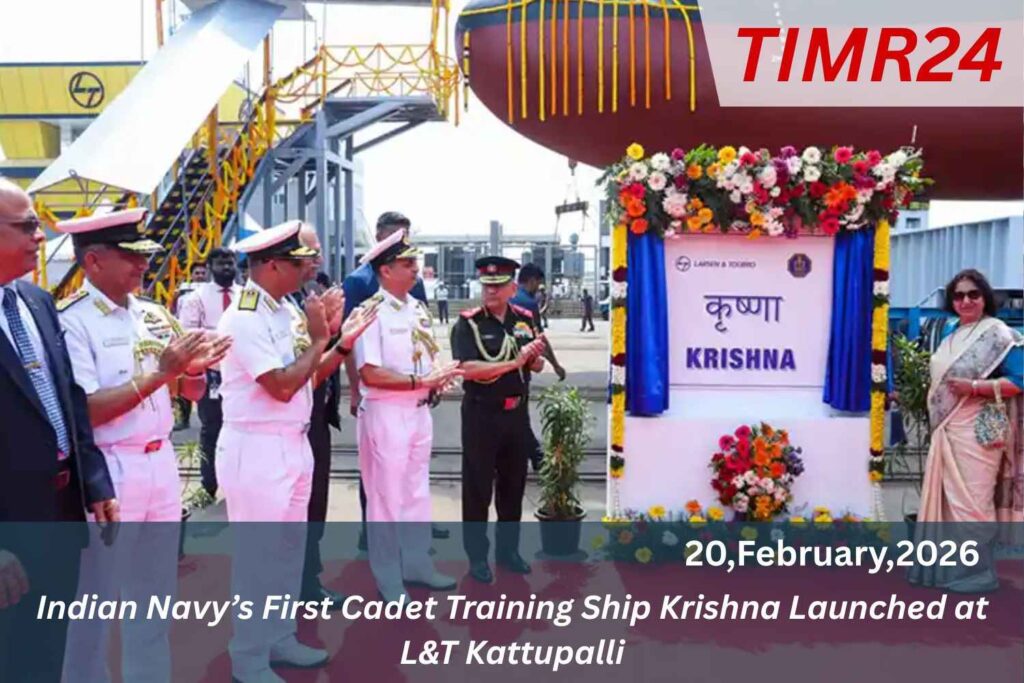
On 16 February 2026, the first of three Cadet Training Ships, numbered 18003 Krishna, was launched at L&T Shipbuilding in Kattupalli, Chennai, by Anupama Chauhan. The event was attended by Chief of Defence Staff General Anil Chauhan and senior armed forces officials. Indigenously designed and built by L&T, the vessel is set for delivery to the Indian Navy by the end of 2026. It will facilitate sea training for officer cadets, including women, and will also accommodate trainees from allied foreign countries. This launch represents a significant achievement in the Navy’s indigenous shipbuilding efforts, aligning with the Aatmanirbhar Bharat and Make in India initiatives.
Dedicated Cadet Training Ship
India’s maritime strength and defence training infrastructure received a major boost with the launch of the Indian Navy’s first dedicated Cadet Training Ship (CTS) Krishna at the Kattupalli shipyard near Chennai. Built by Larsen & Toubro at its advanced facility in Kattupalli Shipyard, the project represents a significant step toward self-reliance in defence manufacturing and maritime training excellence. The new training platform is designed specifically to prepare future naval officers with advanced sea-based operational experience, reinforcing India’s strategic maritime capabilities in the Indian Ocean region. The launch highlights the growing collaboration between public defence institutions and private.
Shipbuilding industries in strengthening indigenous naval infrastructure The Cadet Training Ship Krishna is expected to play a crucial role in training officer cadets by providing hands-on exposure to navigation, seamanship, marine engineering, and operational procedures in real maritime conditions. Unlike conventional naval vessels designed primarily for combat operations, this specialized ship integrates modern training facilities, simulation systems, and learning environments that enable cadets to gain practical knowledge of naval operations at sea. The vessel is equipped with modern navigation equipment, safety systems, accommodation facilities, and advanced communication.
Indigenous Technologies Supporting
Technologies to ensure effective training operations. The ship’s design reflects global maritime standards while incorporating indigenous technologies, supporting India’s long-term defence modernization goals India’s increasing focus on indigenous defence production aligns with the government’s broader self-reliance initiatives aimed at reducing dependency on foreign military imports. The development of the Cadet Training Ship Krishna reflects the successful implementation of domestic shipbuilding capabilities, technological innovation, and industrial collaboration. Larsen & Toubro’s Kattupalli facility has emerged as a major hub for advanced.
Shipbuilding and defence manufacturing, capable of constructing complex naval platforms using modern engineering practices. The launch demonstrates India’s growing expertise in designing and producing specialized naval vessels that meet international standards while catering to domestic defence requirements The training ship is expected to significantly enhance the quality of naval officer training by providing structured sea training modules. Cadets will be able to experience real-time maritime operations, emergency response procedures, and tactical navigation exercises, which are essential for developing leadership and operational skills.
Technical Competencies Required
The vessel will also support advanced training programs focusing on maritime security, surveillance operations, and technical competencies required for modern naval warfare. By offering dedicated infrastructure for professional training, the ship will help build a highly skilled naval workforce capable of addressing evolving maritime challenges The launch of CTS Krishna also reflects India’s strategic emphasis on maritime security amid growing geopolitical developments in the Indo-Pacific region. As maritime trade routes and naval presence continue to gain importance, strengthening naval training infrastructure becomes essential for ensuring operational readiness and regional stability.
The Indian Navy plays a critical role in safeguarding sea lanes, protecting national interests, and responding to humanitarian and disaster relief operations. The addition of a dedicated training ship strengthens institutional capacity by preparing future officers to handle complex operational environments From an industrial perspective, the project showcases the capabilities of India’s private sector in defence manufacturing. Larsen & Toubro’s involvement demonstrates the increasing role of domestic companies in executing high-value defence contracts, contributing to economic growth and technological advancement. The company’s expertise in engineering, shipbuilding, and defence.
Strengthens The Domestic Manufacturing Ecosystem
Production has enabled the development of sophisticated naval platforms that support India’s strategic objectives. The collaboration between defence authorities and private industry enhances innovation, promotes skill development, and strengthens the domestic manufacturing ecosystem The ship’s advanced training infrastructure includes modern classrooms, simulation facilities, and specialized equipment for marine engineering training. These features enable cadets to learn essential technical and operational skills in a controlled yet realistic environment. The vessel also provides accommodation and onboard support facilities designed to ensure efficient training operations during.
Extended deployments The integrated training approach allows naval cadets to develop practical knowledge alongside theoretical understanding, improving overall training effectiveness India’s maritime ambitions require a well-trained naval force capable of addressing emerging security Challenges, including piracy, maritime disputes, and disaster response operations. The introduction of CTS Krishna supports the long-term objective of building a technologically advanced and operationally efficient naval force. The training ship will help bridge the gap between classroom learning and real-world maritime operations, enabling cadets to develop essential.
Competencies required for modern naval missions The launch also contributes to regional economic development by strengthening India’s shipbuilding sector and generating employment opportunities. The construction process involved skilled engineers, technicians, and (India) workers Supporting industrial growth and technological innovation. The project highlights India’s ability to execute complex defence manufacturing programs within the country, reducing reliance on external suppliers and promoting strategic independence The Cadet Training Ship Krishna is expected to support future modernization initiatives by serving as a platform for advanced research and training methodologies.
India’s Shipbuilding Sector And Generating
The vessel may also facilitate international naval cooperation and training exchanges, enhancing India’s global maritime partnerships. By providing world-class training infrastructure, the ship reinforces India’s commitment to developing A professional and capable naval force equipped to meet evolving global challenges Overall, the launch of the Indian Navy’s first Cadet Training Ship Krishna represents a major milestone in India’s defence modernization journey. It reflects the country’s focus on indigenous manufacturing, technological advancement, and professional training excellence. The vessel will play a key role in shaping future naval leadership, strengthening maritime.
Security capabilities, and enhancing India’s position as a leading maritime power in the region. As India continues to expand its naval infrastructure and operational capabilities, projects like CTS Krishna demonstrate The nation’s commitment to building a self-reliant and (India) technologically advanced defence ecosystemdefence infrastructure developments, you may also explore our internal coverage on major naval modernization programs and shipbuilding projects that highlight India’s growing maritime capabilities. The development of advanced training platforms such as CTS Krishna indicates the country’s long-term vision of strengthening national security through innovation, strategic investment, and professional excellence in naval training.
Q1. What is the Cadet Training Ship Krishna?
It is the Indian Navy’s first dedicated training vessel designed to train naval officer cadets in maritime operations, navigation, and technical skills.
Q2. Where was CTS Krishna launched?
It was launched at Larsen & Toubro’s Kattupalli shipyard near Chennai, Tamil Nadu.
Q3. What is the purpose of this ship?
The ship provides practical sea training and operational experience to naval cadets.
Q4. Who built the ship?
It was built by Larsen & Toubro under India’s indigenous defence manufacturing program.
Q5. Why is this project important for India?
It strengthens naval training capacity, supports self-reliance in defence production, and enhances maritime security.