















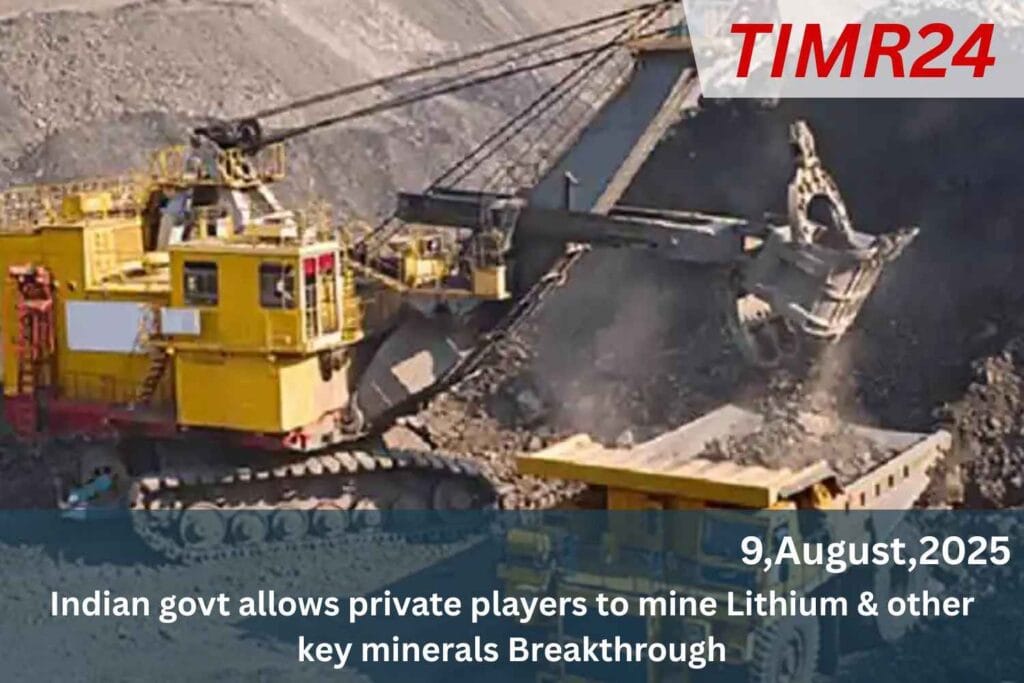
The Indian Union Cabinet has approved an amendment to mining laws, allowing private sector involvement in commercial lithium mining and five other minerals. This move aims to reduce dependence on imports for lithium, a crucial element in electric vehicle battery manufacturing. The amendment removes lithium from the list of atomic minerals, allowing the central government to auction mineral concessions. The India-Australia Critical Minerals Investment Partnership aims to develop new supply chains for critical minerals. In a significant policy shift aimed at boosting domestic mineral production and reducing dependency on imports, the Indian government has allowed private players to lithium and other strategic minerals. This move aligns with the government’s vision to strengthen.
Policy Background and Objectives
The country’s position in the global supply chain, especially in the electric vehicle (EV) and renewable energy sectors, which are heavily reliant on lithium and rare earth elements. The decision forms part of India’s broader mining reforms under the Mineral Laws Amendment and the New Mining Policy initiatives introduced in recent years. These reforms seek to attract private investment by providing a transparent, investor-friendly regulatory framework that encourages exploration and mining of critical minerals. By opening the sector to private participation, the government aims to fast-track the development of domestic lithium reserves and secure supply chains essential for the manufacturing of batteries and electronic (Mining)
Strategic Importance of Lithium and Key Minerals
Lithium is a core component of lithium-ion batteries, which power electric vehicles, smartphones, and renewable energy storage systems. As India sets ambitious targets for electric mobility and renewable energy capacity, securing access to lithium becomes crucial for energy security and economic growth. In addition to lithium, other critical minerals like cobalt, nickel, and rare earth elements are vital for emerging technologies and defence applications. The government’s move to facilitate private mining is expected to bolster the domestic supply of these minerals and reduce reliance on imports, primarily from China and other countries.
Private Sector Participation and Investment Opportunities
The entry of private players is expected to catalyze investment in exploration, mining technology, and infrastructure development. Companies can now acquire licenses to explore and lithium and other key minerals through a transparent auction or bidding process, ensuring competitive and efficient resource allocation. The private sector’s involvement also encourages the adoption of modern mining practices that emphasize sustainability and environmental safeguards, aligning with India’s commitment to green growth. for lithium. (Energy Agency)
Impact on India’s EV and Renewable Energy Goals
With private mining operations scaling up, anticipates a robust supply of lithium to meet the growing demand from battery manufacturers and electric vehicle producers. This development is crucial to achieving the government’s target of 30% electric vehicle adoption by 2030 and expanding renewable energy generation to 500 GW. Increased domestic production will lower costs and supply risks, boosting India’s competitiveness in the global EV market. For further insights.
Challenges and Environmental Considerations
While the policy encourages mining, challenges such as securing environmental clearances, land acquisition, and balancing ecological concerns remain critical. The government has emphasized stringent environmental regulations and community engagement to ensure responsible mining. Additionally, technological innovation in mining and processing is expected to minimize environmental footprints, promoting sustainable development By allowing private players to lithium and other essential minerals, the Indian government is taking a decisive step towards self-reliance in strategic resources. This policy not only paves the way for increased investment and technological advancement in the mining sector but also strengthens India’s position in the rapidly evolving global energy landscape.
Q1. What Lithium has the Indian government allowed private players?
The government has permitted private companies to lithium, cobalt, nickel, rare earth elements, and other key strategic Lithium minerals.
Q2. Why is mining lithium important for India?
Lithium is essential for manufacturing batteries used in electric vehicles and renewable energy storage, making it vital for India’s clean energy goals.
Q3. How will private mining benefit India’s economy?
Private sector involvement is expected to boost investment, increase domestic mineral production, reduce import dependence, and create jobs.
Q4. What measures are in place to ensure environmentally responsible mining?
Strict environmental guidelines and impact assessments are mandated, ensuring sustainable and eco-friendly mining practices.
Q5. How can private companies participate in mining lithium and other minerals?
Private firms can apply for mining licenses and leases through transparent auction processes conducted by the government.