













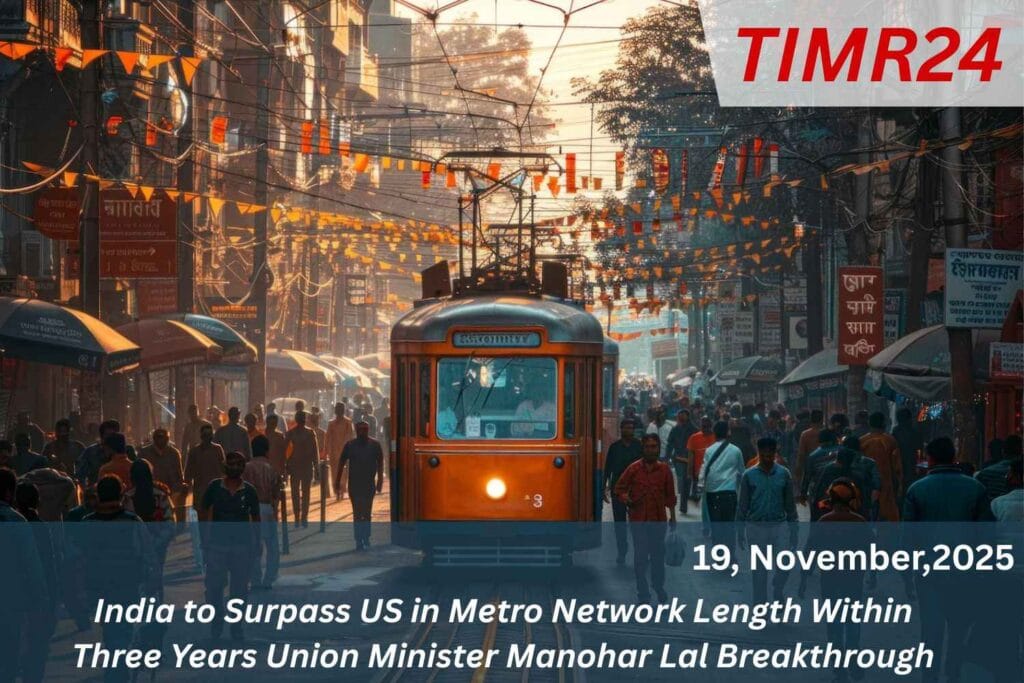
Union Minister Manohar Lal announced that India will likely surpass the United States in metro network length in the next two to three years, with the current network exceeding 1,100 km in 24 cities. This growth, from only five cities in 2004–05, demonstrates India’s commitment to sustainable urban transport. While the US and China initiated metro systems earlier, India’s rapid expansion is attributed to collaborative efforts between the central and state governments. The Minister highlighted the critical role of urbanisation in boosting the economy, projecting that cities will contribute 80% of the national GDP by 2050, and affirmed support for urban infrastructure projects in Telangana.
India’s ambition to build one of the world’s most extensive urban mobility systems took a major leap forward with Union Minister Manohar Lal’s announcement that the country is poised to surpass the United States in total metro rail network length within the next three years. The minister’s statement reflects not just infrastructure growth but a complete transformation of how India is preparing its cities for the future. With rapid population growth and intense urbanisation, Indian cities have been in desperate need of fast, reliable, and clean public transportation, and metro rail has become the backbone of this shift. Today than 900 kilometres of metro rail, making.
Reliable and clean public transportation
It is the world’s second-largest metro network after China, and the pace of construction across the country shows no signs of slowing. Cities such as Delhi, which already boasts the country’s largest metro system, continue to expand with new corridors, last-mile connectivity solutions, and integrated transport hubs, while Mumbai’s rapidly growing metro system is reshaping travel patterns across the region. To explore related developments in the region, you can also visit our Urban Transport category and the Metro Rail Updates section for continuous coverage. As the government continues pushing for transformative mobility, cities like Pune,
Chennai, Ahmedabad, Lucknow, Kochi, and Bengaluru are becoming central nodes in India’s future transport map. The upcoming expansion in Ahmedabad, enhanced further by the regional connectivity vision, shows how tier-2 cities are no longer lagging. In Chennai, efforts to strengthen the east-west and north-south transit corridors are part of a broader urban redesign aimed at reducing congestion and improving productivity. The push to elevate metro construction aligns with India’s broader urban development strategies, including the Smart Cities Mission, which promotes multimodal integration, pedestrian-friendly pathways, and clean energy adoption.
Congestion in major Indian cities
Internal initiatives like our own Infrastructure & Mobility page highlight how metro projects complement other high-impact government programmes. This aggressive expansion is driven by economic logic as well as environmental necessity. Congestion in major Indian cities results in billions of rupees lost annually in wasted fuel and productivity delays. A robust metro network reduces the strain on road systems, cutting down pollution levels and making daily commutes significantly faster. For instance, Bengaluru’s extended Purple Line has already led to notable traffic reduction on previously choked routes. Similarly, Mumbai’s Metro Line 3, once.
Operational, is expected to shift nearly 1.6 million daily commuters away from road transport. These shifts reinforce the idea that metro connectivity isn’t just a transport investment; it is a long-term commitment to improving the quality of urban life. Our Smart City Transport internal insight illustrates the parallel development of electric buses, last-mile feeders, and mobility-as-a-service frameworks. What makes India’s metro growth particularly striking is its scale. At present, over 900 kilometres of metro lines are under construction across multiple states, making India one of the most active metro-building nations in the world.
Frameworks, public-private partnerships
The United States, although equipped with large transit networks in cities like New York and Washington, has not invested in rapid expansion in recent decades. In contrast, India is rolling out new projects every year, supported by strong policy frameworks, public-private partnerships, (India)and innovative financing tools such as land value capture. The government’s shift toward faster clearances, digital monitoring of construction progress, and wider adoption of modern tunnelling technologies has helped accelerate timelines. Metro development in Delhi and Mumbai, for instance, shows how India is mastering complex underground engineering despite dense urban landscapes.
Even smaller cities are embracing metro rail as a vehicle for future growth. The Surat Metro, built with an aim to support one of India’s fastest-growing urban economies, highlights how transport infrastructure directly shapes investment patterns. In Lucknow and Kanpur, metro systems have vastly improved accessibility to educational, commercial, and medical hubs. The Kochi Metro, known for its sustainability commitments, integrates solar energy and women-led workforce participation, setting new benchmarks for social inclusiveness in infrastructure development. Our upcoming Government Development Plans coverage helps track upcoming tenders.
The government’s commitment to electrifying public
Approvals and funding allocations for emerging projects. India’s pursuit of metro expansion also aligns with its environmental goals. As the country pushes to reduce carbon emissions and transition to cleaner cities, public transport becomes a central pillar. Metro systems run on electricity and significantly reduce the dependence on petrol and diesel-based vehicles. The government’s commitment to electrifying public mobility not only through metros but through electric buses, EV charging networks, and the upcoming Regional Rapid Transit System (RRTS) creates a unified vision for sustainable transport. This integrated approach ensures that metro networks are not isolated systems but part of a larger ecosystem.
The minister’s statement does more than highlight India’s progress; it signals a clear direction. By surpassing the United States in network length, India positions itself as a global leader in public mobility innovation. The growth of metro networks is expected to generate thousands of jobs, boost real estate values around stations, and support new business districts. Cities with efficient metro systems often witness higher economic competitiveness, greater tourism activity, and improved living conditions. When metro lines extend into suburban areas, they also provide a lifeline to workers who travel long distances for employment. The expansion of the last-mile.
Through transit-oriented development
Connectivity using e-rickshaws, feeder buses, walkways, and cycling routes helps ensure that metro stations actually serve as easy-to-reach transport hubs for everyone. India’s metro network will play a major role in shaping the urban landscape through transit-oriented development (TOD). This urban planning approach encourages high-density, mixed-use communities around stations, fostering walkable neighbourhoods where people can live, work, and access public services without needing private vehicles. Major Indian metros, particularly Delhi and Pune, have already started implementing TOD projects, integrating commercial centres, offices, retail clusters, and residential spaces near transit corridors.
This shift supports more efficient land use and reduces unnecessary urban sprawl. With continued political will, steady funding, and growing public demand for clean and reliable (Mohua) mobility, India’s dream of becoming a global leader in metro infrastructure is not just achievable; it is already unfolding. As Manohar Lal emphasised, the next three years will mark a transformative leap in India’s urban evolution, placing the country firmly on the global map as a champion of modern transport development.
1. When will India surpass the US in metro network length?
Within the next three years, according to Union Minister Manohar Lal.
2. Which cities are currently expanding metro networks?
Delhi, Mumbai, Pune, Chennai, Bengaluru, Lucknow, Kanpur, Ahmedabad, Surat, and more.
3. How does metro expansion help commuters?
It reduces traffic, pollution, travel time, and fuel costs.
4. How many kilometres of metro are operational in India now?
India has over 900 km operational and 900+ km under construction.
5. Does India plan to integrate the metro with other transport?
Yes, through RRTS, bus rapid transit, and smart multimodal hubs.