









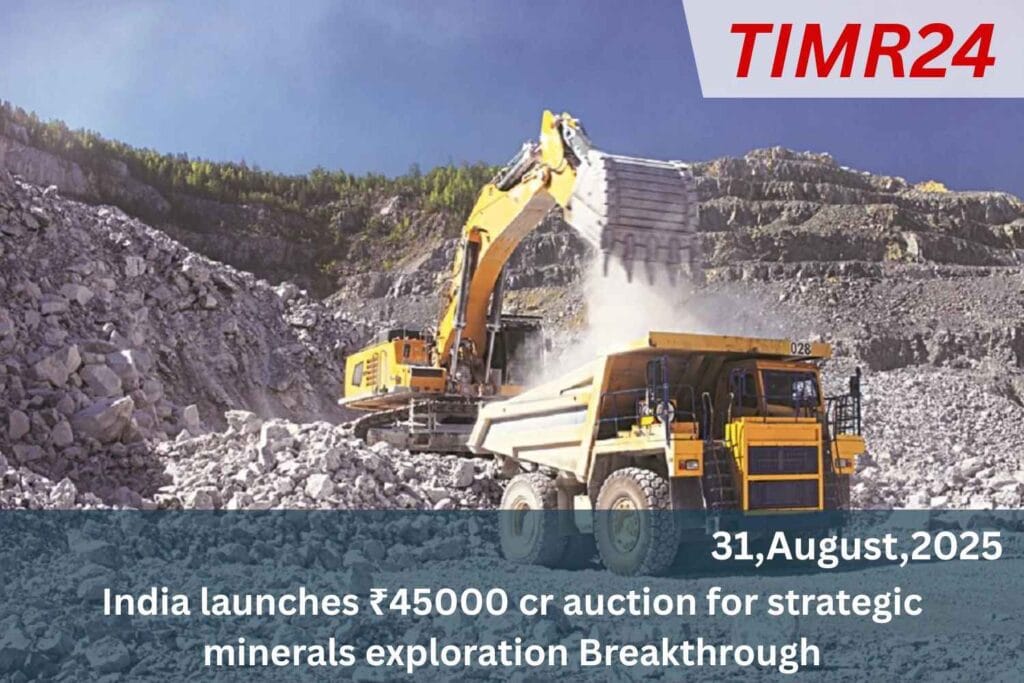
Indian government launches first tranche of auctions for 20 mineral blocks, valued at ₹45000 crore, aiming to harness critical minerals for national development. Auctions spread across eight states, targeting Korean and Japanese mining companies. India has embarked on one of its most ambitious mineral exploration programs with the launch of a ₹45,000 crore auction dedicated to strategic minerals. This initiative marks a crucial turning point for the nation’s resource security, industrial competitiveness, and future-ready growth in sectors such as renewable energy, electric mobility, defense, and electronics manufacturing. Strategic minerals, often referred to as “critical minerals,” form the backbone of advanced technologies and are indispensable for building resilient supply chains.
With the global economy increasingly pivoting towards clean energy, digitalization, and next-generation defense systems, India’s decision to aggressively auction exploration rights signals both urgency and foresight in securing these essential resources. Critical minerals like lithium, cobalt, nickel, graphite, and rare earth elements are often termed the “oil of the future” due to their unparalleled significance in clean technologies. They power everything from lithium-ion batteries for electric vehicles to semiconductors, wind turbines, and aerospace systems. India’s dependence on imports, particularly from China, South America, and African nations, has left the country vulnerable to supply disruptions and price fluctuations. By initiating large-scale exploration within its borders,
India aims to reduce external dependency and establish itself as a reliable supplier for its domestic industries while contributing to global supply diversification lithium and cobalt are fundamental to battery technologies fuelling India’s electric vehicle revolution, while rare earths are critical for defense (Ports) applications and high-performance electronics. Recognizing their indispensability, the government’s move to auction blocks for exploration is aligned with broader initiatives such as the National Mineral Policy, Atmanirbhar Bharat mission, and National Electric Mobility Mission Plan, which collectively emphasize self-reliance and sustainability in resource utilization.
Auction Model and Government Push
The ₹45,000 crore auction is being executed in a transparent, competitive model similar to coal block auctions, ensuring that both private and public sector players can participate in a level playing field. The auction covers diverse states known for mineral potential, including Jharkhand, Chhattisgarh, Rajasthan, Odisha, and Karnataka. These regions hold promising reserves of lithium, graphite, nickel, and rare earths that can significantly reduce India’s reliance on imports if developed effectively The Ministry of Mines, in collaboration with the Geological Survey of India (GSI) and state mining departments, has identified promising blocks after extensive surveys.
To accelerate progress, the government has also introduced policy reforms that streamline clearances, incentivize investment, and promote sustainable mining practices By combining commercial viability with environmental responsibility, India hopes to ensure that the exploitation of critical minerals contributes to long-term economic and ecological balance. Perhaps the most immediate and transformative impact of this auction will be felt in India’s electric vehicle (EV) sector. The country has set ambitious targets to achieve 30% EV penetration by 2030, a goal that requires massive volumes of lithium, cobalt, and nickel. Until now, domestic companies have been heavily reliant.
Impact on Electric Vehicle and Renewable Energy Ecosystem
on imports, driving up costs and limiting large-scale manufacturing. The exploration and eventual extraction of these minerals will not only stabilize supply but also make EVs more affordable for the Indian consumer. Furthermore, the renewable energy sector particularly solar and wind power will benefit from access to rare earth magnets and other strategic materials required for turbines and advanced storage systems. With India’s ambitious renewable energy target of 500 GW by 2030, having a secure supply chain of critical inputs will be pivotal for achieving energy transition goals. This auction can thus be directly linked with.
Role in Defense and High-Tech Manufacturing
The National Hydrogen Mission and Renewable Energy Expansion Programs, both of which demand robust mineral support for electrolysers, fuel cells, and storage technologies. Beyond clean energy and mobility, the availability of strategic minerals is critical for strengthening India’s defense manufacturing ecosystem. Rare earths and specialty metals are used in missiles, radar systems, jet engines, and communication technologies. As India seeks to expand indigenous defense production under the Make in India and Defence Production and Export Promotion Policy, securing access to such minerals becomes a matter of national security.
Additionally, India’s aspirations to become a global semiconductor hub also hinge on reliable access to critical materials. The government’s Sem icon India Programme envisions making the country a global player in chip manufacturing, which requires gallium, germanium, and other specialty inputs. This mineral auction therefore aligns seamlessly with the digital economy and defense modernization roadmap While the auction is a breakthrough, it is not without challenges. Strategic mineral exploration is complex, capital-intensive, and often involves sophisticated technologies. Many of these resources are located in ecologically sensitive areas, tribal regions, or zones with complex geological formations, raising concerns of displacement.
Biodiversity loss, and social conflict. Hence, India must balance its developmental aspirations with environmental stewardship and inclusive growth The government has signalled its intent to adopt global best practices in sustainable mining, including advanced rehabilitation, green mining technologies, and community participation models. Lessons from countries like Australia and Canada, which are global leaders in responsible mineral exploration, will be crucial for India as it scales operations. Moreover, collaborations with international firms can bring cutting-edge expertise in geology, extraction, and processing, reducing the learning curve.
Opportunities for Global and Domestic Investors
The ₹45,000 crore auction also opens lucrative opportunities for domestic and international investors. Global mining giants, EV battery manufacturers, and technology firms are likely to show interest in India’s mineral potential. For domestic players, this is a chance to diversify operations and tap into future-ready industries. Public sector enterprises like NMDC and private conglomerates in energy, automotive, and metals sectors are expected to participate aggressively, creating a dynamic investment landscape.
The government’s parallel initiatives to promote downstream processing and value addition mean that India is not merely aiming to extract and export raw minerals but to build complete value chains. This includes refining, processing, and manufacturing of batteries, magnets, and components, which will generate employment, enhance export potential, and stimulate research and innovation in advanced materials.
Strategic Geopolitical Positioning
On the global stage, India’s move comes at a time when the world is grappling with supply chain uncertainties. China currently dominates the supply and processing of most strategic minerals, creating geopolitical vulnerabilities. By building domestic capabilities, India strengthens its bargaining power in international negotiations while offering an alternative supply hub for friendly nations. This aligns with initiatives like the Quad Critical and Emerging Technologies Working Group and partnerships with the US, Japan, and Australia, which aim to create resilient global supply chains for critical minerals.
In this context, the auction not only serves domestic industrialization but also elevates India’s role in global resource diplomacy. With rising demand for sustainable and conflict-free supply chains, India can emerge as a trusted partner for nations seeking alternatives to monopolistic suppliers. The launch of the ₹45,000 crore auction for strategic minerals exploration is far more than an economic measure it is a strategic leap for India’s industrial, environmental, and geopolitical aspirations. By securing critical inputs for electric vehicles, renewable energy, defense, and high-tech manufacturing, the country is laying the foundation for long-term self-reliance and global leadership.
The journey ahead will require careful management of environmental concerns, technological complexities, and social sensitivities, but the vision is clear: India seeks to transform from being a resource-dependent nation to a resource-secure and globally competitive power. As exploration advances and (Energy) reserves are tapped, the results of this auction could reshape the nation’s trajectory for decades to come, placing India firmly at the center of the global transition to a sustainable, technology-driven future.
Q1. What is the purpose of India’s ₹45,000 cr minerals auction?
The purpose is to explore and develop critical minerals essential for energy, defense, and technology.
Q2. Which minerals are included in the auction?
Lithium, cobalt, nickel, rare earth elements, and other strategic minerals.
Q3. How will this benefit India’s economy?
It will reduce import dependence, boost self-reliance, attract FDI, and create jobs.
Q4. Who can participate in the auction?
Domestic and global mining companies with expertise in exploration and processing.
Q5. How does this align with India’s clean energy goals?
These minerals are vital for EV batteries, solar panels, wind turbines, and digital technologies.