















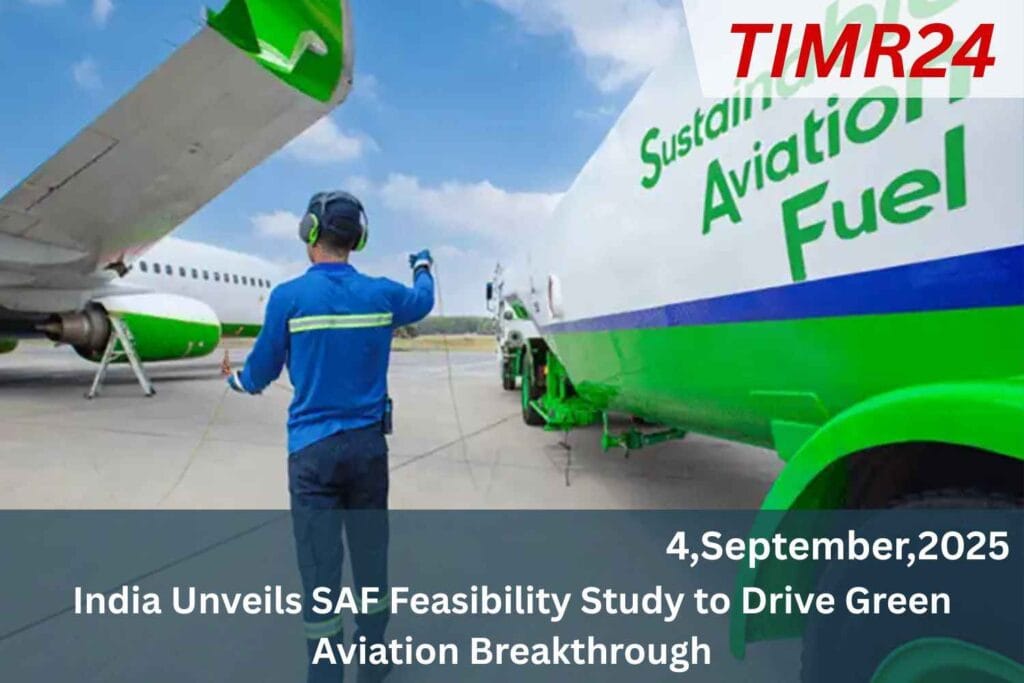
India’s Ministry of Civil Aviation, ICAO, and the European Union have released a Sustainable Aviation Fuel (SAF) Feasibility Study, assessing its potential to produce and adopt SAF using domestic feedstocks like biomass and agricultural residue. The study aims to reduce lifecycle CO₂ emissions and reduce crude imports, while also benefiting farmers. India has taken a decisive step in the journey toward decarbonizing its aviation sector with the unveiling of a Sustainable Aviation Fuel (SAF) feasibility study that promises to redefine the future of air travel in the country. As one of the world’s fastest-growing aviation markets.
Faces the dual challenge of catering to rising passenger demand while aligning with its long-term net-zero commitments by 2070. The new SAF initiative signals not only an environmental transformation but also a strategic shift that integrates economic opportunity, energy independence, and global competitiveness. At the heart of this breakthrough lies the effort to assess whether Sustainable Aviation Fuel can be scaled commercially in India while addressing affordability and infrastructure challenges. The study covers critical dimensions such as the availability of domestic feedstock, refining capacity, distribution channels, and the readiness of airlines to integrate SAF into their operations.
This is not a standalone environmental project but rather a structured pathway that complements India’s larger energy transition goals. By focusing on SAF, India is also signaling its alignment with global aviation decarbonization frameworks like the CORSIA initiative under the International Civil Aviation Organization (ICAO). For readers interested in the broader policy landscape, our section on provides context on how aviation fits within India’s sustainability roadmap.
Why SAF is Vital for Green Aviation
Unlike ground transport, where electric vehicles and hydrogen mobility are gaining traction, aviation faces significant technological and operational barriers to electrification. Jet engines demand high energy density fuels, and in this respect, SAF emerges as the most viable medium-term solution. Studies have shown that SAF can reduce lifecycle greenhouse gas emissions by up to 80% compared to fossil-based jet fuel. In addition, it is compatible with existing aircraft technology and fuelling infrastructure, making it a drop-in alternative rather than requiring expensive redesigns. To explore how India is positioning similar green fuels across sectors, our detailed piece on the provides insights into complementary clean energy pathways.
The government’s SAF initiative cannot succeed without deep collaboration among stakeholders. Leading airlines such as IndiGo, Air India, and Vistara have expressed interest in SAF adoption as part of their sustainability strategies. Simultaneously, major refining companies like Indian Oil Corporation Limited (IOCL), Bharat Petroleum Corporation Limited (BPCL), and Hindustan Petroleum (HPCL) are being encouraged to invest in refining technologies capable of producing SAF at scale. This synergy between the aviation industry and the energy sector is critical for bridging gaps between policy intent and commercial execution. For a broader view of how India’s transport industries are converging toward sustainability, you can refer to our coverage of green mobility initiatives.
Economic and Strategic Advantages
The feasibility study is also designed to explore economic advantages that extend far beyond aviation emissions. India currently imports a significant portion of its aviation turbine fuel, exposing airlines to fluctuating global prices. Domestic production of SAF can not only reduce this dependence but also generate new industries around bio-refining, waste-to-fuel technology, and renewable feedstock cultivation. This opens opportunities for rural employment, industrial diversification, and foreign direct investment in the energy sector. For those interested in investment trends, our feature on offers a comprehensive look at how capital is flowing into cleaner mobility projects.
While the potential is immense, the road ahead is not without hurdles. The most pressing issue remains cost competitiveness, as SAF is still two to three times more expensive than conventional jet fuel. Feedstock availability is another challenge, since India must balance food security with the use of agricultural residue and non-edible oils for fuel production. Additionally, building refining capacity and distribution networks will require time, technology transfers, and substantial financial incentives. However, these challenges also open the door for policy innovation, where fiscal incentives, subsidies, and research partnerships can play a transformative role.
Global Context and India’s Leadership Role
Globally, countries such as the United States and members of the European Union are aggressively pushing SAF adoption through mandates and subsidies. By launching its feasibility study now, India is ensuring it does not lag behind in this crucial race. In fact, by combining its growing aviation sector with a robust renewable energy base, India has the potential to become a leader in green aviation technologies for developing nations. Collaborations with international bodies such as and (UNFCCC) will further enhance India’s global standing. For related analysis on international comparisons, our section on explores similar leadership positions in clean energy.
The implications of SAF adoption go beyond climate mitigation. Cleaner skies mean improved air quality in and around airports, reduced health hazards for communities, and greater alignment with India’s sustainable development goals. From a social standpoint, SAF production encourages the use of waste biomass and non-edible crops, which can empower rural economies while discouraging open-field burning that contributes to severe air pollution. These co-benefits reinforce why SAF is not just a fuel choice but a broader environmental and social strategy. Readers keen on this dimension may find our article on (Rural Development) particularly relevant.
Future Outlook for India’s Aviation Industry
As the feasibility study progresses, it will lay the foundation for policy recommendations, infrastructure roadmaps, and industry incentives that can accelerate SAF adoption over the next decade. Early pilots and demonstration flights are likely to set the stage for broader rollouts, with India’s major metros such as Delhi, Mumbai, and Bengaluru serving as testing grounds. If executed effectively, SAF adoption can propel India into the ranks of global leaders in sustainable aviation, while also making flying more climate-friendly for millions of passengers. Looking ahead, this move will be remembered not just as a technological shift but as a strategic breakthrough.
Q1. What is the SAF feasibility study launched by India?
The SAF feasibility study is a government-backed initiative to evaluate the commercial production, scalability, and adoption of sustainable aviation fuel in India.
Q2. Why is SAF important for India’s aviation sector?
SAF reduces greenhouse gas emissions by up to 80% compared to conventional jet fuel, supporting India’s net-zero goals and green aviation policies.
Q3. When will SAF be adopted at scale in India?
While early adoption has begun, the feasibility study will guide large-scale SAF implementation over the next decade.
Q4. Which industries are involved in SAF development?
Airlines, oil refineries, policymakers, and renewable energy firms are collaborating to boost SAF production and adoption.
Q5. How does this benefit India’s global aviation role?
It strengthens India’s leadership in sustainable aviation, enhances competitiveness, and attracts green investments.