

















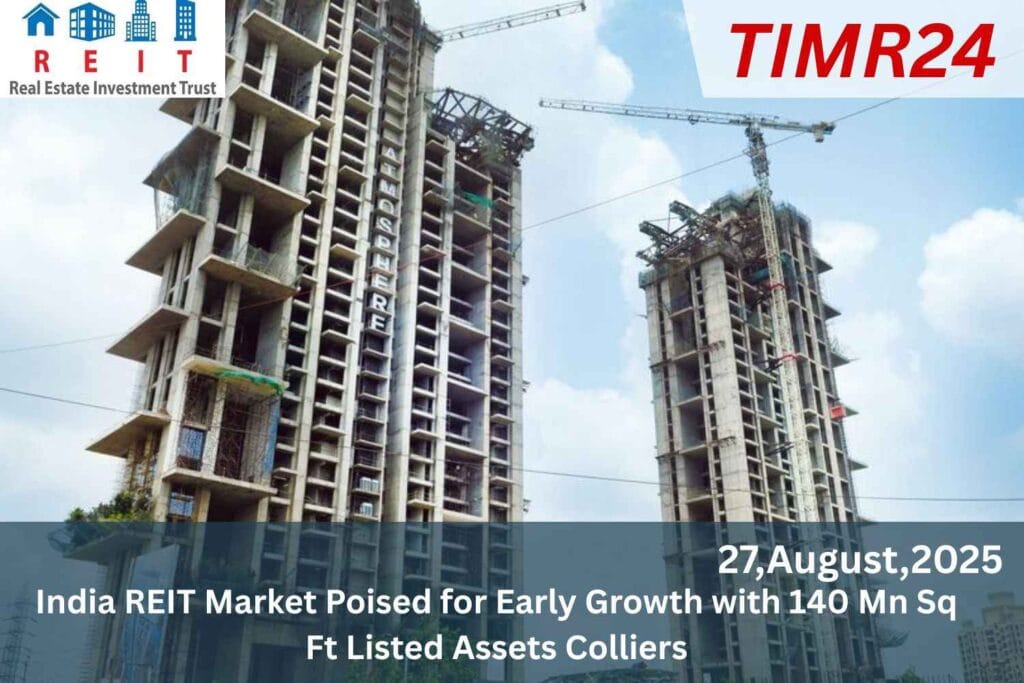
India’s Real Estate Investment Trust (REIT) market is growing, with nearly 140 million sq ft of office and retail assets listed, according to Colliers’ report. The market is expected to grow beyond offices into retail, warehousing, hospitality, and rental housing segments. Bengaluru leads with 24% of additional REIT-worthy stock, followed by Hyderabad at 19%. Indian REITs are also strengthening ESG practices, with 86% of operational office portfolios green-certified and plans to increase renewable energy usage by up to 35%. The Indian real estate market has been experiencing a remarkable transformation over the past decade, and one of the most significant developments has been the introduction and expansion of Real Estate Investment Trusts (REITs).
According to a recent report by Colliers, the India REIT market is poised for early growth, with nearly 140 million square feet of Grade-A commercial office assets already listed, creating a strong foundation for further expansion. This development not only reflects the increasing (Real Estate) institutionalization of Indian real estate but also signals a shift towards more transparent and investor-friendly structures that can attract both domestic and global capital. The REIT journey in India began with the listing of Embassy Office Parks REIT in 2019, which set a benchmark for the sector and demonstrated how a regulated, income-generating investment vehicle could provide consistent returns to investors while simultaneously enhancing liquidity in the real estate market.
Over time, more players such as Brookfield India REIT and Mindspace Business Parks REIT joined the market, offering investors diversified exposure to commercial office assets across major cities like Bengaluru, Hyderabad, Gurugram, and Mumbai. This growing participation has established REITs as a reliable alternative investment option and a preferred gateway for retail investors to access large-scale income-generating real estate, which was earlier dominated by institutional players and high-net-worth individuals. As India’s economy continues to expand, driven by the services sector, digital innovation, and multinational corporations expanding their footprint, the demand for Grade-A office spaces remains strong, creating a steady pipeline for REITs.
According to Colliers, the 140 million square feet of listed assets represent only a fraction of the total office stock in the country, which is estimated at nearly 700 million square feet. This means there is tremendous untapped potential for future listings, particularly as developers and asset managers recognize the benefits of unlocking capital through REIT structures. Moreover, India’s strong regulatory framework, overseen by the Securities and Exchange Board of India (SEBI), ensures greater transparency and governance, which enhances investor confidence. The ability to provide quarterly distributions, professional management, and adherence to disclosure norms has made REITs a secure and attractive proposition. When compared with global markets
Like the United States, Singapore, or Australia where REITs have been established for decades and play a central role in capital markets India is still in its early growth stage, which makes the coming decade crucial for scaling up. An interesting dimension of India’s REIT story is its potential diversification beyond office assets. While commercial office spaces remain the dominant category today, the growing adoption of e-commerce and demand for Grade-A warehousing has created opportunities for industrial and logistics REITs. Similarly, with India’s urban middle class expanding and aspirational lifestyles driving retail spending, retail malls and shopping centers could also form part of future REIT portfolios. Even data centers, which have become critical infrastructure in the digital economy, are being.
Discussed as a possible asset class under REIT structures. This diversification would not only deepen the market but also provide investors with broader choices, balancing risk across different real estate categories. In fact, leading property consultants like Colliers, JLL, and CBRE have highlighted that India’s logistics and warehousing sector alone could attract billions of dollars in investment over the next five years, paving the way for new REIT formats. Another factor boosting REIT growth in India is the changing investment mindset of domestic retail investors. Traditionally, Indian households have favoured gold, fixed deposits, and residential property as wealth-building tools. However, with rising financial literacy, digital access to investment platforms, and exposure to global trends,
A growing segment of investors is exploring REITs for their combination of regular income, liquidity, and long-term capital appreciation. The inclusion of REITs in indices and mutual fund schemes has also widened retail participation, ensuring that this product is no longer confined to institutional investors. Furthermore, as inflationary pressures and interest rate cycles impact fixed-income returns, REITs offer a hedge by delivering rental-linked income streams, which are often indexed to inflation and backed by long-term corporate leases. The policy environment also plays a decisive role in sustaining REIT growth. Over the years, the government and SEBI have introduced reforms to simplify taxation, reduce minimum investment sizes, and align Indian REITs with global standards.
These policy shifts are designed to make REITs more accessible and efficient, which in turn will encourage more listings. The emphasis on infrastructure development, smart cities, and foreign direct investment (FDI) in real estate further supports the expansion of institutional-grade assets that can later be monetized through REITs. For instance, the ongoing development of metro rail networks in cities like Delhi, Bengaluru, and Pune directly enhances the value of commercial hubs, thereby strengthening the underlying fundamentals of REIT portfolios. The India REIT market, as highlighted by Colliers, is at a promising inflection point. With 140 million square feet of listed Grade-A assets already operational, and a massive untapped pool of commercial, retail, and logistics assets waiting to be unlocked.
The next phase of growth will be defined by diversification, increased investor participation, and policy support. As global investors continue to view India as a high-growth destination, the REIT framework will serve as a critical bridge between capital markets and real estate development (SEBI) ensuring sustainable growth, transparency, and long-term value creation. For those looking to explore investment opportunities in India’s evolving property landscape, the REIT market offers a unique window into the country’s economic future one that blends the resilience of real estate with the dynamism of financial innovation.
Q1. What is the current size of India’s REIT market?
India’s REIT market has reached 140 million sq ft of listed assets, according to Colliers.
Q2. Why are REITs gaining popularity in India?
They offer stable returns, transparency, and easy access for both institutional and retail investors.
Q3. Which sectors are driving REIT growth in India?
Grade A offices, retail, industrial, and logistics spaces are the key drivers.
Q4. What role does SEBI play in REIT regulation?
SEBI ensures investor protection, transparency, and smooth operations of REITs.
Q5. Who are the major investors in Indian REITs?
Global funds, domestic institutions, and individual retail investors are actively participating.