
















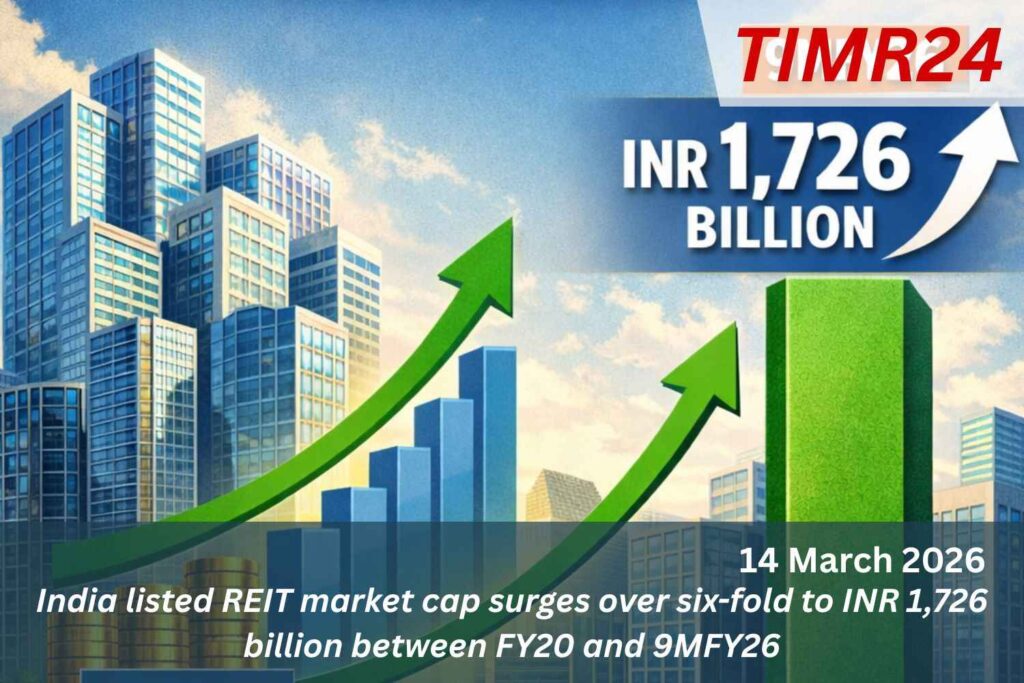
India’s Real Estate Investment Trust (REIT) market has surged from INR 271 billion in FY20 to INR 1,726 billion in the first nine months of FY26, marking a six-fold increase due to new listings and unit price growth. Currently, five REITs are operating, with the latest being Knowledge Realty Trust REIT which debuted in August 2025, while existing REITs reported over 20% Y-o-Y unit price growth from Q3FY25 to Q3FY26. Regulatory changes, including SEBI’s reclassification of REITs, inclusion in equity indices, and the RBI’s proposal for commercial bank lending, are anticipated to enhance market liquidity and broaden investor participation. The 2026-27 Union Budget also aims to monetize.
Management Strategies India’s Real Estate
Central Public Sector Enterprise assets through REITs, attracting institutional investors. CBRE predicts that India’s small and mid-sized REIT market could surpass USD 75 billion, driven by a substantial pool of eligible assets. The office sector remains the most attractive for investment among local investors, reflecting a shift towards active asset management strategies India’s Real Estate Investment Trust (REIT) market has witnessed remarkable growth over the past few years, reflecting rising investor confidence and strong demand for commercial real estate assets. Since the first REIT listing in the country in 2019, the sector has evolved into a major investment avenue for institutional and retail investors.
According to recent market data, the total market capitalization of India’s listed REITs has expanded more than six-fold, reaching approximately ₹1,726 billion between FY20 and the first nine months of FY26. This impressive growth highlights the increasing maturity of India’s real estate investment ecosystem and the strong regulatory framework supporting it The development of the REIT ecosystem in India has been largely driven by regulatory reforms introduced by Securities and Exchange Board of India. The regulatory body introduced the REIT framework to allow investors to participate in income-generating real estate assets such as office parks, IT parks, and commercial complexes.
Parks REIT Marked A Turning Point
Through this framework, investors can gain exposure to premium real estate portfolios without directly owning physical property. Over time, this structure has attracted significant capital from domestic and international investors seeking stable income and long-term capital appreciation The launch of India’s first listed REIT, Embassy Office Parks REIT, marked a turning point for the commercial real estate sector. The successful listing of this REIT demonstrated that large-scale institutional real estate assets could be monetized through public markets. The portfolio primarily consists of Grade-A office parks located in major business hubs such as Bengaluru, Mumbai, and Pune.
Its success encouraged other developers and global investment firms to explore similar listing opportunities Following this milestone, additional REITs entered the market, including Mindspace Business Parks REIT and Brookfield India Real Estate Trust. These REITs collectively manage some of the country’s most prominent commercial office assets. Their listings helped expand the overall size of India’s REIT market while improving liquidity and investor participation. As a result, the sector witnessed significant market capitalization growth, eventually reaching the ₹1,726 billion mark by FY26.
Demand Because Their Portfolios Include
One of the key factors contributing to the rapid expansion of the REIT market in India is the strong demand for Grade-A commercial office space. Major global corporations, technology companies, and multinational firms continue to establish offices in India’s major cities, driving the need for modern workspaces. REITs benefit directly from this demand because their portfolios include high-quality office buildings leased to long-term corporate tenants. The stable rental income generated by these properties ensures predictable cash flows for investors Another important driver behind the growth of the REIT market is the increasing participation of retail investors.
Traditionally, large commercial real estate investments were accessible only to institutional investors or wealthy individuals. However, REIT units listed on stock exchanges allow smaller investors to invest in premium real estate with relatively modest capital. This democratization of real estate investment has expanded the investor base and increased trading activity in the market, REITs offer attractive dividend yields compared to many traditional investment options. Regulations require REITs to distribute a significant portion of their rental income to investors in the form of dividends. This makes them particularly appealing for income-seeking investors such as retirees and conservative portfolio managers.
Corporate Ecosystem Have Increased Demand
The combination of regular payouts and potential capital appreciation has made REITs a balanced investment product within diversified portfolios India’s growing economic strength has also played a significant role in supporting the expansion of the REIT sector. The country’s rising service sector, booming IT industry, and expanding corporate ecosystem have increased demand for modern office infrastructure. Cities like Bengaluru, Hyderabad, Pune, and Mumbai have emerged as global business hubs, attracting multinational corporations that require large office campuses. REITs provide a structured mechanism for developers and investors to monetize these high-value assets.
In addition to commercial office assets, industry experts believe that the next phase of REIT growth in India could include new asset classes. Logistics parks, data centers, retail malls, and warehousing infrastructure are increasingly being considered for inclusion in REIT portfolios. As India’s digital economy and e-commerce sectors expand rapidly, these asset categories are expected to generate stable rental income similar to office spaces Another trend supporting the growth of REITs is the increasing interest from foreign institutional investors. Global investment funds and sovereign wealth funds are actively exploring opportunities in India’s real estate sector due to its long-term growth potential.
Maintained High Occupancy Rates And Stable
REIT structures provide these investors with transparency, regulatory protection, and liquidity through stock exchange listings. This has made India an attractive destination for cross-border real estate capital The performance of existing REITs has further strengthened investor confidence. Over the past few years, listed REITs in India have maintained high occupancy rates and stable rental collections even during challenging economic periods. Their ability to maintain consistent income streams has reinforced their reputation as relatively stable investment vehicles in the real estate sector Infrastructure development and urbanization trends are also expected to accelerate the expansion of the REIT market.
As more cities develop advanced business districts and technology corridors, the supply of high-quality commercial real estate will continue to grow. Developers are increasingly exploring the REIT route as an exit strategy for monetizing large real estate portfolios while freeing capital for new projects Government policy support is another crucial factor. Regulatory authorities continue to refine the REIT framework to make it more investor-friendly. Measures such as simplified taxation, improved disclosure requirements, and enhanced transparency standards have strengthened investor confidence. These reforms are expected to attract additional listings and increase.
Indicates The Increasing Financialization
The overall size of the market in the coming years The six-fold growth in India’s listed REIT market capitalization from FY20 to 9MFY26 is therefore not just a statistical milestone but a reflection of broader structural changes in the country’s real estate sector. It indicates the (India) increasing financialization of real estate assets, where property ownership is gradually shifting from individual investors to institutional investment structures analysts believe that the REIT market in India could expand significantly over the next decade. With trillions of rupees worth of commercial real estate assets across major cities, the potential pipeline for future REIT listings remains substantial.
As regulatory frameworks continue to mature and investor awareness grows, the sector is likely to become a major component of India’s capital markets For investors, REITs represent a unique opportunity to participate in the growth of India’s commercial real estate sector while benefiting from steady rental income. For developers, they provide a powerful financial tool to unlock value from large property portfolios. For the broader economy, the expansion of REITs contributes to greater transparency, improved capital allocation, and enhanced liquidity in the real estate market.
Overall, the remarkable expansion of India’s REIT market capitalization to ₹1,726 billion underscores the increasing integration of real estate with the country’s financial (India) markets. With continued policy support, strong economic fundamentals, and growing investor participation, India’s REIT sector is poised to remain one of the most promising segments of the country’s real estate and investment landscape.
Q1. What is a REIT?
A Real Estate Investment Trust is a company that owns and manages income-generating real estate assets such as office buildings, malls, and warehouses.
Q2. Why has India’s REIT market grown rapidly?
Growth has been driven by strong office demand, regulatory support, rising investor participation, and successful REIT listings.
Q3. How big is India’s REIT market now?
India’s listed REIT market capitalization has reached about ₹1,726 billion by 9MFY26.
Q4. Are REITs safe investments?
REITs are considered relatively stable because they generate regular rental income and are regulated by financial authorities.
Q5. Can small investors invest in REITs?
Yes, REIT units are listed on stock exchanges, allowing retail investors to participate with smaller investments.