

















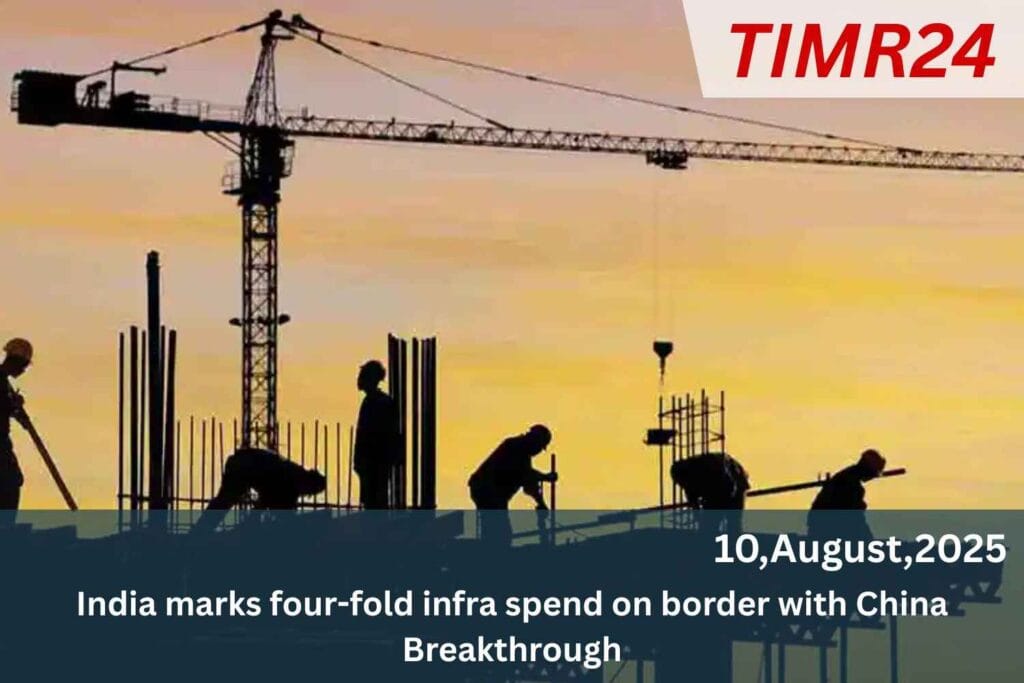
India has increased its BRO’s budget four-fold to Rs 14,387 crore in 2023-24, aiming to build world-class infrastructure along the China-India border. India has significantly ramped up Infrastructure development along its border with China, with the Border Roads Organisation (BRO) budget rising nearly fourfold—from ₹3,782 crore in 2013-14 to ₹14,387 crore in 2023-24 according to External Affairs Minister S. Jaishankar. This stark increase underlines India’s amplified strategic focus on its northern frontier ( The Infrastructure of India) India’s infrastructure push is palpable in its road-building achievements: between 2014 and 2022, 6,806 km of roads were constructed.
Tunnels & All-Weather Links
Along the border, up from 3,610 km in the 2008–14 period. In Eastern Ladakh, a new 130-km road from Samosa to Daulat Beg Oldie (DBO) bypasses existing routes, Reducing vulnerability to Chinese surveillance and enhancing operational security. It’s expected to become fully functional by late 2026.Tunnelling forms a strategic asset in mountainous border areas. The Sela Tunnel in Arunachal Pradesh, inaugurated in March 2024, ensures year-round connectivity to Tawing and reduces travel time by bypassing weather-prone passes. Elsewhere, projects such as the Shinbun La Tunnel—to be the world’s highest tunnel at an altitude of approximately 15,800 ft and the Soji-La Tunnel, once completed, will be Asia’s longest road tunnel, further enhancing resilient infrastructure.
Village Development & Digital Connectivity
Additionally, the expansion of the Machinima airstrip to a full-length runway capable of handling large transport aircraft is underway, strengthening air logistical support India isn’t only building strategic assets—it’s also focusing on border livelihoods. Under the Vibrant Villages Programme (VVP), comprehensive infrastructure development is underway in border villages across states like Arunachal Pradesh, Sikkim, Uttarakhand, Himachal Pradesh, and Ladakh For instance, 113 projects worth ₹117 crore have recently been approved for 75 Himachal Pradesh villages, including community halls, solar street lighting, and sanitation infrastructure. Simultaneously, the 4G Saturation
Bridges, Corridors, and Strategic Highways
Major bridge and corridor initiatives are also transforming access:
- The Shillong–Sachar Greenfield Corridor, a ₹22,864 crore, 166.8 km four-lane highway, will link Meghalaya and Assam, enhancing connectivity toward Northeastern states
- The Arunachal Frontier Highway and Trans-Arunachal Highway programs cover multiple corridors connecting valleys and border zones, fostering both troop mobility and economic growth.
- The North Eastern Railway Connectivity Project is linking state capitals such as Guwahati, Itanagar, Agartala, and Aizawl via rail, with Imphal on its way to joining, thereby reducing reliance on the narrow Siliguri Corridor.
- Project, initiated by BSNL, aims to install 20,000 towers across some 30,000 border villages at a cost of ₹26,000 crore—ensuring internet connectivity even in remote terrain.
- India’s border development also encompasses air assets: the Nyoman airfield in eastern Ladakh, costing ₹230 crore, is slated to become operational by October. It will improve rapid air deployment capabilities in high-altitude terrain.
Outcomes: Security, Speed, and Strategic Depth
This infrastructure build-out is not just about development it directly enhances India’s defensive posture. Jaishankar noted that improved infrastructure enabled rapid troop deployment during the 2020 standoffs with China—an advantage India lacked in 2014 when mule tracks were the norm. India’s investment in border infrastructure since 2014 marks a transformative era from roads, tunnels, and airfields to village upliftment and digital outreach. The BRO has completed hundreds of projects in recent years, bridging strategic gaps, boosting readiness, and empowering border communities. Strategic tunnels, all-weather roads, and airfields now enable India to mobilize swiftly and sustainably across challenging terrain (Infrastructure Development).
Q1. What is the recent development in India’s border infrastructure spending?
India has increased its infrastructure spending on the border with China by nearly four times to strengthen connectivity and defence readiness.
Q2. Why has India increased spending on the China border?
The rise aims to enhance strategic roads, bridges, and military facilities for faster troop and supply movement in sensitive border regions.
Q3. Which areas will benefit most from this spending?
Key focus areas include Ladakh, Arunachal Pradesh, and other high-altitude border zones where terrain and security challenges are high.
Q4. What types of projects are included in the plan?
Projects cover road construction, bridge upgrades, advanced logistics hubs, and all-weather connectivity to remote military outposts.
Q5. How will this impact India’s Défense capabilities?
The upgrades will improve rapid troop deployment, supply chain efficiency, and overall border security preparedness.