














The Union Cabinet has approved the launch of the National Critical Mineral Mission (NCMM) on 29 January 2025, aiming to secure a long-term, sustainable supply of critical minerals and strengthen India’s mineral value chains. The mission will run for seven years, from 2024-25 to 2030-31, with a proposed expenditure of Rs 163 billion and an expected investment of Rs 180 billion from PSUs and stakeholders. The government has also undertaken several reforms to reduce reliance on imported materials for electric vehicle batteries. The MMDR Amendment Act, 2023, includes the inclusion of 24 critical and strategic minerals in Part D of Schedule-I, removal of six minerals from the list of atomic minerals, and the introduction of Section 11D for mining leases and composite licenses.
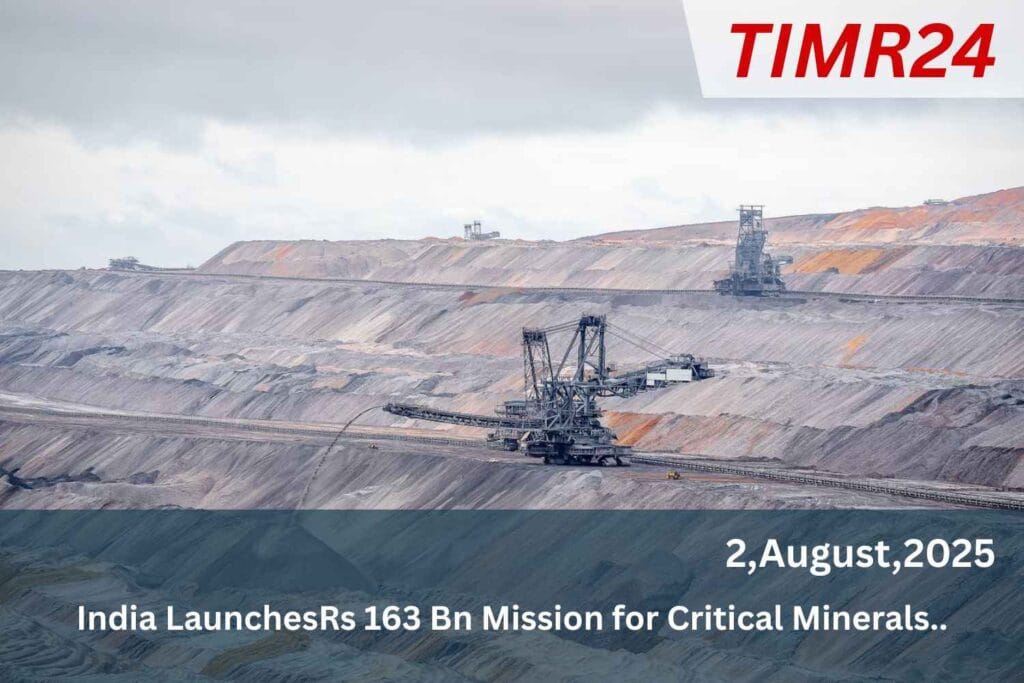
India Launches ₹163 Bn Mission for Critical Minerals
In a bold move to secure its supply chain for emerging technologies and reduce dependence on imports, the Government of India has launched a ₹163 billion (₹16,300 crore) Critical Minerals Mission. The initiative aims to ensure the availability of key raw materials vital for clean energy, electronics, defence, and space applications, while strengthening the nation’s mining ecosystem.
1. What Are Critical Minerals?
Critical minerals are elements essential for high-tech applications and strategic industries, but which are often scarce or concentrated in a few global regions. India’s list of critical minerals includes lithium, cobalt, nickel, rare earth elements (REEs), graphite, titanium, and tungsten. These are indispensable for manufacturing EV batteries, solar panels, wind turbines, semiconductors, and defence systems. To address growing demand, the Ministry of Mines has released a comprehensive (Coal), identifying 30 minerals as critical for India’s future.
2. Implementation Through Kanji Bidesh India Ltd (KABIL)
The ₹163 billion mission will be largely executed through Kanji Bidesh India Ltd (KABIL) — a joint venture of NALCO, Hindustan Copper, and MECL. KABIL has been tasked with acquiring mineral assets overseas, building strategic reserves, and developing domestic capabilities in mineral exploration and processing, it is actively exploring collaborations with mineral-rich countries like Australia, Argentina, Chile, and Namibia to secure long-term supply contracts for lithium and cobalt.
3. Strengthening Domestic Exploration and Processing
Aims to boost domestic exploration of critical minerals through advanced geological surveys, satellite mapping, and deep-earth drilling. The Geological Survey of India (GSI) and other agencies are receiving support to identify new reserves and make them available for commercial mining. The mission also includes the establishment of processing facilities and value-addition hubs to reduce raw material exports and promote local manufacturing.
4. Strategic Significance and Global Positioning
This mission is seen as a strategic imperative not only for economic growth but also for national security and technological self-reliance. Currently, India imports over 80% of its lithium and other key minerals. The new policy aims to reverse this trend by building domestic capacity and reducing external vulnerabilities. The initiative is aligned with India’s broader industrial goals under (Make in India) and the ensuring resource security for critical sectors like renewable energy, electronics, and defence production.
5. Long-Term Impact
The Critical Minerals Mission is expected to attract private sector investments, promote innovation in sustainable mining practices, and create thousands of jobs. It will also help India transition toward a cleaner, technology-driven economy by securing the essential inputs for green growth. This ₹163 billion mission reflects India’s commitment to future-proofing its industrial and energy sectors while asserting its role in the global mineral value chain.
q1. What is India’s Critical Minerals Mission?
It is a ₹163 billion initiative to secure essential minerals like lithium, cobalt, and rare earths for clean energy, electronics, and defence sectors.
q2. Who is leading the mission implementation?
Kanji Bidesh India Ltd (KABIL), a joint venture of NALCO, HCL, and MECL, is executing the mission, both domestically and abroad.
q3. Why are critical minerals important?
They are vital for EV batteries, solar panels, wind turbines, semiconductors, and national defence technologies.
q4. How will the mission reduce import dependence?
By increasing domestic exploration, building processing facilities, and securing overseas supply agreements through strategic partnerships.
q5. Which policies does this mission support?
It aligns with Make in India, Atmanirbhar Bharat, and India’s net-zero 2070 goals.