










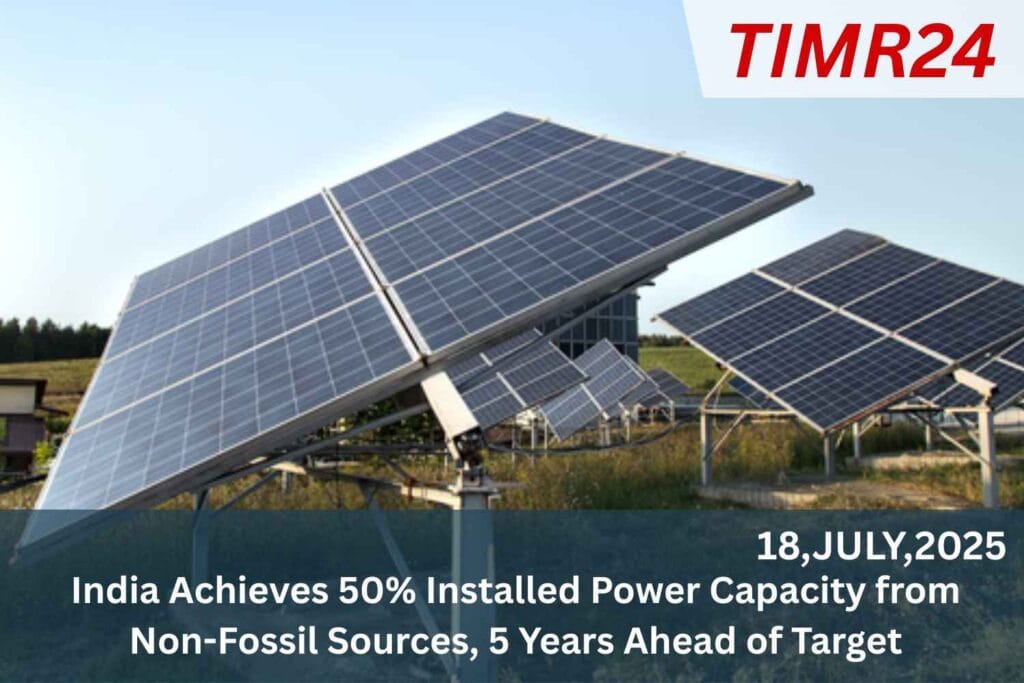
India has achieved 50% of its installed electricity capacity from non-fossil fuel sources, five years ahead of its target under the Paris Agreement’s Nationally Determined Contributions. This achievement signifies India’s commitment to climate action and sustainable development, and its growing role as a global leader in renewable energy. Union Minister of New and Renewable Energy Shri Pralhad Joshi praised India’s progress.
Officially achieved a significant energy transition milestone by installing 50% of its total power generation capacity from non-fossil fuel sources, five years ahead of its 2030 target. The Ministry of Power confirmed this remarkable development, positioning India among the top nations making measurable progress toward climate commitments.
What This Milestone Means
As of June 2025, total installed power capacity crossed 426 GW, with non-fossil sources—including solar, wind, hydro, nuclear, and bioenergy—accounting for over 213 GW. This achievement meets the commitment made at COP21 in Paris, where pledged to reach 50% non-fossil capacity by 2030. This is not just a policy win but a practical acceleration of India’s energy diversification strategy. You can explore more on India’s energy and its alignment.
Key Drivers Behind the Success
Rapid adoption of renewable energy is the main force behind this success. The country added over 18 GW of solar capacity in FY24 alone, making it the third-largest solar market globally, after China and the US. MNRE has played a pivotal role in facilitating solar and wind deployment through policies like green energy corridors, solar park schemes, and rooftop solar initiatives. Significant contributions have also come from the expansion of hydropower and nuclear energy. Recently, operationalized new units at contributing to its low-emissions base-load power supply.
Role of Private Sector and International Collaboration
The private sector, including leading players in the renewable energy ecosystem such as Adani Green, Renew Power, and Tata Power, has aggressively invested in utility-scale and distributed energy systems. India has also attracted substantial foreign direct investment (FDI) in clean energy, supported by multilateral banks and green bonds. International cooperation initiatives like have strengthened India’s global leadership in clean energy diplomacy and innovation.
Climate Commitment and COP28 Alignment
Reaching this milestone significantly boosts India’s position ahead of COP30 and enhances its credibility under the Paris Agreement. As part of its updated NDCs, India committed to reducing emissions intensity and achieving net-zero by 2070. Achieving 50% clean capacity by 2025 allows greater flexibility for future climate actions and energy security planning.
The Road Ahead
Despite this achievement, challenges remain—particularly in areas like grid modernization, battery storage, and interstate power distribution. The government is focusing on developing green hydrogen, offshore wind, and pumped hydro storage as the next frontiers. Programs such as the PM-KUSUM scheme for farmers and PLI schemes for solar PV manufacturing are expected to accelerate decarbonization in sectors beyond power generation.
Milestone Overview
As per the Ministry of Power, India’s total installed capacity stands at 426 GW, out of which 213 GW is powered by non-fossil fuel sources—including solar, wind, hydro, nuclear, and bioenergy. This early success fulfils a core target of India’s Nationally Determined Contributions (NDCs) under the UN Framework Convention on Climate Change.
Growth Drivers: Solar, Wind & Policy Support
India’s sharp increase in solar capacity, adding nearly 18 GW in FY24, played a major role in reaching this milestone. Policies by the Ministry of New and Renewable Energy (MNRE), such as the Solar Park Scheme, green energy corridors, and PLI schemes for solar manufacturing, have supported consistent growth. The country’s strong wind energy base, particularly in Tamil Nadu, Gujarat, and Maharashtra, along with large hydropower installations and expanding nuclear generation, has strengthened the clean power mix.
Private Sector & Global Partnerships
India’s achievement is also powered by active private sector participation. Leading companies like Adani Green, Renew Power, and NTPC Green Energy have invested in utility-scale renewable assets. Moreover, India is a founding member of helping accelerate global solar deployment with over 100 partner countries.
Conclusion
Early achievement of 50% installed capacity from non-fossil sources is not only a domestic victory but a global benchmark. It reflects a strong policy framework, technological adaptability, and collaborative progress toward a sustainable energy future.
Q1. What milestone has India achieved in power generation?
India has reached 50% installed power capacity from non-fossil sources.
Q2. When was this target originally set for?
The target was set for 2030 but achieved in 2025.
Q3. What sources are included in non-fossil power?
Solar, wind, hydro, nuclear, and bioenergy.
Q4. What helped India achieve this early?
Rapid solar and wind expansion, strong policies, and private sector investment.
Q5. How does this support India’s climate goals?
It aligns with Paris Agreement commitments and Net Zero by 2070 goal.