

















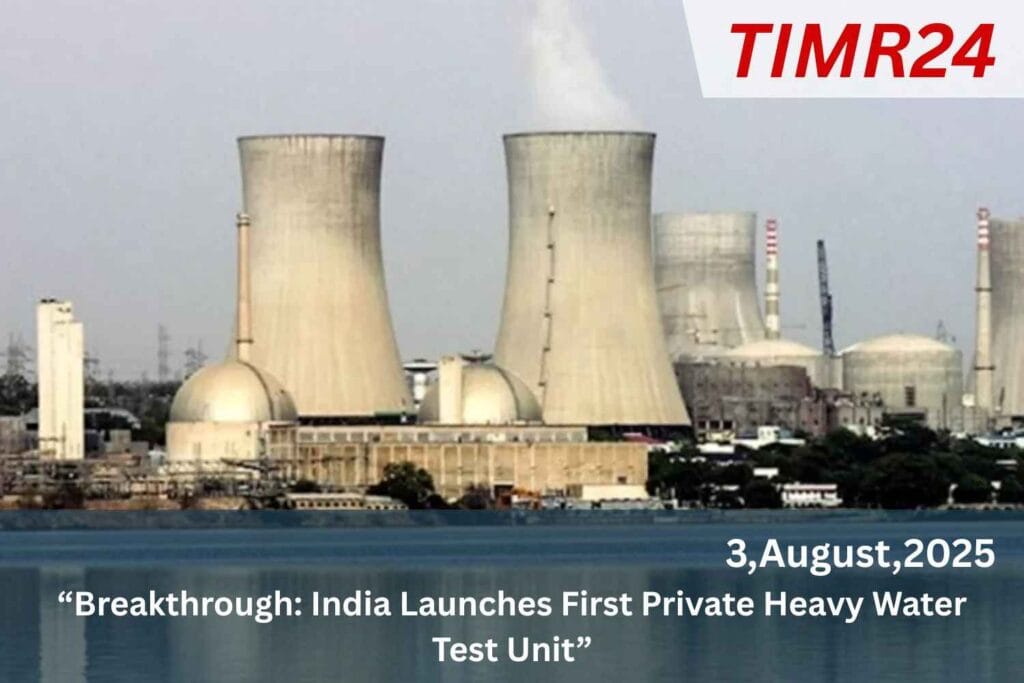
India’s Nuclear Power Corporation of India and Bhabha Atomic Research Centre have inaugurated the country’s first private-sector test facility for upgrading depleted heavy water, commissioned by TEMA India Ltd. The facility, designed and built by TEMA India’s nuclear division, aligns with the government’s Atmanirbhar Bharat mission and represents a significant leap in private sector participation in strategic infrastructure.
Introduction to the Breakthrough
In a significant milestone for India’s nuclear technology and industrial self-reliance, the country’s first private-sector heavy water test unit has been officially unveiled. This development marks a new chapter in the public-private collaboration in India’s strategic sectors. The test unit was established with the technical oversight of the Department of Atomic Energy (DAE) and the Heavy Water Board (HWB), signaling growing confidence in the private sector’s ability to handle complex and sensitive nuclear technologies.
Understanding Heavy Water and Its Role
Heavy water, or deuterium oxide (D₂O), is a crucial component used as a moderator and coolant in pressurised heavy water reactors (PHWRs). India’s nuclear reactors, such as those operated by the Nuclear Power Corporation of India Limited (NPCIL), rely heavily on heavy water to sustain controlled nuclear fission. Traditionally, the production and management of heavy water in India have been solely handled by government bodies like HWB.
Private Sector Participation
This newly launched test unit represents the first instance of private-sector infrastructure being allowed into the production ecosystem for a strategic nuclear input. The test unit, developed by a leading Indian engineering firm (name withheld until formal notification), will be responsible for conducting process evaluations, quality testing, and material compatibility trials. The involvement of private players aims to increase efficiency, promote innovation, and ultimately reduce dependence on state-run facilities. This step aligns with the Government of India’s. (Bhabha Atomic Research Centre BARC).
Location and Operational Details
The test unit has been set up in collaboration with DAE scientists and is located in a secured industrial zone, with strict compliance to nuclear safety and regulatory protocols established by the Atomic Energy Regulatory Board (AERB). The facility is not involved in direct production but serves as a pilot-scale verification system for heavy water purification and material handling techniques. This approach minimizes risks while enhancing the technical capability of India’s industrial base in handling nuclear materials.
The private heavy water test unit is expected to generate opportunities for small and medium enterprises (SMEs) in the nuclear supply chain, including fabrication, testing, instrumentation, and maintenance services. As moves toward Atmanirbhar Bharat (Self-Reliant India), this project stands as a successful model of how strategic sectors can gradually open up to private industry while maintaining strict safety and national security controls. The test unit could serve as a pilot model for future private involvement in fuel fabrication, waste management, and reactor auxiliaries.
Strategic and Scientific Impact
The commissioning of the unit reflects shift toward a more inclusive nuclear supply chain, allowing private enterprises to contribute to components traditionally monopolized by public agencies. This not only improves capacity but also prepares to scale its nuclear power program, essential for meeting its long-term clean energy targets. According to (Solar Energy) nuclear energy is expected to play a key role in the country’s decarbonization goals.
Conclusion
The unveiling of India’s first private heavy water test unit is a significant moment in the evolution of the country’s nuclear ecosystem. It showcases trust in private capability, enhances technological depth, and contributes to national self-reliance in critical inputs for clean energy. As India looks to expand its nuclear capacity, such partnerships will be key to balancing growth, safety, and innovation.
q1. What is the significance of India’s first private heavy water test unit?
It marks the first time a private entity is involved in testing critical nuclear materials, promoting self-reliance and public-private collaboration in the atomic energy sector.
q2. What is heavy water used for?
Heavy water (D₂O) is primarily used as a moderator and coolant in nuclear reactors, especially in Pressurised Heavy Water Reactors (PHWRs).
q3. Is this facility producing heavy water?
No, the unit is designed for testing and evaluation, not direct production. It assesses process performance, material compatibility, and system efficiency.
q4. Who regulates the safety of the private test unit?
The facility operates under strict oversight from the Atomic Energy Regulatory Board (AERB) and follows Department of Atomic Energy (DAE) protocols.
q5. How does this unit support India’s nuclear goals?
It enhances testing capabilities, supports faster development of PHWRs, and aligns with India’s aim to expand its clean nuclear energy infrastructure.