













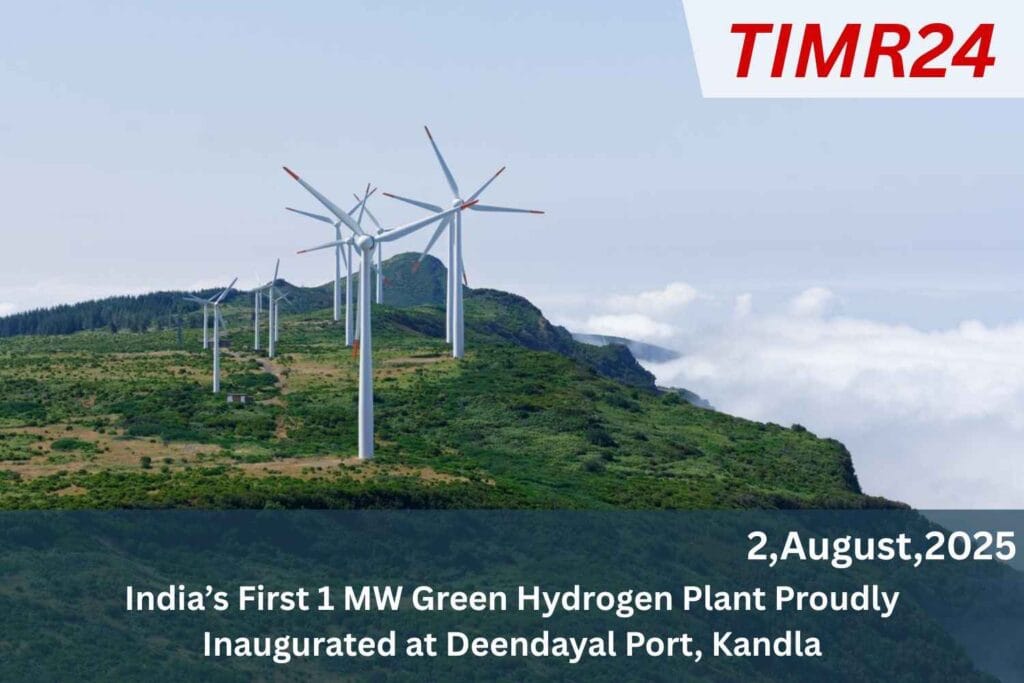
India’s Union Minister of Ports, Shipping & Waterways, Shri Sarbananda Sonowal, inaugurated India’s first 1 MW Green Hydrogen Power Plant at Deendayal Port Authority (DPA), Kandla. The plant, capable of producing approximately 140 metric tonnes of green annually, is a significant milestone in India’s shift towards clean energy and reflects the country’s commitment to reaching Net Zero emissions. The plant is a shining example of speed, scale, and skill under Maritime India Vision 2030. The plant is an inspiration for ports across the country to adopt eco-friendly technologies.
The plant is a testament to Prime Minister Narendra Modi’s visionary leadership and the country’s growing leadership in clean energy, innovation, and self-reliance. In a significant milestone for India’s clean energy ambitions, the country’s first 1 megawatt (MW) green plant has been officially inaugurated at Deendayal Port in Kandla, Gujarat. This marks a major step in India’s pursuit of becoming a global hub for green production under the National Green Hydrogen Mission.
In a landmark step toward achieving India’s clean energy transition goals, the country’s first 1 megawatt (MW) green plant was inaugurated at Deendayal Port, Kandla, in Gujarat. This facility signifies a major advancement under the Government of India’s ambitious (Green Hydrogen) and supports India’s broader commitment to achieving net-zero carbon emissions by 2070.
1. Green and Its National Importance
Green is produced using renewable energy through a process called electrolysis, emitting zero carbon in the process. The inauguration of this 1 MW facility aligns with the (National Green) which aims to make India energy independent and decarbonize key sectors such as transport, industry, and shipping. By 2030, India targets an annual production of 5 million metric tonnes of green hydrogen, and projects like this at Deendayal Port are early but important enablers of that vision.
2. Strategic Location at Deendayal Port
Deendayal Port, one of the 12 major ports under the Ministry of Ports, Shipping and Waterways (MoPSW), was strategically chosen due to its proximity to industrial zones, shipping infrastructure, and renewable energy sources. This facility not only supports local decarbonization efforts but also serves as a pilot for integrating green production with port operations and logistics. The plant has been working towards sustainable port development, and this hydrogen plant complements other eco-friendly initiatives including solar installations and electrification of cargo-handling equipment.
3. Technology and Sustainability
The 1 MW plant uses an advanced alkaline electrolyser system powered by renewable energy. This will generate approximately 200 kg of green hydrogen per day, which will initially be used for port operations, such as fuelling hydrogen-powered vehicles and machinery. Over time, the infrastructure is expected to scale up and feed into India’s broader green mobility and industrial hydrogen needs. According to the integrating green hydrogen into ports and heavy industries will play a vital role in achieving net-zero emissions by 2070.
4. Role in Maritime Green Transition
The project also supports the government’s larger Maritime India Vision 2030, which envisions greener and more efficient port operations across the country. Green hydrogen is expected to become a key fuel for zero-emission shipping, and early adopters like Deendayal Port are paving the way. As part of the ports are being encouraged to adopt clean energy solutions, and the Kandla plant serves as a working model for other ports to replicate.
5. Economic and Innovation Impact
The successful commissioning of this project is expected to attract further investment into Gujarat’s hydrogen ecosystem, stimulate innovation in hydrogen technologies, and open up opportunities for public-private partnerships in clean energy infrastructure. It sets a benchmark for future plants in terms of cost, scalability, and integration with existing energy and transport networks. This landmark project underscores India’s readiness to lead in the global green hydrogen economy, combining sustainability, innovation, and strategic infrastructure planning.
q1. Where was India’s first 1 MW green hydrogen plant inaugurated?
At Deendayal Port, Kandla in Gujarat.
q2. What is the purpose of this green hydrogen plant?
To produce clean hydrogen using renewable energy for port operations and industrial use.
q3. How much green hydrogen will the plant produce daily?
Approximately 200 kilograms per day.
q4. Why is Deendayal Port a strategic location for the plant?
It’s a major port with strong industrial and logistics connectivity, ideal for scaling clean energy solutions.
q5. What technology is used in the Kandla green hydrogen plant?
The plant uses an alkaline electrolyser powered by renewable energy.