














India’s real estate sector is expected to experience significant growth due to the rise in electric vehicles (EVs), according to a report by Savills India. The report reveals that the country will require 5,760 to 6,852 acres of land by 2030 to support EV manufacturing, lithium-ion battery plants, and public charging infrastructure. The growth in EV adoption is driven by market forces, government policies, rising environmental concerns, and increasing fuel costs.
The government has launched initiatives to accelerate EV adoption and strengthen the supporting ecosystem. The report also predicts that India will need 81,000 to 92,500 public and semi-public charging stations, requiring a total land requirement of 2,402 to 2,744 acres. The country aims to produce 13% of its EV battery cell demand domestically by 2030, reducing reliance on imports. The report also predicts strong demand for large land parcels for EV battery and component manufacturing and smaller plots for charging stations across cities.
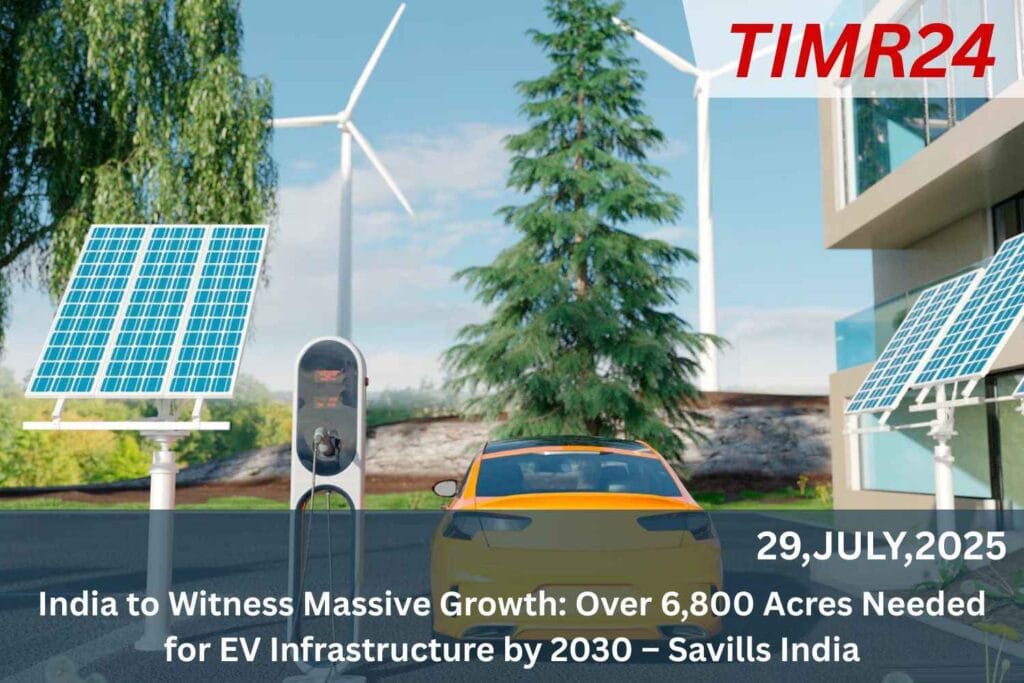
A recent report by real estate consultancy Savills India reveals that the country will require over 6,800 acres of land to build electric vehicle (EV) infrastructure by 2030. This massive land requirement reflects the growing pace of India’s transition to sustainable mobility, and highlights the urgency of creating a reliable charging ecosystem, robust manufacturing facilities, and integrated logistics zones to support the EV sector.
Growing Demand for EV Infrastructure
India’s push for electric mobility, supported by government initiatives like FAME II (Faster Adoption and Manufacturing of Hybrid and Electric Vehicles) and state-level EV policies, has accelerated the need for a comprehensive infrastructure network. The Savills India report emphasizes that the projected 6,800+ acres will be necessary for setting up EV assembly lines, battery manufacturing units, charging stations, warehousing hubs, and R&D centres.
This estimate also accounts for the expected rise in EV adoption across both passenger and commercial vehicle segments. The projection aligns with India’s broader mission under the (National Electric Mobility Mission) which aims to make India a global hub for electric mobility and component manufacturing.
Key Infrastructure Components
To enable the EV ecosystem to thrive, the infrastructure must address multiple areas:
- EV Charging Stations: According to (Energy), India is targeting the deployment of thousands of public charging stations, especially in urban centres and along highways. The land requirement for these alone contributes significantly to the total projection.
- Battery Manufacturing Plants: Gigafactories producing lithium-ion batteries will require large industrial plots, often spanning tens to hundreds of acres each. These units are crucial to reduce dependency on imports and bring down the cost of EVs.
- Warehousing and Logistics Parks: With the rise in EV sales, companies will also need dedicated space for distribution, service, and storage — a key part of the overall EV value chain.
Urban Planning and Real Estate Impact
This surge in demand for land will reshape India’s industrial and urban development landscape. Tier-1 and Tier-2 cities are expected to see increased activity around logistics corridors, special economic zones (SEZs), and industrial parks. States such as Tamil Nadu, Maharashtra, Uttar Pradesh, and Gujarat — already leaders in EV policy rollouts — will likely be the primary beneficiaries of this infrastructural expansion.
Real estate developers and industrial park planners are now aligning their future projects with green mobility goals, integrating EV readiness into master plans. The report also highlights a rising trend of land banking for EV hubs, especially near highways, ports, and urban agglomerations.
Challenges and Road Ahead
While the outlook is optimistic, there are challenges in land acquisition, zoning regulations, and electricity infrastructure. Government facilitation through single-window clearances, incentives, and private sector collaboration will be essential to meet the 2030 deadline. Furthermore, integration with India’s broader clean energy transition goals and urban development missions like Smart Cities Mission will enhance alignment and execution.
Conclusion
The projection by Savills India highlights the scale of opportunity and urgency in preparing for a clean mobility future. With over 6,800 acres required, strategic planning and coordinated efforts across states, industries, and urban planners will be key. For regular insights into the EV sector and infrastructure developments, you can follow updates from NITI Aayog’s Mobility section.
Q1. Why does India need over 6,800 acres for EV infrastructure?
To support the rapid growth of electric vehicles through charging stations, battery plants, assembly units, and logistics hubs.
Q2. Who released this projection about land requirements?
The estimate was provided by real estate consultancy Savills India in a recent report.
Q3. Which states are likely to see the most EV infrastructure development?
States like Tamil Nadu, Maharashtra, Uttar Pradesh, and Gujarat are expected to lead due to proactive EV policies.
Q4. What challenges could affect this infrastructure expansion?
Key challenges include land acquisition, zoning regulations, and electricity connectivity.
Q5. How does this support India’s EV adoption goals?
The land development will enable a strong ecosystem, accelerating EV production, adoption, and sustainable transport goals by 2030.