









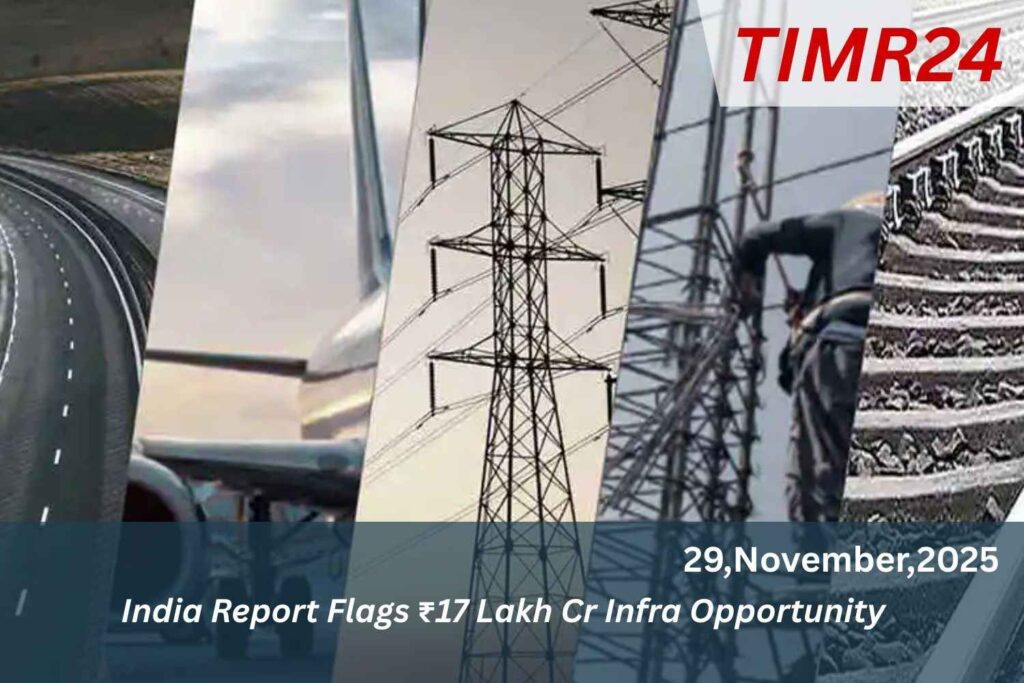
India could potentially save up to 17 lakh crore in its National Infrastructure Pipeline by improving pre-construction planning, specifically the Detailed Project Report (DPR) stage, as indicated in a white paper by Vector Consulting Group. The study highlights that systemic design flaws lead to delays and cost overruns, despite good intentions from stakeholders. Insights from CXOs of major infrastructure companies reveal that issues like land conflicts and approval delays arise from inadequate surveys and outdated data during the DPR stage. The QCBS method for selecting DPR consultants often results in unsustainable low bids, limiting quality and design validations.
Expedite Infrastructure Project Delivery
Currently, only 0.5%-1% of project costs are allocated for pre-construction, well below the global average of 10%. The paper advocates for five reforms to enhance DPR processes, which could realign incentives, enhance contractor margins, and expedite infrastructure project delivery in India. India is preparing to invest at an unprecedented scale into physical infrastructure under the National Infrastructure Pipeline (NIP). Roads, expressways, metro systems, logistics hubs, renewable energy parks, water management systems, and urban infrastructure together represent the backbone of India’s long-term economic plan. However, a recent white paper by Vector.
Consulting Group highlights a startling insight: India could save nearly ₹17 lakh crore across its infrastructure pipeline simply by improving how projects are planned at the DPR stage. The Detailed Project Report (DPR) is where infrastructure projects are imagined, debated, costed, and structured. Unfortunately, it is also where many public projects begin to fail silently. Weak ground surveys, unrealistic timelines, rushed approvals, incomplete stakeholder coordination, and poor financial modelling lead to inflated budgets, contract disputes, idle capital, and years of avoidable delays. While funding constraints often get blamed for delayed infrastructure, the Vector study suggests that planning quality is the real bottleneck.
Announce Projects, And Meet Political
Better DPR planning does not mean working more slowly; it means making decisions with clarity. One of the major issues highlighted is that India’s DPR culture is designed for speed rather than accuracy. Government agencies are under constant pressure to show progress, announce projects, and meet political deadlines. As a result, project reports are often created without updated field data, modern engineering standards, or risk analysis models. In railways, alignments sometimes fail to account for land acquisition feasibility. In urban infrastructure, utility shifting is underestimated. In highways, future traffic volume is over-calculated while soil strength is under-examined.
Every one of these errors snowballs into contracts being reworked after the project has already begun. Another major inefficiency arises from fragmented ownership of planning responsibilities. A single infrastructure project might involve state governments, central ministries, private EPC firms, land authorities, financial agencies, and environmental regulators, each operating in isolation. DPRs are often prepared without meaningful collaboration among these stakeholders. Only after contracts are awarded do conflicts surface, leading to redesigns, arbitration, stalled construction, and ballooning project costs. This systemic weakness is why many government-funded projects miss deadlines.
Industrial Demand is Misjudged Projects
For years, despite having budget approvals in place, the consulting paper reveals that the biggest cost leak does not come from corruption, but from poor project design and unrealistic forecasting. For instance, demand projections are frequently over-optimistic. Traffic studies assume higher vehicle movement than reality, metro ridership estimates are inflated, and industrial demand is misjudged. Projects approved on inaccurate assumptions fail to recover costs, forcing future governments to absorb additional fiscal pressure. Sound DPR methodology would align economic need with engineering planning instead of just clearance targets.
Developed economies have solved this problem using independent review mechanisms. In countries like Japan and Germany, DPR approval requires review by neutral engineering panels that assess geological risk, economic realism, and lifecycle maintenance costs. India, however, still allows sponsoring departments to self-approve most of their projects. The report urges India to create independent planning authorities that review DPRs objectively, much like financial audits are conducted today. According to Vector Consulting Group, the ₹17 lakh crore potential savings are not theoretical.
Integrated Logistics Simulations
It is derived from delay data, cost-overrun histories, and audited expenditure reviews across transport, urban development, and energy sectors. Reducing rework, legal disputes, idle machinery, escalation costs, and change-order frequency alone could yield enormous budget relief. Even a modest 10–15% efficiency improvement can unlock trillions of rupees for new projects without raising additional debt. The report also emphasises data-driven planning. Modern DPRs should use satellite mapping, digital utility databases, drone surveys, digital twin modelling, and integrated logistics simulations. While India has access to these tools, many governments tender.
Still mandates outdated templates for DPR preparation. Technology investments made during planning offer the highest ROI in the entire project lifecycle. When earthwork (India) quantities are digitally validated and alignment risk is simulated upfront, fewer surprises remain on site. Funding agencies also benefit from stronger DPRs. Lenders become more confident, private participation increases, and financial closure happens faster. Today, many PPP projects collapse not because investors lack interest, but because risk is not transparently distributed at the planning stage. Clearer DPRs allow better concession agreements, predictable toll structures, and realistic revenue.
India’s Infrastructure Ecosystem
Models are making infrastructure more attractive for global capital. If implemented well, the DPR reform could completely reshape India’s infrastructure ecosystem. Instead of chasing project announcements, departments would chase quality benchmarks. Instead of celebrating ground-breaking ceremonies, performance would be measured by timely deliveries. And instead of uncontrolled cost escalations, public money would yield visible outcomes faster. This approach also directly supports employment and industrial growth. Faster completion leads to earlier economic stimulation. Metro corridors start serving commuters sooner.
Logistics highways become active trade routes. Industrial parks fill faster. Infrastructure is not just concrete; it is a growth multiplier. A delayed port or railway yard costs businesses billions in lost productivity annually. The true cost of weak DPR planning extends far beyond government balance sheets; it ripples through the economy. Global institutions like the World Bank and Asian Development Bank have long emphasised project preparation as the foundation of infrastructure development. But India’s huge scale makes the impact of bad DPRs exponentially larger. A small mistake in a ₹200 crore project is painful. The same mistake in a ₹30,000 crore corridor is catastrophic.
For India to become a $10 trillion economy, execution discipline must match ambition. Planning is where discipline begins. If India transforms the DPR process into a strategic advantage rather than a bureaucratic formality, infrastructure could shift from being a fiscal burden to becoming a financial engine. The Vector Consulting Group white paper does not merely diagnose the problem; it provides a national roadmap. It suggests training planners, certifying DPR consultants, standardising frameworks across ministries, and creating independent approving committees. The cost of reform is negligible compared to the reward. India does not lack money for infrastructure.
It lacks planning strength. Fixing that single weakness could free up ₹17 lakh crore (Road) enough to build thousands of kilometres of highways, dozens of airports, smart cities, and freight corridors without increasing taxes or debt. That is not just an efficiency upgrade; it is a national opportunity.
Q1. What is a DPR in infrastructure projects?
A DPR (Detailed Project Report) defines scope, cost, design, timelines, and feasibility before execution begins.
Q2. Who published this infrastructure savings study?
It was published by Vector Consulting Group.
Q3. Why do projects exceed budgets in India?
Nearly 60% failures arise from design gaps, unrealistic timelines, and faulty forecasting in DPRs.
Q4. How can better DPRs save money?
They reduce redesigns, disputes, idle time, cost escalation, and financing uncertainty.
Q5. Can DPR reform attract private investment?
Yes, transparent planning dramatically improves investor confidence and project bankability.