


















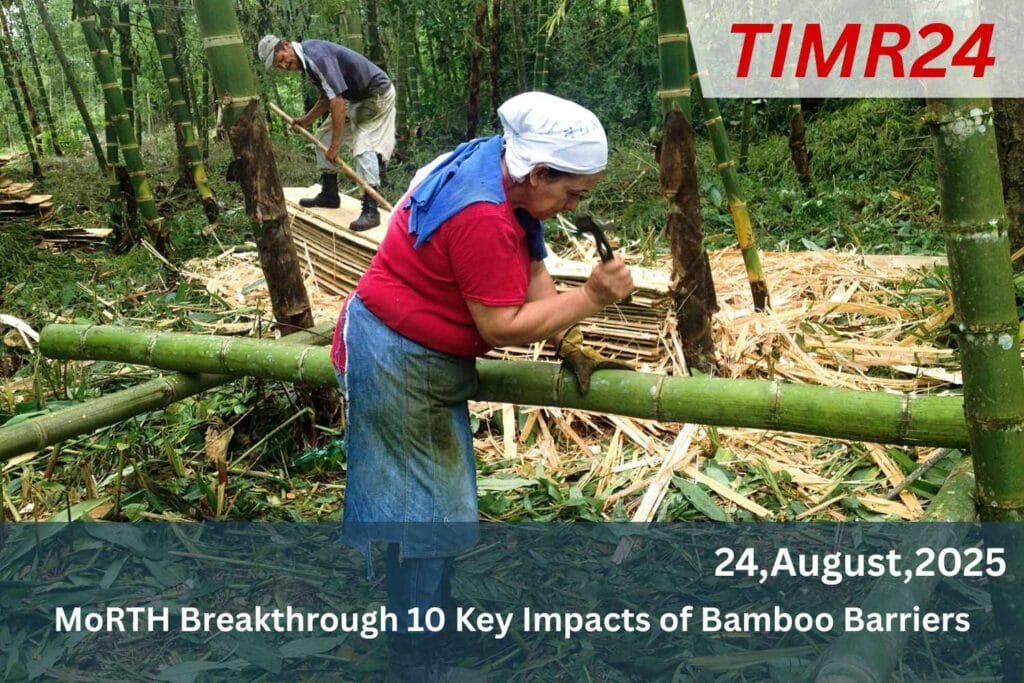
The Union transport ministry plans to replace steel crash barriers with bamboo in national highway buildings, aiming to reduce construction costs by 20%. The technology, patented in India, meets European safety standards and could benefit growers. The Ministry of Road Transport and Highways (MoRTH) has taken a pioneering step by replacing steel crash barriers with bamboo-based barriers on Indian highways. This innovation not only strengthens road safety but also introduces a sustainable alternative that aligns with India’s vision of reducing carbon emissions and promoting green infrastructure. By integrating bamboo into highway building, MoRTH is setting a global example in eco-friendly engineering.
Steel has traditionally been the backbone of crash barrier construction. However, its high production costs, carbon footprint, and dependency on imports have prompted the need for alternatives. Bamboo, known as “green steel” in the construction sector, offers incredible tensile strength, resilience (Green Highway) and affordability. With proper treatment, bamboo can resist pests, decay, and environmental wear, making it a reliable option for national highways One of the primary concerns in replacing steel is whether bamboo can withstand high-speed vehicle impacts. To address this, crash tests were conducted under the Indian Road Congress (IRC) guidelines. Results showed that engineered bamboo barriers provide safety.
Levels comparable to steel while being significantly lighter and more cost-effective These tests ensure that bamboo barriers meet both national and international road safety standards, positioning India as a global leader in sustainable road innovation.
Economic and Environmental Impact
The decision by MoRTH to adopt bamboo crash barriers carries dual benefits economic growth and environmental sustainability.
- Eco-Friendly: Bamboo absorbs carbon dioxide, making it a carbon-negative material.
- Employment Opportunities: Bamboo farming and processing generate jobs in rural and tribal areas.
- Cost Reduction: Manufacturing bamboo barriers is cheaper than steel, reducing project costs for national highways.
MoRTH has identified pilot highway stretches where bamboo crash barriers will first be installed. Once these trials prove successful, the government plans to scale up implementation across the national highway network. This step could transform the future of road safety infrastructure not only in India but also in developing countries seeking low-cost, sustainable solutions.
The shift also contributes to India’s climate action goals under COP26, where the country committed to reducing carbon intensity and promoting green construction practices.
Challenges and Road Ahead
While bamboo offers numerous advantages, some challenges remain:
- Long-term durability under varying weather conditions.
- Large-scale supply chain development for treated bamboo.
- Need for continuous R&D in bamboo reinforcement technology.
MoRTH is collaborating with research institutions, bamboo boards, and engineering experts to overcome these hurdles The replacement of steel crash barriers with bamboo is more (MoRTH) than an infrastructure upgrade it is a paradigm shift in India’s development model. It reflects a balance between safety, sustainability, and innovation. If successful, this initiative could inspire other nations to adopt bamboo as a mainstream construction material.
Q1. Why is MoRTH replacing steel crash barriers with bamboo?
MoRTH is introducing bamboo crash barriers as a sustainable, eco-friendly, and cost-effective alternative to traditional steel barriers.
Q2. Are bamboo crash barriers as strong as steel?
Yes, treated bamboo barriers, reinforced with technology, have been tested for durability, strength, and road safety compliance.
Q3. What are the benefits of bamboo barriers?
They are eco-friendly, reduce carbon emissions, are cheaper than steel, and promote rural employment through bamboo cultivation.
Q4. Where will these bamboo barriers be used first?
MoRTH plans to introduce bamboo barriers on selected national highways as a pilot project before large-scale adoption.
Q5. How will this move impact the steel industry?
While it may slightly reduce steel demand for crash barriers, it opens new opportunities in sustainable infrastructure.