



















IST - Tuesday, April 7, 2026 11:17 am
Hot News

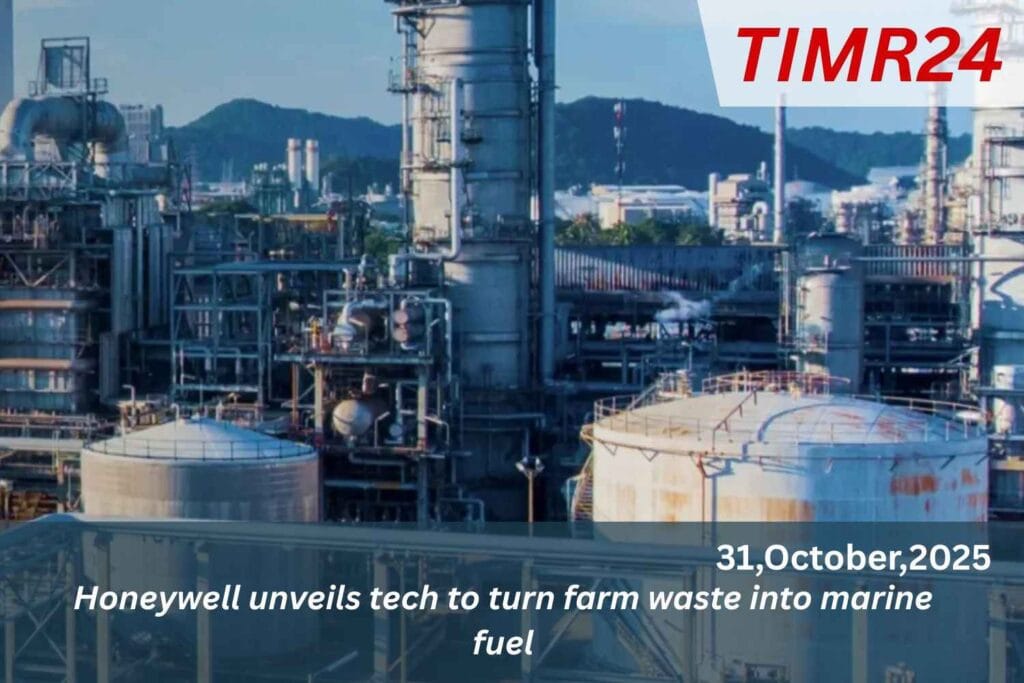
Honeywell unveils tech to turn farm waste into marine fuel

Soniya Gupta

Updated on:

Honeywell

Honeywell has launched a groundbreaking technology that converts agricultural and forestry waste into renewable fuels, specifically targeting hard-to-abate sectors like maritime. This innovation allows for the production of low-carbon marine fuel, gasoline, and sustainable aviation fuel (SAF) from biomass sources such as wood chips and crop residues. The drop-in fuels provide ship operators with a cost-effective, lower-carbon alternative by utilizing locally available agricultural waste, thereby reducing production costs. This development is in line with Honeywell’s commitment to support India’s energy transition and meets growing demands to decrease carbon emissions in the shipping industry, which has historically relied.

On heavy fuel oil. Additionally, Honeywell’s Biocrude Upgrading process can be offered as a modular plant, simplifying deployment and reducing project risks In a landmark move towards decarbonizing global shipping and promoting circular economy principles, Honeywell has (Raises) announced the launch of a revolutionary technology that transforms agricultural residue and farm waste into renewable marine fuel. This innovation comes at a time when the maritime industry faces increasing pressure to reduce greenhouse gas emissions and transition towards cleaner energy sources. The technology, developed under Honeywell’s growing renewable energy portfolio.

Honeywell’s Sustainable Marine Fuel Initiative

Marks a major stride in sustainable fuel production and aligns with global climate goals under the International Maritime Organization (IMO) and Paris Agreement. Honeywell’s latest development aims to address two major global challenges agricultural waste management and maritime carbon emissions. India, for instance, generates over 500 million tonnes of crop residue annually, much of which goes unused or is burned, releasing harmful pollutants into the air. At the same time, the global shipping sector contributes nearly 3% of total carbon dioxide emissions. Honeywell’s technology bridges these challenges by creating a closed-loop system.

Where waste from farmlands is converted into bio-based marine fuel, significantly reducing the carbon intensity of maritime transport This initiative reinforces Honeywell’s long-term commitment to sustainability and innovation. The company has been investing heavily in renewable energy technologies, including biofuels, green hydrogen, and carbon capture solutions. The introduction of this waste-to-fuel process not only enhances energy efficiency but also supports rural economies by providing farmers with new income sources for agricultural residues that were previously discarded At the core of Honeywell’s innovation is a catalytic thermochemical.

Conversion process that turns biomass feedstock such as crop stubble, sugarcane bagasse, or rice husk into a high-quality liquid fuel suitable for marine engines. The system operates by breaking down complex organic materials into simpler hydrocarbons through pyrolysis and hydro-treatment techniques. The resulting product, often called bio-marine fuel or renewable marine diesel, can be blended directly with conventional marine fuels or used independently in modified vessels This process is designed to deliver up to 80% reduction in lifecycle carbon emissions compared to.

Traditional marine diesel. Moreover, it eliminates the need for additional chemical additives, making it a cost-effective and environmentally safe alternative. Honeywell’s proprietary refining and purification steps ensure the fuel meets stringent IMO 2020 sulfur emission standards, making it an immediate and practical replacement in the shipping industry Honeywell’s waste-to-marine fuel technology supports the IMO’s strategy to cut total annual greenhouse gas emissions from international shipping by at least 50% by 2050 compared to 2008 levels. The technology provides a scalable pathway to achieve these targets by creating renewable fuel alternatives.

Economic and Environmental Impact

That require minimal infrastructure changes for existing fleets the initiative contributes to the United Nations Sustainable Development Goals (SDGs), particularly Goal 7 (Affordable and Clean Energy), Goal 12 (Responsible Consumption and Production), and Goal 13 (Climate Action). The use of waste as a feedstock promotes resource efficiency, while the generation of clean energy from bio-based sources enhances energy security for nations dependent on imported fossil fuels The economic potential of converting farm waste into renewable marine fuel is substantial. Farmers can now monetize residues that were previously burned or disposed. of at cost.

The decentralized production model can be adopted across multiple agricultural regions, stimulating local job creation and encouraging rural industrialization Environmentally, Honeywell’s approach mitigates open-field burning a significant source of air pollution and particulate matter (PM2.5) in countries like India. By capturing carbon in biofuel production, the technology also reduces methane emissions from decomposing waste. Each tonne of bio-marine fuel produced prevents approximately three tonnes of CO₂ emissions from entering the atmosphere, offering one of the most effective carbon offset solutions in renewable fuel production.

Partnership and Collaboration Opportunities

Honeywell’s announcement has opened the door for strategic partnerships across sectors. The company plans to collaborate with shipping firms, biofuel producers, agricultural cooperatives, and government agencies to scale production and distribution. Pilot plants are expected to be established in regions with high agricultural activity and strong port infrastructure, such as India, Southeast Asia, and Latin America By partnering with global logistics and energy companies, Honeywell aims to create a complete value chain from collection of agricultural residues to biofuel refining and marine supply. The initiative is expected to attract investment from sustainability-focused funds and carbon credit markets, given its measurable impact on emission reductions.

The introduction of Honeywell’s waste-to-marine fuel technology epitomizes the circular economy model, where waste materials are repurposed into valuable energy resources. Unlike conventional linear systems that rely on extraction and disposal, this model ensures that carbon is continuously cycled through renewable processes. The maritime industry, which has historically relied on fossil fuels, can now integrate circular practices without major operational disruptions Honeywell’s innovation also complements global trends in green shipping corridors—specific routes between major ports committed to using low-carbon fuels and technologies.

Integrating this fuel into such corridors could significantly accelerate the industry’s transition to sustainability, while offering a replicable framework for other heavy transport sectors like aviation and freight logistics This launch adds to Honeywell’s growing list of environmental technologies. The company has already introduced Ethanol-to-Jet (ETJ) and Eco fining technologies that convert waste oils and alcohol into sustainable aviation fuel (SAF). With the addition of farm waste-to-marine fuel solutions, Honeywell now addresses multiple sectors of global transportation, aligning with its vision to achieve carbon neutrality in its operations by 2035.

In addition to fuel conversion systems, Honeywell continues to expand its expertise in automation, smart energy management, and carbon capture utilization and storage (CCUS). By integrating digital monitoring systems with its biofuel technologies, the company ensures traceability and transparency across the value chain, providing end-users with verifiable carbon accounting metrics The commercial success of Honeywell’s technology will depend on policy support, feedstock availability, and market readiness for renewable fuels. However, early indicators suggest growing optimism. With tightening emission regulations and increasing adoption of carbon.

Pricing mechanisms, renewable marine fuels could capture a significant market share by 2030 Industry analysts predict that bio-based marine fuels could account for up to 25% of total marine fuel consumption within the next decade, provided large-scale production and distribution networks are established. Honeywell’s technological head start, combined with its global presence and research capabilities, positions it as a frontrunner in this emerging sector Honeywell’s initiative to transform farm waste into marine fuel marks a transformative leap in sustainable innovation. By combining agricultural waste utilization with low-carbon marine energy.

Solutions, the company has paved a practical route towards a greener, circular, and inclusive energy future. This breakthrough not only strengthens global decarbonization efforts but also (gov) supports farmers, empowers rural economies, and sets a precedent for corporate sustainability leadership.

Q1. What is Honeywell’s new farm waste-to-marine fuel technology?
It’s an advanced process that converts agricultural residues into sustainable marine biofuel using Honeywell’s defining™ system.

Q2. How does it benefit the environment?
The fuel reduces greenhouse gas emissions by up to 80% and prevents farm waste from being burned, reducing air pollution.

Q3. Can ships use this fuel without engine modifications?
Yes. It’s a drop-in fuel compatible with existing marine engines and infrastructure.

Q4. Where will this technology be implemented first?
Honeywell plans pilot deployments in regions with high agricultural residue availability, such as India and Southeast Asia.

Q5. What industries can benefit apart from shipping?
Aviation, freight, and heavy transport sectors can adapt similar processes for renewable fuel alternatives.