








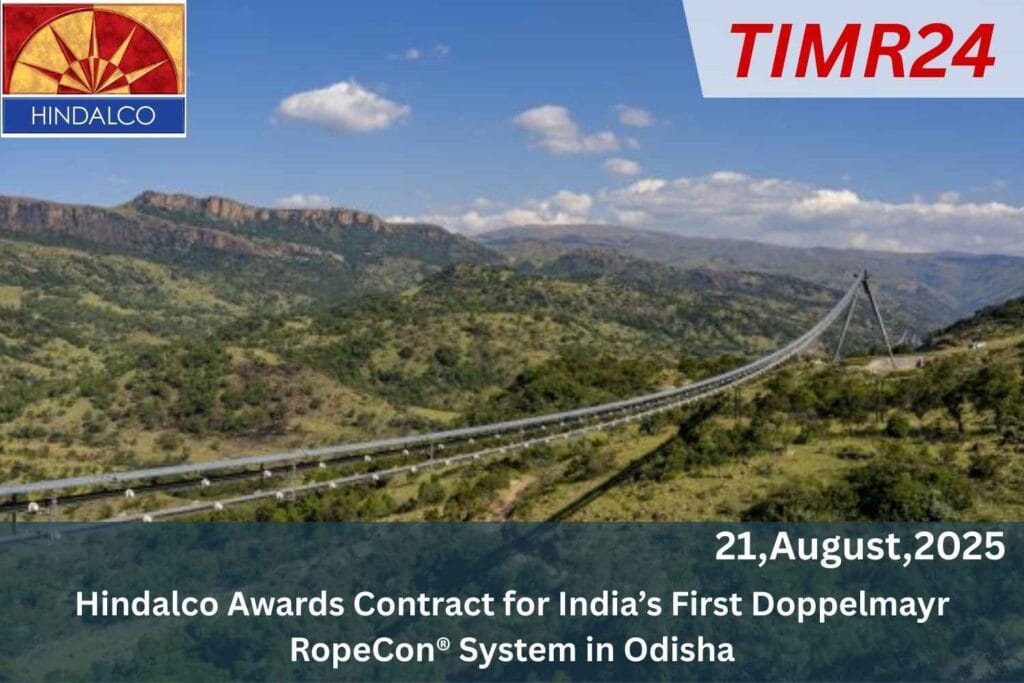
Hindalco Industries Limited has awarded a contract to Doppel Mayr for India’s first Rope on® system at the Aditya Alumina Refinery in Kasaragod, Odisha. The innovative aerial conveyor will transport 1,500 tonnes per hour of bauxite, generate up to 907 kWh of energy, and minimize land disturbance. Hindalco Industries, the metals flagship of Aditya Birla Group, has taken a major step towards sustainable mining logistics by awarding a contract for India’s first Doppelmayr RopeCon® system in Odisha. This pioneering technology, developed by Austrian ropeway leader Doppelmayr, is designed to revolutionize the transportation of bauxite from mines to refineries while minimizing. environmental disruption The RopeCon® system works on the principle of a conveyor suspended on ropes.
Combining the advantages of conventional conveyor belts and ropeway systems which makes it highly suitable for rough terrains like those found in Odisha’s mineral belts. With this project, Hindalco is not only strengthening its supply chain efficiency but also setting a benchmark for eco-friendly industrial practices in India. The RopeCon® system is expected to play a transformative (Water Projects) role in the mining sector. Traditional methods of transporting minerals often involve heavy truck movement through forests, villages, and hilly terrain, leading to dust pollution Deforestation, and higher carbon emissions. By contrast, RopeCon® offers a low-footprint solution that moves material over long distances with minimal ground disturbance.
For Odisha, a state rich in natural resources yet environmentally sensitive, the adoption of this system could balance development with sustainability. Hindalco’s decision to embrace such a technology reflects its broader commitment to green operations, a goal that aligns with India’s climate action roadmap and global sustainability targets. Readers interested in the broader mining landscape can also explore how showcase similar sustainability-driven initiatives across industries. Another important dimension of this project lies in its impact on logistics and operational efficiency. RopeCon® can transport thousands of tons of material per hour over rugged terrain without.
The need for road infrastructure or extensive land acquisition This reduces operational costs and improves the reliability of supply chains, which is critical for Hindalco’s alumina and aluminium production in Odisha. By cutting down on truck movement, the company also expects a substantial reduction in fuel usage and vehicle emissions. Similar to the way India has been innovating in infrastructure such as through Hindalco’s adoption of RopeCon® highlights how industrial leaders are using technology to make operations cleaner and more efficient From a regional development perspective, the RopeCon® project brings multiple benefits.
The installation will create specialized employment opportunities during construction and operation phases, and it will also set the stage for Odisha to become a hub of advanced mining logistics. The project demonstrates how cutting-edge international technology can be integrated into India’s resource sector, boosting both industrial capacity and environmental responsibility. This aligns with other forward-looking projects in the state, such as the upcoming which is designed to expand regional connectivity while adhering to modern standards of efficiency and sustainability.
The environmental aspect of RopeCon® is particularly noteworthy. By using cables suspended at heights, the system avoids disturbing forest cover and wildlife corridors, thereby reducing ecological fragmentation. It also helps conserve land resources, a crucial factor in states like Odisha where both mining and agriculture compete for space. Moreover, RopeCon® has a relatively silent operation compared to fleets of trucks, making it more community-friendly in regions where mining activities often lead to conflicts with local populations This project could serve as a model for future mining operations across India, especially in ecologically sensitive zones.
Its success might encourage more companies to adopt advanced conveyor technologies instead of relying solely on conventional transport methods. Looking at the global picture, Hindalco’s RopeCon® installation also positions India as a pioneer in adopting advanced mining logistics solutions in Asia. While countries like Austria and Jamaica have already deployed RopeCon® systems, Hindalco’s decision to bring it to India shows confidence in both the technology and its long-term benefits. It adds to the growing list of infrastructure and industrial breakthroughs that are reshaping the country’s development story. Just as are reimagining water sustainability, RopeCon® is reimagining mineral transport sustainability.
Hindalco’s contract for India’s first Doppelmayr RopeCon® system in Odisha is not just an industrial agreement but a milestone in the nation’s journey toward sustainable development. It exemplifies how innovation, when aligned with responsibility, can deliver transformative change. For Hindalco, it secures efficiency, cost savings, and long-term operational reliability. For Odisha, it ensures that economic (Greenfield Airport) progress does not come at the cost of the environment. And for India, it signals the beginning of a new era where global technology meets local sustainability needs, paving the way for greener growth in mining and beyond.
Q1. What project has Hindalco awarded in Odisha?
Hindalco has awarded a contract for India’s first Doppel Mayr Rope on® system in Odisha.
Q2. What is the purpose of the Rope on® system?
The system will transport bauxite efficiently while reducing environmental impact.
Q3. Who is the technology partner for the project?
The RopeCon® system is being developed by Doppelmayr, a global ropeway technology leader.
Q4. Why is this project significant for India?
It marks India’s first installation of RopeCon® technology, boosting sustainable mining logistics.
Q5. Where will the system be implemented?
It will be deployed in Odisha to streamline Hindalco’s mining operations.