









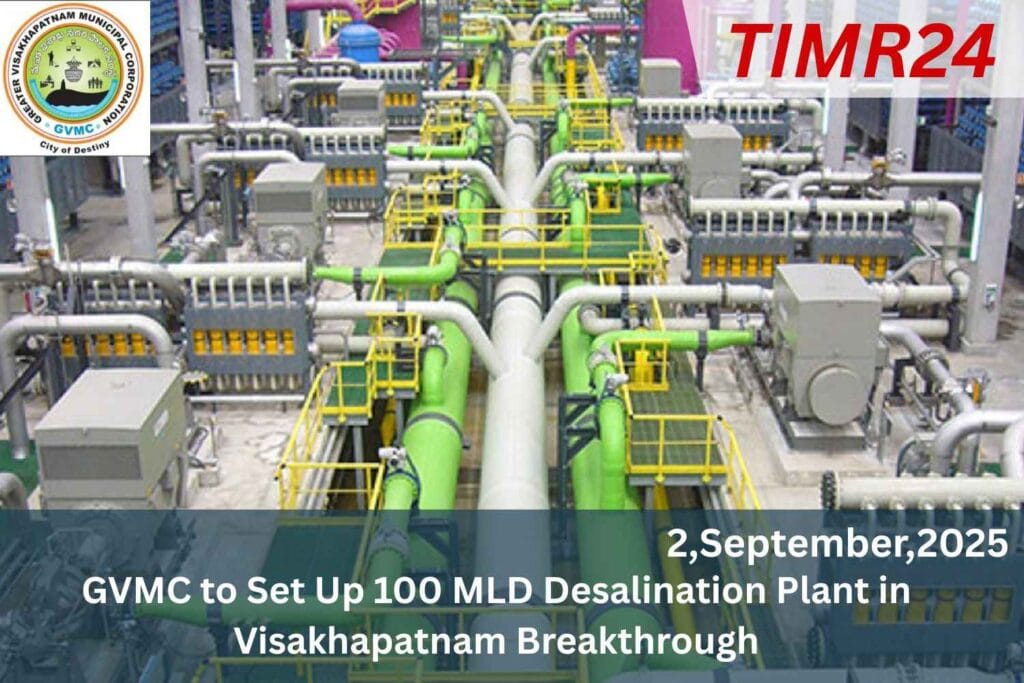
The Up Greater Visakhapatnam Municipal Corporation is planning to establish a 100 MLD desalination plant to meet industrial water demand and reduce domestic supply pressure. A stakeholder meeting with APUIAML and IDE Technologies reviewed feasibility and project components. The project is expected to be developed under a PPP model. The announcement by the Greater Visakhapatnam Municipal Corporation (GVMC) to establish a 100 MLD desalination plant in Visakhapatnam represents not just another infrastructure project but a significant milestone in India’s pursuit of sustainable water management and urban resilience. As a fast-growing coastal city, Visakhapatnam faces the dual challenge of increasing population and industrial growth on one hand, and limited freshwater.
Resources on the other. Traditionally, the city has depended on reservoirs like Meghadrigedda and Yeller, as well as the Polavaram project for water supply, but the fluctuations in rainfall, recurrent droughts, and rising consumption patterns have made it clear that new strategies are essential for ensuring long-term water security. By investing in desalination, GVMC is joining a global network of cities that are leveraging technology to tap into the unlimited potential of seawater, ensuring that water scarcity does not become a bottleneck for growth The significance of this project for Visakhapatnam cannot be overstated. The city, often referred to as the financial and industrial hub of Andhra Pradesh, is home to a rapidly expanding population and a thriving industrial base.
The presence of large-scale industries, ports, refineries, and defense establishments requires consistent water supply not only for domestic consumption but also for sustaining economic activities. Any disruption in freshwater availability affects both households and industries, creating ripple effects across the urban ecosystem. In this context, the desalination plant offers a long-term safeguard, particularly during years when rainfall is erratic. According to reports from NITI Aayog, almost 600 million Indians live under conditions of high-to-extreme water stress, highlighting that Visakhapatnam’s challenges are part of a much larger national issue. This project, therefore, sets an example for other coastal cities struggling with similar constraints.
technological perspective, GVMC’s 100 MLD
From a technological perspective, GVMC’s 100 MLD desalination plant is expected to use reverse osmosis (RO) as the primary process, a method that has already proven its effectiveness in countries like Israel, Saudi Arabia, and Singapore. Reverse osmosis works by forcing seawater through specialized membranes that filter out salts, minerals, and impurities, leaving behind water that is safe for drinking and other uses. Globally, desalination has become a cornerstone in addressing water scarcity, and India’s decision to strengthen this sector reflects a forward-looking approach to climate adaptation. The reliance on RO-based desalination does, however, require careful.
Planning to manage its energy intensity, and GVMC has indicated that the plant will incorporate energy-efficient systems to minimize costs and environmental impact. At the same time, best practices from other nations will likely be studied and adopted to suit the unique coastal and climatic conditions of Visakhapatnam. For additional insights into India’s growing infrastructure landscape, one can explore our detailed coverage on (Water Development Projects) Another critical aspect of this initiative is its socio-economic impact. Beyond guaranteeing water security, the desalination plant is poised to generate employment opportunities during its construction and operational phases.
Skilled and unskilled workers, engineers, and maintenance professionals will find opportunities linked to the project, thereby contributing to local job creation. Moreover, reliable water availability will encourage new investments in industries and manufacturing hubs in and around Visakhapatnam. Businesses often consider uninterrupted utilities as a critical factor when choosing locations for expansion, and the assurance of stable water supply through desalination strengthens Visakhapatnam’s positioning as an attractive destination for economic growth. It is expected that sectors like pharmaceuticals, petrochemicals, and IT parks will directly benefit, complementing.
environmental challenges Desalination
The broader industrial policies of Andhra Pradesh. For readers interested in related industrial dynamics, our analysis on provides additional context While the project presents clear benefits, GVMC has also emphasized the importance of addressing potential environmental challenges. Desalination, though a solution to water scarcity, generates brine as a by-product essentially concentrated saltwater which, if not managed properly, can disrupt marine ecosystems when released into the sea. To counter these risks, GVMC is reportedly studying eco-friendly disposal mechanisms, including diffusers that disperse brine back into seawater without causing localized ecological damage.
Furthermore, the plant will explore renewable energy integration, such as solar and wind, to offset the energy-intensive nature of desalination processes. These measures align closely with India’s commitments under the Paris Climate Agreement and the national mission on sustainable habitats outlined By embedding environmental safeguards, GVMC ensures that the project contributes not only to water resilience but also to ecological balance. On a broader scale, the desalination project also reflects India’s evolving approach towards climate resilience and sustainable urban planning. With increasing instances of erratic rainfall and drought-like conditions across states.
cities can no longer rely solely on traditional water sources. Coastal cities, in particular, are well positioned to leverage desalination technology, and Visakhapatnam’s 100 MLD plant could serve as a blueprint for other urban centers such as Chennai, Mangalore, and Mumbai. In fact, Chennai has already set up large desalination plants that supply significant portions of the city’s drinking water, offering lessons that can be adapted for Visakhapatnam. The global experience, documented in reports by (UN Water) underscores that desalination is not just a stop-gap measure but a long-term adaptation strategy for cities threatened by water stress and climate uncertainty.
From an urban development standpoint, this project strengthens GVMC’s track record in implementing forward-thinking infrastructure. The corporation has previously championed initiatives such as underground drainage networks, solid waste management, and sewage treatment plants. By adding desalination to its portfolio, GVMC demonstrates a holistic approach that goes beyond immediate concerns and envisions long-term resilience. In many ways, this project is not just about water it is about the future of Visakhapatnam as a sustainable, climate-ready city. As India pushes ahead with its Smart Cities Mission and sustainable urban development goals, GVMC’s desalination plant highlights how local governments can drive innovation at the city level.
The timing of the project is particularly important, given the city’s aspirations to emerge as a global investment destination. Visakhapatnam has been projected to be the executive capital of Andhra Pradesh, and with this status comes increased responsibility to ensure world-class infrastructure. Water scarcity could otherwise have been a major bottleneck for urban growth, but with the desalination plant, the city will be able to guarantee both residents and businesses a secure supply. This assurance, in turn, will strengthen investor confidence and complement ongoing investments in roads, ports, housing, and industrial corridors.
In conclusion, GVMC’s decision to establish a 100 MLD desalination plant in Visakhapatnam is much more than an engineering feat it is a transformative step towards building a water-secure, climate-resilient, and economically vibrant city. By addressing immediate water scarcity challenges while simultaneously integrating sustainability and environmental safeguards, the project sets a benchmark for future urban development in India. It reflects how technology, policy, and governance can converge to solve pressing urban issues and create resilient communities. As Visakhapatnam prepares to scale new heights in industrialization and urbanization.
Q1. What is the capacity of the GVMC desalination plant?
The desalination plant has a capacity of 100 MLD (million litters per day).
Q2. Why is desalination important for Visakhapatnam?
It ensures sustainable water supply by reducing dependency on freshwater sources.
Q3. What technology will be used in the desalination process?
Reverse Osmosis (RO) technology will likely be implemented for efficient treatment.
Q4. How will this project benefit residents and industries?
It will provide uninterrupted drinking water and ensure reliable water for industrial needs.
Q5. When is the desalination plant expected to be operational?
The project is in planning and execution stages, with completion targeted in the next few years.