

















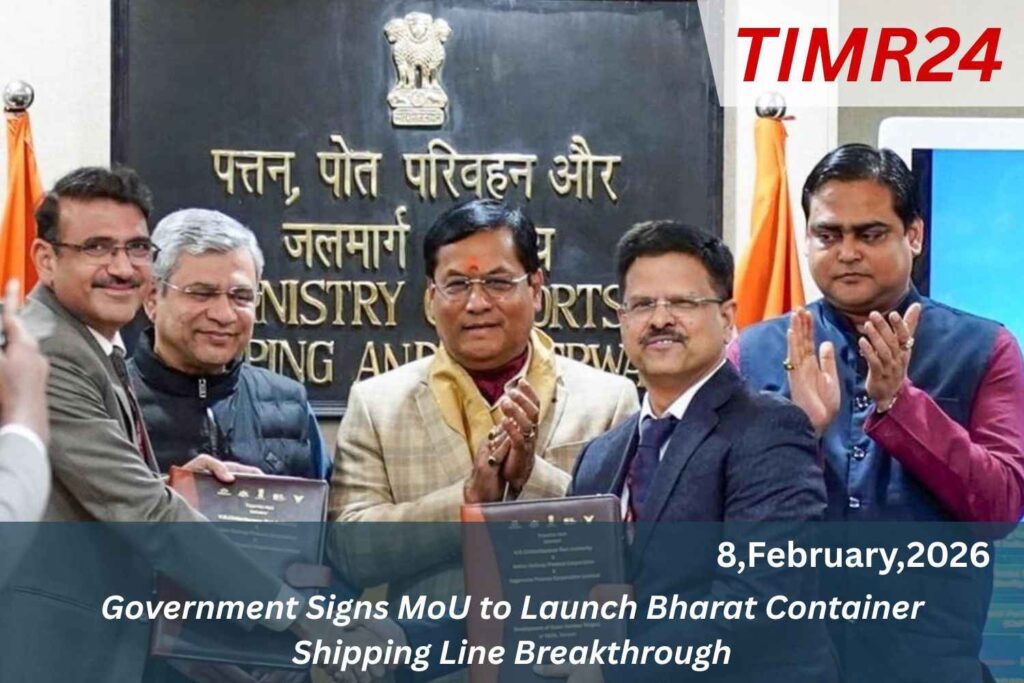
The Union Government signed a Memorandum of Understanding (MoU) to establish the Bharat Container Shipping Line (BCSL) aimed at enhancing India’s container shipping ecosystem. Key figures present included Union Ministers Sarbananda Sonowal and Ashwini Vaishnaw, highlighting cooperation in shipping, ports, and rail logistics. The BCSL MoU involved several organizations, including the Shipping Corporation of India and various port authorities, aligning with the Container Manufacturing Assistance Scheme (CMAS) announced in the Union Budget 2026–27. Additionally, a separate tripartite MoU for the Outer Harbour Project at V.O.
What Is the Bharat Container Shipping Line Initiative
Chidambaranar Port was signed, facilitating joint funding of up to ₹15,000 crore for port capacity expansion. Sonowal emphasized that these initiatives support Atmanirbhar Bharat and Maritime Amrit Kaal 2047, aiming to boost India’s strategic presence in global trade. The government anticipates these developments will strengthen national shipping capabilities and multimodal connectivity, addressing historical challenges faced by Indian exporters and importers The Government of India has taken a significant step toward strengthening the country’s maritime and logistics ecosystem by signing a Memorandum of Understanding (MoU) to establish.
The Bharat Container Shipping Line. This initiative is aimed at creating a robust, Indian-owned container shipping service that can support the nation’s growing trade volumes and reduce dependency on foreign shipping lines. With global supply chains facing frequent disruptions and freight volatility, the launch of a national container shipping line is being viewed as a strategic intervention to enhance logistics resilience, improve cost efficiency, and support India’s long-term trade ambitions. This development aligns closely with broader national objectives such as Atmanirbhar Bharat, Make in India, and the vision of transforming India into a global manufacturing and export hub.
The Bharat Container Shipping Line is envisioned as an integrated shipping and logistics platform that will primarily handle containerized cargo across domestic and international routes. The initiative seeks to provide Indian exporters and importers with reliable, cost-effective shipping options while improving control over critical logistics infrastructure. By establishing a national container line, the government aims to address long-standing challenges such as high freight costs, limited availability of containers during peak demand, and over-reliance on foreign shipping companies. The project is expected to work in close coordination with Indian ports.
Why the MoU Matters for India’s Trade Ecosystem
Inland waterways, rail networks, and logistics parks, creating a seamless multimodal transport system The signing of the MoU marks more than just an administrative step; it signals the government’s intent to structurally reform India’s maritime trade framework. In recent years, Indian exporters have faced sharp increases in container freight rates, especially during global disruptions such as the pandemic and geopolitical conflicts. The Bharat Container Shipping Line is expected to bring greater pricing stability and capacity assurance, particularly for small and medium exporters who often struggle with fluctuating logistics costs. By ensuring predictable shipping services.
Integration with Ports, Rail, and Inland Waterways
The initiative could significantly improve India’s export competitiveness in sectors such as textiles, pharmaceuticals, engineering goods, and agricultural products A key highlight of the Bharat Container Shipping Line is its focus on integrated logistics rather than standalone shipping operations. The proposed framework emphasizes seamless connectivity between ports, rail freight corridors, inland waterways, and road transport networks. This integrated approach is expected to reduce transit times, minimize handling costs, and improve overall supply chain efficiency. The initiative complements existing infrastructure programs such as the Sagarmala Programme and the Dedicated Freight Corridors.
Boost to Atmanirbhar Bharat and Domestic Shipping
According to the Ministry of Ports, Shipping and Waterways, improved port-led development can significantly lower logistics costs as a percentage of GDP. The establishment of a national container shipping line is also a major boost to the Atmanirbhar Bharat mission. Currently, a large portion of India’s container cargo is carried by foreign-owned vessels, leading to significant outflows of foreign exchange. By promoting an Indian-flagged shipping line, the government aims to retain value within the domestic economy while strengthening India’s maritime capabilities. This move could also encourage domestic shipbuilding, vessel leasing, and maritime services.
Impact on Exporters Importers, and MSMEs
creating employment opportunities across the shipping value chain. For exporters and importers, particularly MSMEs, the Bharat Container Shipping Line could be a game-changer. Access to reliable shipping services at competitive rates can significantly improve cash flow management and delivery timelines. Many small exporters currently face booking delays and high surcharges imposed by international shipping lines. A government-backed container service could provide priority access and transparent pricing mechanisms. Additionally, better logistics predictability may encourage new businesses to enter export markets, thereby broadening India’s export base.
Role in Strengthening Supply Chain Resilience
Global supply chains are increasingly vulnerable to disruptions caused by geopolitical tensions, climate events, and economic shocks. The Bharat Container Shipping Line is expected to play a crucial role in enhancing India’s supply chain resilience by ensuring uninterrupted cargo (India) movement even during global crises. Having a national shipping capability allows the country to prioritize essential goods and strategic commodities when international capacity becomes constrained. This strategic autonomy is particularly important for sectors such as energy, fertilizers, food grains, and pharmaceuticals, where supply disruptions can have wide-ranging economic and social impacts.
Alignment with India’s Long-Term Maritime Vision
The MoU to launch the Bharat Container Shipping Line fits squarely within India’s long-term maritime vision of becoming a leading global shipping and logistics hub. The government has repeatedly emphasized the need to increase India’s share in global shipping tonnage and enhance port efficiency. By integrating shipping services with digital logistics platforms, the initiative may also support data-driven decision-making and real-time cargo tracking. This digital integration complements initiatives like the Unified Logistics Interface Platform
Challenges and the Road Ahead
While the initiative holds immense promise, its success will depend on effective execution, professional management, and financial sustainability. Competing with established global shipping lines will require operational efficiency, modern vessels, and customer-centric services. Public-private partnerships, transparent governance, and phased capacity expansion could play a critical role in ensuring long-term viability. Industry stakeholders will be closely watching how the government structures ownership, funding, and operational control under the Bharat Container Shipping Line framework.
Conclusion A Transformational Step for Indian Logistics
The signing of the MoU to establish the Bharat Container Shipping Line represents a transformational step in India’s logistics and maritime policy landscape. By addressing structural gaps in container shipping and promoting integrated logistics, the initiative has the potential (India) to lower trade costs, strengthen supply chain resilience, and enhance India’s export competitiveness. If implemented effectively, the Bharat Container Shipping Line could emerge as a cornerstone of India’s ambition to become a global trade and manufacturing powerhouse, reinforcing the country’s strategic and economic interests in an increasingly uncertain global environment.