


















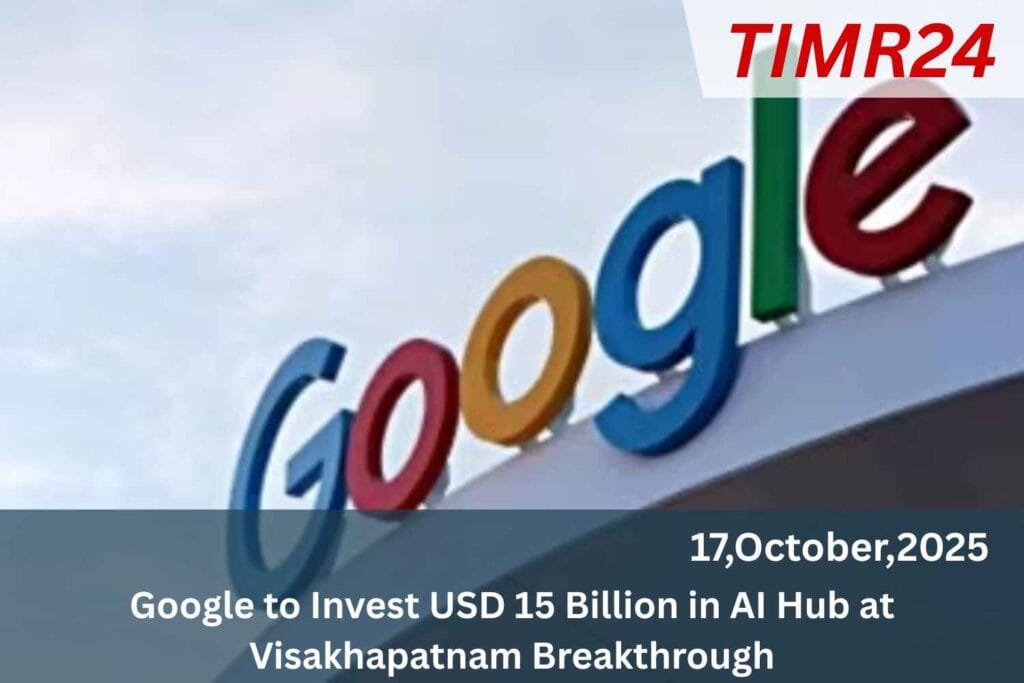
India’s Union Minister for Electronics and IT, Shri Ashwini Vaishnaw, has praised Google’s new AI Hub in Visakhapatnam as a significant step in the country’s digital economy. Vaishnaw emphasized the hub’s alignment with the India AI Mission’s goals and urged Google to focus on skill development and job creation. He also proposed a Vizag-Sittwe digital link and the development of Andaman and Nicobar Islands as international data hubs. The investment is Google’s largest in India. In a landmark announcement that is set to redefine India’s digital and technological landscape, Google has unveiled plans to invest USD 15 billion in establishing an advanced.
AI and data innovation hub in Visakhapatnam, Andhra Pradesh. This move marks one of the largest private investments in India’s tech sector and positions the country as a key player in the global AI ecosystem. Beyond the financial commitment, the project underscores Google’s long-term strategy to combine cutting-edge technology with sustainable growth, job creation, and regional development. It is a decisive step not only in strengthening India’s AI capabilities but also in fostering a technology-driven economy that aligns with the government’s Digital India and Make in India initiatives Visakhapatnam, popularly known as the “City of Destiny,” is rapidly emerging as a major.
Technology and industrial hub on India’s eastern coast. The city has historically been known for its strategic port, industrial zones, and growing urban infrastructure. However, its digital transformation trajectory has recently accelerated, thanks to supportive government policies, investments in infrastructure, and an increasing talent pool in technology and engineering. Google’s decision to establish its AI hub here is a reflection of Visakhapatnam’s potential to serve as a bridge between domestic innovation and global AI markets. The government of Andhra Pradesh has actively facilitated land acquisition, infrastructure development, and policy frameworks to attract.
The Scope of Google’s AI Hub
International technology investments, (Digital India) positioning the city as an ideal location for such a large-scale initiative The planned facility is envisioned as a sprawling campus equipped with state-of-the-art data centers, AI research labs, and cloud computing infrastructure. It is designed to support a wide range of applications, including machine learning, natural language processing, robotics, healthcare analytics, and advanced cybersecurity systems. The hub will also host collaborations with universities, research institutions, and startups, fostering a vibrant ecosystem of innovation One of the most exciting aspects of this project is the emphasis on applied AI solutions.
That can solve real-world challenges in India. For instance, AI-driven tools for agriculture, healthcare diagnostics, and urban mobility are expected to emerge from this hub. By aligning technology development with practical applications, Google aims to ensure that its investment has a measurable impact on both the economy and society. A unique feature of Google’s AI hub in Visakhapatnam is its focus on sustainable operations and green energy. The campus will incorporate renewable energy sources such as solar, wind, and hybrid systems, minimizing its carbon footprint. Advanced cooling technologies, energy-efficient servers, and smart grid integration will be deployed to ensure the data centers meet global environmental standards.
This focus on sustainability aligns with India’s national climate goals, particularly initiatives like the National Green Hydrogen Mission and the broader push toward renewable energy adoption. Google’s investment demonstrates that high-tech infrastructure can be implemented without compromising environmental responsibility, providing a blueprint for future projects across India. Internal link suggestion
Impact on Employment and Skill Development
Beyond technology and infrastructure, the AI hub is expected to generate substantial employment opportunities across multiple sectors. Direct employment will include positions in AI research, software development, data engineering, cybersecurity, and cloud operations. Indirect (NITI Aayog) employment will emerge in logistics, facility management, urban services, and local supply chains Additionally, Google plans to train over one million professionals in AI, cloud computing, and related technologies, collaborating with Indian universities, technical institutes, and skill development programs. This initiative is designed to bridge the skill gap in emerging technologies and ensure.
A steady pipeline of qualified talent. The hub will also provide incubation support for startups, especially those focused on AI-driven innovation in sectors like healthcare, education, and agriculture, encouraging entrepreneurship and economic diversification The Google AI hub represents more than just a corporate investment; it is a strategic accelerator for India’s AI ecosystem. By establishing a high-tech center for research and development, the hub will foster collaboration between academia, industry, and government, creating an environment where innovation thrives Data localization will also be a key component, ensuring that sensitive data remains within India while complying.
With global standards such as GDPR. This will bolster trust in cloud and AI services and attract additional international players to India’s technology landscape. Furthermore, the hub complements government programs like the National AI Strategy, reinforcing India’s ambitions to become a global leader in responsible and inclusive artificial intelligence. India’s emergence as a key AI hub has broader implications for the global technology landscape. Google’s investment signals international confidence in India’s talent, infrastructure, and policy environment. It also demonstrates the country’s ability to attract large-scale, high-tech investments that rival traditional.
Global Significance of Google’s Investment
AI hubs in the United States, Europe, and Southeast Asia. Moreover, the project highlights a shift toward distributed innovation, where global technology companies establish centers in regions with untapped potential. For India, this translates into economic growth, technological sovereignty, and increased influence in shaping the global AI narrative Looking ahead, Google’s Visakhapatnam AI hub is poised to become a catalyst for India’s digital revolution. Beyond its immediate impact on jobs and technology, it represents a long-term vision for sustainable growth, innovation, and global competitiveness. As India continues to invest in AI research, digital infrastructure, and human.
Capital, initiatives like this will help the country take a leadership role in emerging technologies The hub is expected to foster a culture of experimentation, creativity, and problem-solving, empowering the next generation of Indian engineers, scientists, and entrepreneurs. By combining technology with societal impact, the Google AI hub embodies a new era of innovation where business growth and community development go hand in hand Google’s $15 billion AI hub in Visakhapatnam is more than a corporate investment—it is a visionary project with the power to reshape India’s technology landscape. By combining sustainable infrastructure, advanced AI research, workforce.
Development, and strategic collaboration, this initiative exemplifies how global companies can drive local innovation while contributing to economic and social progress. For Visakhapatnam, the hub marks a transformation from an industrial city to a global center for AI excellence, signaling India’s readiness to lead in the next wave of technological evolution.
Q1. What is Google’s $15 billion AI investment in Visakhapatnam about?
Google plans to establish a large-scale AI and data hub in Visakhapatnam to advance India’s digital infrastructure and AI innovation ecosystem.
Q2. Why was Visakhapatnam chosen for the AI hub?
The city’s strategic location, infrastructure, and government support make it ideal for global tech investments and sustainable data centre operations.
Q3. How will this investment benefit India?
It will create jobs, boost startup ecosystems, support AI research, and strengthen India’s global digital competitiveness.
Q4. What sustainability measures are being taken?
The AI hub will run on renewable energy and implement advanced cooling and carbon-neutral technologies.
Q5. How does this align with India’s Digital India goals?
It supports the Digital India vision by promoting AI adoption, digital literacy, and data sovereignty.