
















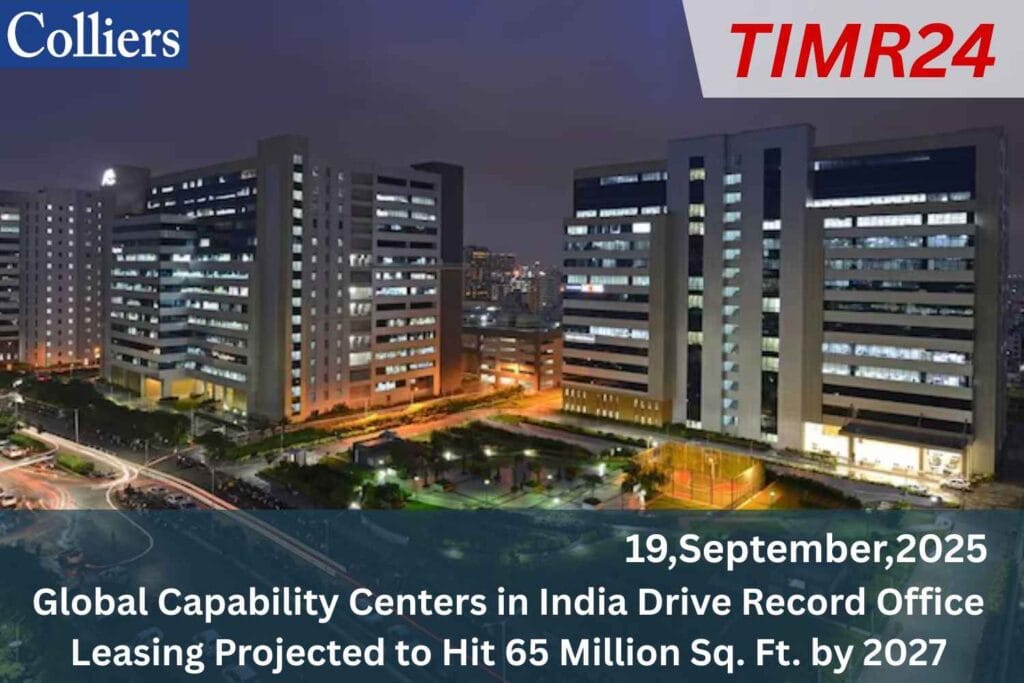
Global Capability Centers (GCCs) have leased nearly 100 million sq. ft. of office space across India’s top seven cities since 2021, resulting in record-breaking transaction volumes. The share of GCCs in overall office leasing has surged to almost 40% in 2025, with GCC leasing projected at 60-65 million sq. ft. during 2026-2027, reflecting a 15-20% increase over the previous two years. Technology GCCs continue to lead GCC leasing with a 37% share, but demand has stabilized in recent years. BFSI and engineering & manufacturing firms have expanded rapidly, with office space take-up rising 3-4X times between 2021 and 2025. BFSI and engineering & manufacturing firms are expected to account for over.
40% of GCC space uptake, underscoring the ongoing demand transition from tech-led to a broad-based growth. Bengaluru and Hyderabad have established themselves as India’s leading GCC hubs, with over 60 million sq. ft. of leasing since 2021. Chennai is expected to witness a 5.3X surge in GCC leasing in 2025 compared to 2021 levels, leading to a preference for premium, future-ready space The Indian office real estate market has been undergoing a remarkable transformation, and one of the strongest drivers of this growth is the rapid expansion of Global Capability Centers (GCCs). According to a recent Colliers report, the total office space leased by GCCs is projected to reach.
Nearly 65 million square feet by 2027, setting a record benchmark that reaffirms India’s position as a global hub for innovation, technology, and business services. This trend is not merely about square footage; it signifies the evolving role of India in the global economy and the strategic shifts multinational corporations are making to optimize their operations in a cost-effective yet innovation-driven environment The rise of GCCs in India has been closely linked with the country’s competitive advantage in talent availability, cost arbitrage, and a mature outsourcing ecosystem. Over the past decade, India has moved beyond being a back-office destination to becoming a center of excellence.
For engineering, research, product development, and Digital Transformation. Cities such as Bengaluru, Hyderabad, Pune, Gurugram, and Chennai are leading the charge, providing high-quality infrastructure, robust connectivity, and an ecosystem conducive to the needs of global enterprises. These cities are home to some of the largest multinational companies that are not only expanding their headcount but also upgrading to premium office spaces, driving the demand for new-age commercial real estate From a demand perspective, the GCC growth story is deeply intertwined with India’s evolving workforce. With more than 1.4 billion people and a median age of around 28.
The country offers one of the youngest and most tech-savvy workforces globally. The push towards digital adoption, accelerated by the pandemic, has further highlighted the importance (India’s) of India as a hub where companies can consolidate technology operations, foster innovation, and scale faster than in most other geographies. This has created a scenario where multinational corporations are increasingly relying on their India GCCs not just for cost savings, but as strategic arms for global growth Colliers’ projection of 65 million square feet by 2027 is a testament to the robust pipeline of real estate projects and the confidence investors have in India’s long-term potential.
The demand for office spaces is also evolving in terms of design and functionality. Today’s GCCs prefer flexible, sustainable, and technologically advanced workspaces that support hybrid working models. Landlords and developers are responding by investing in Grade-A buildings that meet global sustainability standards, incorporate smart technologies, and offer employee-centric amenities. These enhancements make Indian office markets comparable to international standards, thereby attracting even more foreign companies to set up or expand their GCCs in the country While technology and IT-enabled services continue to dominate the GCC landscape.
There has also been a sharp increase in centers dedicated to areas such as financial services, healthcare, engineering R&D, and global supply chain management. For example, financial majors are establishing their innovation and analytics hubs in Pune and Hyderabad, while engineering-focused firms are scaling up in Bengaluru and Chennai. This diversification reduces dependency on a single sector and makes the overall demand for office leasing more stable and resilient against cyclical downturns Another critical factor driving GCC growth in India is policy support and regulatory clarity. Over the past few years, the Indian government has introduced reforms to.
Simplify business operations, improve ease of doing business, and enhance infrastructure investment. The Digital India initiative, coupled with massive investments in smart cities and urban connectivity, has made Indian metros and tier-II cities more attractive for multinational companies. With tax incentives, data protection laws, and policies designed to support foreign investment, India is positioning itself as a strategic base for companies that want to serve global markets efficiently The real estate sector itself is responding proactively to this surge in demand. Developers are not only building larger campuses but also reimagining office spaces as ecosystems where collaboration.
Creativity, and sustainability are integrated seamlessly. Flexible leasing models, coworking tie-ups, and managed office solutions are also emerging as attractive options for GCCs, particularly those in the early stages of setting up operations. As the industry evolves, the balance between traditional long-term leases and agile workspace solutions is expected to create a dynamic office leasing environment, further fueling the market’s momentum An important dimension of this story is sustainability. With global corporations increasingly committing to net-zero targets, the demand for green buildings in India is rising sharply. Certifications such as LEED and IGBC are becoming standard.
Requirements, and many new projects are being designed with renewable energy integration, efficient water management, and waste reduction systems. This aligns with the ESG mandates of multinational corporations and positions India not just as a cost-effective destination, but as a responsible and future-ready hub for global operations The rise of GCCs is also reshaping the socio-economic landscape of Indian cities. As companies expand, they bring with them high-value jobs, improved infrastructure, and increased demand for housing, retail, and social amenities. This has a multiplier effect on the local economy, boosting sectors such as transport, hospitality, education, and healthcare.
Cities like Hyderabad and Pune, which were once considered secondary hubs compared to Bengaluru, are now emerging as strong contenders in attracting GCC investments This geographic diversification ensures balanced growth across multiple regions, reducing concentration risks and creating opportunities for newer urban centers to rise Looking ahead, the projection of 65 million square feet by 2027 could even be surpassed if the current momentum continues. Factors such as artificial intelligence, cloud adoption, and digital transformation are only going to increase the need for specialized talent and scalable office infrastructure. Moreover, as geopolitical shifts push.
Companies to diversify their operations outside traditional hubs like China, India is expected to attract even greater interest as a reliable alternative. This will not only boost office leasing but also accelerate the transformation of India into a global innovation powerhouse the rapid growth of Global Capability Centers in India reflects a structural shift in how multinational corporations view their operations and innovation strategies. The projected record of 65 million square feet of office leasing by 2027 underscores the confidence global players have in India’s talent pool, infrastructure, and policy framework. For the Indian real estate market, this presents unprecedented opportunities to.
Evolve into a world-class ecosystem that meets the needs of the next generation of businesses. More importantly, it positions India at the heart of global enterprise transformation, where the story is not just about office spaces, but about creating the foundations of future-ready economies For deeper insights, you can explore learn about (India’s GCC Growth) Additionally, insights on provide a broader perspective on how commercial real estate is evolving in alignment with global business demands.
q1. What are Global Capability Centers (GCCs)?
Global Capability Centers are specialized units of multinational companies in India, handling advanced operations like IT, analytics, finance, and R&D to serve global markets.
q2. Why are GCCs expanding in India?
India offers a strong talent pool, cost efficiencies, digital infrastructure, and a supportive policy environment, making it attractive for GCC expansion.
q3. How much office space will GCCs occupy by 2027?
GCCs in India are projected to occupy 65 million sq. ft. of office space by 2027, marking a record growth in leasing activity.
q4. Which cities are seeing the highest GCC growth?
Bengaluru, Hyderabad, Pune, Gurugram, and Chennai are leading hubs for GCC expansion due to availability of talent and infrastructure.
q5. What impact do GCCs have on India’s real estate?
GCC growth drives demand for premium office spaces, encourages commercial real estate development, and boosts employment in urban centers.