

















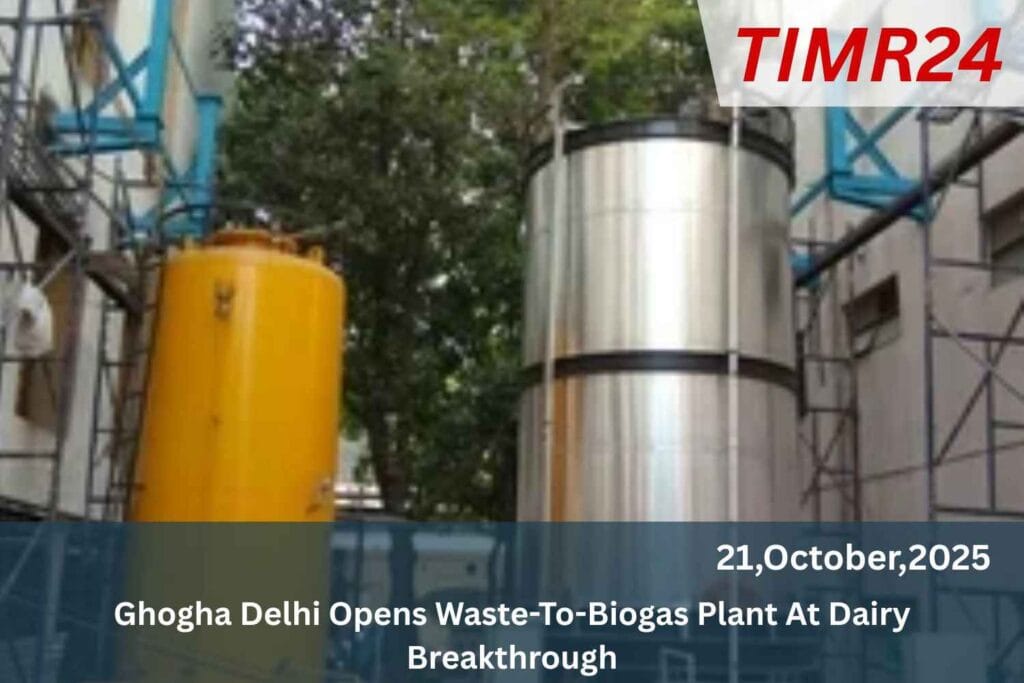
Delhi’s Chief Minister, Rekha Gupta, has inaugurated a municipal solid waste-to-compressed biogas plant and integrated fuel station at Ghogha Dairy, marking a significant step in the city’s clean energy efforts. The plant, set up under an MoU with Indraprastha Gas Limited, will process 100 tonnes of garbage daily to generate 4 tonnes of gas. The initiative aims to address waste management challenges and contribute to sustainable energy generation and urban cleanliness. Ghogha Delhi has made a remarkable stride in sustainable energy and environmental conservation with the launch of its waste-to-biogas plant at the dairy facility, an initiative that represents.
A convergence of innovation, eco-consciousness, and practical solutions for the dairy industry. This plant is designed to transform dairy waste into valuable biogas, providing a renewable energy source while significantly reducing environmental pollution. In traditional dairy operations, organic waste such as cow dung, whey, and leftover feed often accumulates in large quantities, creating disposal challenges and contributing to greenhouse gas emissions. By introducing a biogas facility, Ghogha Delhi addresses these challenges directly, turning what was previously a liability into an asset that supports cleaner energy production and more sustainable dairy practices. This initiative reflects the broader global movement toward.
Circular economy solutions, where waste is not discarded but converted into resources that can be reused within the system. For readers seeking deeper insights into sustainable dairy solutions, you can explore our (Renewable Energy) The biogas plant employs state-of-the-art anaerobic digesters, which facilitate the decomposition of organic matter in the absence of oxygen, producing methane-rich biogas. This gas can be harnessed for multiple purposes, including powering dairy operations, heating water, or even feeding into the local electricity grid. By generating energy on-site, the dairy reduces its dependence on conventional electricity and fossil fuels.
Thereby lowering operational costs while contributing to climate change mitigation efforts. Beyond energy production, the plant produces bio-slurry, a nutrient-rich byproduct that can be used as organic fertilizer in agriculture. This aligns with the goals of sustainable farming, as farmers increasingly seek alternatives to chemical fertilizers to improve soil health and crop yields. The ability to integrate energy production and agriculture through waste utilization highlights the efficiency and innovation embedded in Ghogha Delhi’s project. Readers interested in renewable energy technology in agriculture can refer to our From an environmental perspective, the impact of this plant is significant.
Untreated dairy waste releases methane, a potent greenhouse gas that contributes substantially to global warming. By converting waste into biogas, Ghogha Delhi not only prevents methane emissions but also reduces the volume of waste released into the environment, minimizing water and soil pollution. The initiative exemplifies how businesses can adopt sustainable practices without compromising operational efficiency. The project also reflects India’s commitment to renewable energy, supporting the country’s goals under the National Bio-Energy Mission and contributing to the achievement of clean energy targets set by the Ministry of New and Renewable Energy.
As more industries look to integrate sustainable solutions into their core operations, Ghogha Delhi sets an example of how innovation and environmental responsibility can coexist effectively The economic implications of this initiative are equally noteworthy. By producing biogas on-site, the dairy can offset energy costs, creating long-term financial savings. Furthermore, the bio-slurry generated can be utilized internally or sold to local farmers, creating additional revenue streams. This model demonstrates that environmentally friendly practices can also be economically viable, which is crucial for widespread adoption. Many small and medium-sized dairies often hesitate to implement green.
Technologies due to perceived high costs, but Ghogha Delhi’s successful execution showcases that with proper planning and investment, renewable energy solutions can be both cost-effective and sustainable. For a comparative perspective on economic benefits of biogas plants in dairies Technologically, the plant incorporates advanced monitoring systems to ensure optimal performance. Parameters such as temperature, pH, feedstock composition, and gas output are continuously monitored, allowing operators to maintain efficiency and safety. This approach ensures consistent energy production and reduces operational risks. Moreover, Ghogha Delhi is exploring innovative.
Techniques such as co-digestion with agricultural residues to further increase methane yield. Collaborative research with universities and renewable energy startups positions the company as a leader in sustainable dairy operations and biogas technology. Industry experts note that such collaborations are essential for continuous improvement and for adapting global best practices to local conditions. Readers interested in technological innovations in waste-to-energy solutions can The societal benefits of the Ghogha Delhi biogas plant are also considerable. By promoting clean energy and sustainable farming practices, the initiative indirectly supports public health and community.
Welfare. Reduced environmental pollution from dairy waste contributes to cleaner air and water in surrounding areas, which can have long-term health benefits for local populations. Additionally, creating a circular economy model encourages local farmers and businesses to adopt sustainable practices, fostering a culture of responsibility and innovation. The project has garnered attention not only within the dairy sector but also among environmentalists and policy makers who see it as a replicable model for other urban and semi-urban regions in India. Insights on community benefits of biogas initiatives can be found in our Ghogha Delhi’s initiative also emphasizes alignment.
With global sustainability trends. Countries like Germany, Denmark, and the Netherlands have long integrated biogas facilities into agricultural operations, demonstrating significant environmental and economic benefits. By adopting similar approaches, Indian dairies can reduce carbon footprints, enhance energy security, and create more resilient operational models. Moreover, these projects (Energy) support India’s commitments under the Paris Agreement, as reducing methane emissions from organic waste is a key strategy for meeting greenhouse gas reduction targets. Ghogha Delhi’s plant, therefore, is not just a local achievement but part of a larger movement towards global environmental responsibility.
From an operational perspective, the plant strengthens Ghogha Delhi’s energy independence. By generating a substantial portion of the energy required for daily operations internally, the dairy becomes less vulnerable to fluctuations in electricity prices or supply interruptions. This self-sufficiency enhances reliability and reduces long-term operational risks. Additionally, the initiative encourages innovation in waste management practices within the dairy sector, inspiring other companies to explore similar solutions. Internal stakeholders and employees are also likely to benefit from exposure to advanced technologies and sustainable operational practices, creating a.
Culture of learning and innovation. Further insights on operational efficiency through renewable energy integration can be explored in our Finally, Ghogha Delhi’s waste-to-biogas plant represents a significant milestone in India’s sustainable dairy industry. It demonstrates how technology, environmental consciousness and economic pragmatism can converge to create solutions that are replicable, impactful, and future-oriented. The success of this project will likely inspire other dairy operators across India to consider waste-to-energy solutions, accelerating the adoption of green energy initiatives and fostering a culture of sustainability in the agricultural sector.
By bridging the gap between traditional dairy practices and modern renewable energy technologies, Ghogha Delhi sets a new benchmark for innovation, efficiency, and environmental stewardship, paving the way for a greener, more sustainable future in Indian agriculture. For a broader understanding of sustainable energy adoption in the agriculture sector.
Q1. What is the Ghogha Delhi Waste-to-Biogas Plant?
It’s a facility that converts dairy waste into renewable energy (biogas) and organic fertilizer.
Q2. How does the biogas plant work?
Organic waste is broken down in anaerobic digesters to produce methane gas and nutrient-rich bio-slurry.
Q3. What are the environmental benefits of this plant?
Reduces methane emissions, decreases reliance on fossil fuels, and promotes sustainable agriculture.
Q4. Can other dairies replicate this model?
Yes, it serves as a benchmark for sustainable dairy operations across India.
Q5. What happens to the bio-slurry produced?
It is used as an organic fertilizer, providing a natural alternative to chemical fertilizers.