







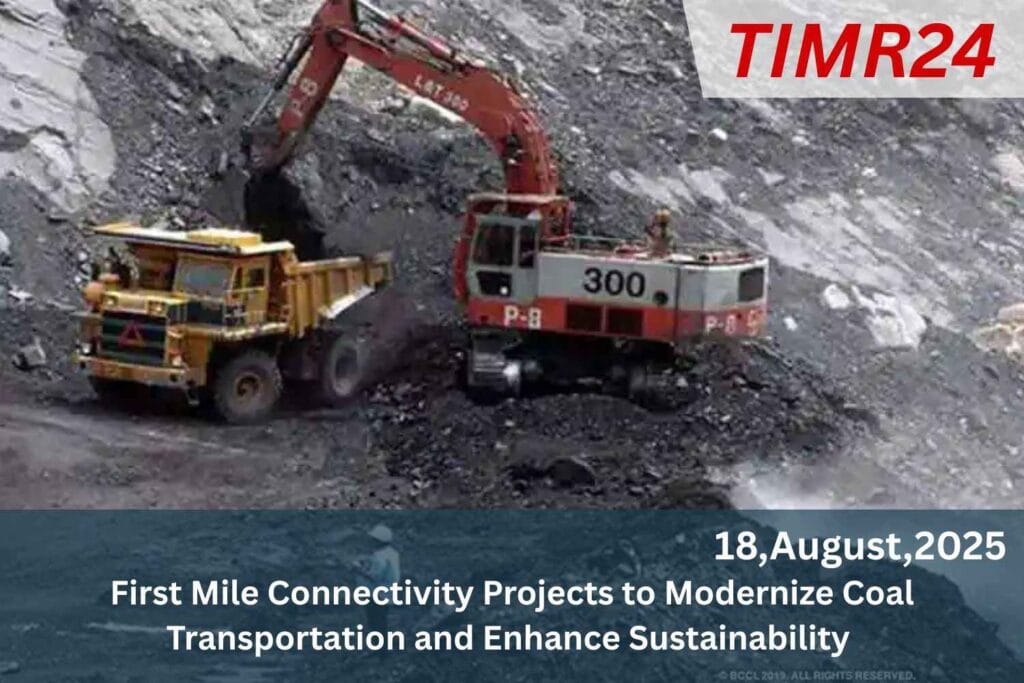
The Union Minister of Coal and Mines, G. Kishan Reddy, has announced the launch of First Mile Connectivity (FMC) projects, which aim to modernize coal evacuation by replacing traditional road transport with mechanized systems. These projects, which include conveyor belts, rapid loading systems, and integrated coal handling plants, aim to reduce air pollution, greenhouse gas emissions, and operational costs. The Ministry plans to set up 102 FMC projects by FY2030, with a total capital expenditure of ₹31,367.66 crore. India’s sector is undergoing a massive transformation with the introduction of First Mile Connectivity (FMC) projects, aimed at streamlining coal transportation, reducing environmental pollution and enhancing overall efficiency in the logistics chain.
Traditionally, movement in India has relied heavily on road transport, which not only increased costs but also contributed to dust pollution and congestion in mining areas. The government, along with public sector undertakings like Coal India Limited (CIL), has shifted focus to mechanized handling systems and eco-friendly infrastructure under FMC initiatives. These projects involve the installation of conveyor belts, silos, rapid loading systems, and automated railway sidings to ensure faster evacuation of coal while minimizing losses. By doing so, the country not only addresses the growing demand for energy security but also aligns coal transportation with sustainability goals. For readers who want to understand the policy background, our detailed coverage on (Coal) explains how
FMC fits into the larger energy roadmap. One of the major drivers of FMC projects is the government’s emphasis on cleaner and more efficient logistics. The Ministry of Coal has set ambitious targets for India and its subsidiaries to complete multiple FMC corridors by 2027, with a projected capacity of over 1 billion tonnes per annum. The idea is to move away from traditional road-based dispatches and replace them with rail-linked, fully mechanized systems. This transition is expected to bring down dust pollution by nearly 90% in mining zones, as coal will no longer be transported in open trucks but through covered conveyors and silos. Additionally, mechanized loading ensures that railway rakes are filled uniformly reducing wastage and turnaround time.
Our in-depth article on highlights how such systems will revolutionize freight handling and improve the efficiency of the Indian Railways network. From a sustainability perspective, FMC projects play a crucial role in lowering the carbon footprint of coal supply chains. Since a major portion of India’s coal is consumed by thermal power plants located far from mines, transportation remains a significant contributor to emissions. By creating end-to-end mechanized evacuation systems, the dependency on diesel-run trucks can be minimized, cutting down greenhouse gas emissions substantially. Furthermore, the adoption of silos and closed conveyor belts also prevents coal spillage and improves
Air quality in surrounding communities. For industries and policymakers exploring eco-friendly strategies, our analysis of offers further insights into complementary initiatives like mine reclamation and renewable integration The economic implications of FMC projects are equally significant. By reducing manual handling, road congestion, and pilferage, coal companies can save operational costs, thereby making coal more affordable for end-users. Faster rake loading also means better turnaround for railway wagons, optimizing the use of India’s rail infrastructure. Moreover, FMC projects attract investments in advanced technology and create new opportunities for engineering and construction firms involved in building conveyor systems, loading stations, and silos. As highlighted in our coverage on such projects also generate employment during construction and operation phases, particularly in
Mining-intensive states like Jharkhand, Chhattisgarh, and Odisha. However, implementing FMC projects is not without challenges. Land acquisition, environmental clearances, and coordination between multiple stakeholders often slow down project execution. Local communities living near mines sometimes raise concerns about displacement and ecological damage. While FMC reduces dust and emissions, the large-scale construction of conveyors and silos also impacts land use and biodiversity. Balancing development with environmental sensitivity remains a key concern for policymakers. Our report on dives deeper into regulatory hurdles and the strategies being explored to overcome them.
Looking ahead, FMC projects are poised to become the backbone of India’s coal evacuation strategy. With coal expected to remain a major component of India’s energy mix in the near future, modernizing its transportation is essential to meet both industrial demand and climate commitments. Integrating FMC with digital monitoring systems, IoT-enabled conveyors, and AI-based loading controls can further enhance efficiency. As India gradually transitions towards renewable energy, these projects also ensure that the remaining years of dependence are managed in the most sustainable way possible. For those tracking the evolution of India’s energy supply chain, our section on (India’s energy) provides a broader perspective on how FMC complements renewable growth and energy diversification.
q1. What are First Mile Connectivity (FMC) projects?
FMC projects focus on modernizing coal transportation from mines to loading points using conveyor belts, silos, and mechanized systems.
q2. How do FMC projects improve coal transport efficiency?
They reduce manual handling, minimize delays, and ensure faster, cleaner, and more cost-effective coal movement.
q3. What is the environmental benefit of FMC projects?
By cutting dust, spillage, and road transport, FMC projects lower carbon emissions and pollution, promoting sustainability.
q4. Which organizations are implementing FMC projects?
Coal India Limited and its subsidiaries are leading FMC projects across major coalfields in India.
q5. When will FMC projects be completed?
Several projects are already operational, while others are targeted for completion by 2027 under phased implementation plans.