



IST - Tuesday, April 7, 2026 3:07 pm
Hot News

Energy REI Expo 2025 and Battery Show Highlight India’s Clean Push

Soniya Gupta

Updated on:

Battery

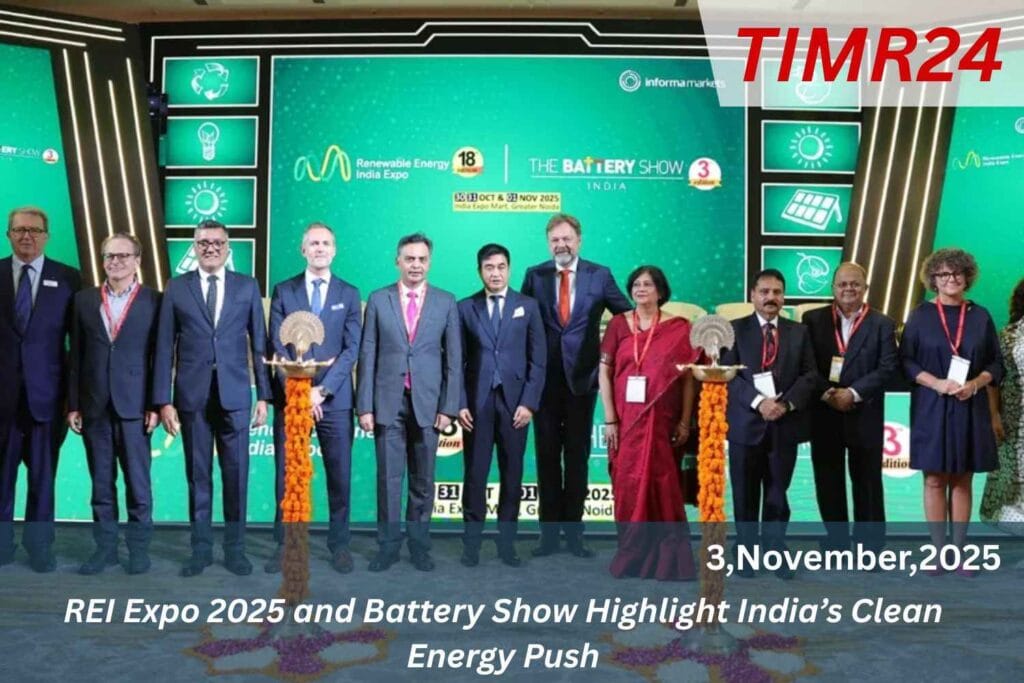
The 18th Renewable Energy India (REI) Expo and 3rd Battery Show India (TBSI) commenced in Greater Noida, gathering over 1,000 exhibitors and 55,000 professionals under the theme “Decoding Pathways to Achieve Net Zero.” Key figures, including Dr. Vibha Dhawan and Dr. Philipp Ackermann, spotlighted India’s clean energy advancements, with capacity surpassing 250 GW by 2025 and a goal of 500 GW by 2030. Major announcements included Solis’s 125 kW hybrid inverter and a 5 GW energy (Renewable) storage system by Replus. The event demonstrated India’s potential as a clean energy leader, fostering innovation and sustainable industrial growth.

The 18th Renewable Energy India (REI) Expo, co-located this year with the 3rd edition of The Battery Show India (TBSI), opened at the India Expo Mart in Greater Noida (October 30–November 1, 2025) and delivered a sprawling, industry-defining showcase that made clear how India’s clean energy transition is shifting from ambition to actionable scale: under the unifying theme “Decoding Pathways to Achieve Net Zero,” the two events together attracted well over 1,000 exhibitors, roughly 1,400 brands and more than 55,000 professionals from across the value chain, creating a single floor where policy makers, manufacturers, developers, financiers and technology.

Providers could plot the practical steps necessary to decarbonize power and mobility the core of the exhibition was a visible, topic-wise architecture that allowed visitors to move easily between concentrated zones from large country pavilions showcasing international manufacturing capabilities to dedicated halls for solar, wind, bioenergy, green hydrogen and energy storage which made the show feel less like a trade fair and more like a working laboratory for integrated clean systems; the organizers intentionally paired REI’s decades-long emphasis on generation with TBSI’s sharper focus on storage and lifecycle battery technologies so attendees could see.

International Manufacturing Capabilities

Literally side by side, how generation, storage and electrified transport must be planned together.  The synergy was particularly striking in battery pavilions, where suppliers displayed innovations across cell chemistry, module engineering, thermal management and recycling a reminder that batteries are no longer a single-product conversation but a systems conversation, spanning raw-material processing, cell production, pack integration, second-life applications and end-of-life recovery; companies at the show emphasised modular plant designs and localization strategies that can lower costs and shorten supply chains while meeting India’s push to build GWh.

Scale domestic capacity Green hydrogen emerged as another cross-cutting storyline: exhibitors and conference speakers framed hydrogen not as a standalone novelty but as a complementary vector that links intermittent renewables to hard-to-decarbonize industry and long-distance transport, presenting electrolyser projects, coupling models for renewables + electrolyser co-location, and fuel-stack demonstrations that showcased how hydrogen can be embedded into industrial clusters and ports. Policy panels at REI debated how to fast-track offtake agreements, create predictable tariffs for electrolytic hydrogen, and design transmission access.

Green Hydrogen Emerged

That rewards flexible assets all of which underscored that techno-commercial innovation must be matched with regulatory clarity if green hydrogen is to scale in line with India’s net-zero goals Solar and wind companies used the platform to illustrate incremental gains in module efficiencies, system design and project-level O&M practices that are improving levelized cost of energy (LCOE) even as developers confront land, grid and curtailment constraints; several booth demonstrations emphasized hybridization co-located storage and renewables controls as the practical pathway to increase renewable utilization and reduce dependence on curtailment-prone single.

Resource plants The show’s dedicated lane brought vehicle makers, charging-infrastructure firms and battery suppliers into direct conversation, and the visible presence of major automakers and component suppliers signalled that vehicle OEMs increasingly view India as both a manufacturing base and a strategic market for next-generation EVs and related services, including battery swapping and fleet electrification. Meanwhile, conversations on policy and finance occupied a continuous strand through the expo: sessions on green bonds, blended finance, and conditional concessional capital explored mechanisms to bridge the investment gap for large storage farms.

Green hydrogen offtake projects and grid reinforcement, while policy roundtables examined how faster land-permit processes, transmission planning and incentives aligned to domestic manufacturing can reduce execution risk and unlock institutional capital. One of the most tangible measures of progress on display at the event was the scale and international diversity of participation country pavilions from Germany, Japan, Korea, China and others which reflected the trade and technology flows supporting India’s ambition; such international collaboration was showcased both in joint ventures announced on the floor and in supplier-to-OEM pathways for battery.

Connected Procurement Strategies

Components that suggested serious movement toward localization. At the same time, multiple exhibitors highlighted India-specific engineering: thermal packaging adapted for Indian ambient conditions, pack designs that reduce pack-level BOS (balance of system) costs, and recycling pilots that aim to capture value from spent modules and cells while ensuring compliance with emerging e-waste rules The conference strand and technical workshops amplified this practical focus: deep-dive sessions tied lab-scale chemistry advances to manufacturable processes, and case studies from developers and utilities connected procurement strategies to grid-operation.

Realities, such as ancillary services markets and aggregated distributed assets providing frequency response. Those conversations are essential because achieving net zero will require more than deployment targets it requires a functioning market architecture that rewards flexibility, encourages long-term storage procurement, and creates transparent project bankability for investors. In parallel, startups and scale-ups used demo theatres and innovation zones to pitch differentiated models from circular-economy battery-recycling startups to AI-driven asset performance platforms to potential project partners and investors, illustrating a healthy pipeline of solutions.

That address both hardware and software dimensions of the energy transition. The show also revealed a mounting emphasis on workforce and supply-chain readiness: skills panels addressed technician training for battery assembly and repair, standards working groups discussed interoperability and safety standards for fast-charging corridors, and industry bodies signalled coordinated efforts to raise quality standards across the manufacturing ecosystem all pragmatic steps to ensure that rapid capacity build-out does not create downstream reliability or safety problems. On investments and targets, exhibitors and commentators at the event underlined ambitious.

National trajectories: reports and company presentations suggested battery capacity in India is on a fast track with industry estimates pointing toward multi-GWh to 100 GWh scale by the mid-2020s  which, if realized, would transform India’s role from an importing market to a major manufacturing hub for cells and packs, with concomitant impacts for EV adoption and grid storage economics Finally, the REI + TBSI combination produced a clear takeaway for policy makers and corporate strategists alike: India’s next stage of clean energy growth will be defined by integration generation plus storage plus mobility plus green fuels and by the speed at which finance, standards and manufacturing.

Localization evolve to match deployment ambitions. For readers and editors building website content from this single-paragraph overview, please use these internal anchors to create topic-specific subsections on your pages — Overview, Energy Storage, Green Hydrogen, Solar & Wind, E-Mobility, (Build) Policy & Finance, Industry Collaboration and Future Outlook the relevant in-depth articles to each anchor so readers can move from this panoramic paragraph to richer, topic-wise coverage.

Q1. What are REI Expo 2025 and Battery Show India?
They are major industry events in India REI is the 18th edition of a large renewable energy expo, and TBSI is the 3rd edition of a battery & energy-storage show.

Q2. When and where will the event be held?
From 30 October to 1 November 2025 at the India Expo Mart, Greater Noida in the Delhi–NCR region.

Q3. What is the theme of the event?
The theme is “Decoding Pathways to Achieve Net Zero.

Q4. Who should attend or exhibit?
Stakeholders across the clean-energy value chain: manufacturers, innovators, investors, policymakers, developers in solar, storage, e-mobility, hydrogen etc

Q5. What key announcements or milestones will be showcased?
India has crossed ~250 GW of renewable capacity in 2025 and is targeting ~500 GW by 2030. Major product launches: e.g., a 125 kW hybrid inverter, a 5 GW energy-storage system.