

















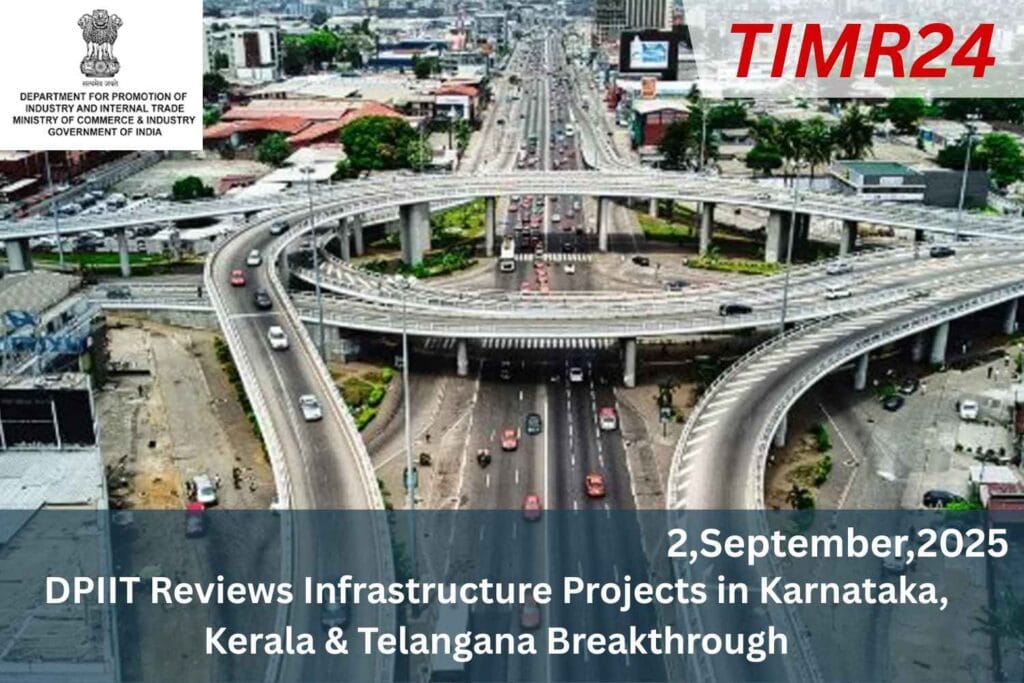
Secretary of the Department for Promotion of Industry and Internal Trade (DPIIT), Shri Amandeep Singh Bhatia, chaired a high-level meeting to review major infrastructure projects in Karnataka, Kerala, and Telangana. The meeting focused on speeding up issue resolution through stronger inter-ministerial and state coordination under the Project Monitoring Group (PMG). Key projects reviewed included the Trivandrum Kanyakumari railway line doubling project, which aims to double the existing single-line track and improve regional connectivity. The 5G/4G network expansion initiative of Reliance Jio was also reviewed, focusing on addressing pending forest and wildlife clearance matters.
The Department for Promotion of Industry and Internal Trade (DPIIT) has been taking consistent steps to ensure that India’s infrastructure pipeline moves forward without unnecessary delays, and its recent review of projects in Karnataka, Kerala, and Telangana highlights this commitment. The review process was not limited to simply monitoring timelines but also involved addressing bottlenecks, identifying future opportunities, and aligning state-level projects with the national vision of inclusive and sustainable development. Each of these states, with their unique industrial and geographic strengths, plays a significant role in India’s economic landscape, and therefore the DPIIT’s intervention becomes essential in balancing speed.
Efficiency, and strategic planning. By looking closely at Karnataka’s industrial corridors, Kerala’s port-led infrastructure, and Telangana’s IT and pharma clusters, one can understand how India is gradually transforming its southern region into a hub of global competitiveness Karnataka has historically been recognized as one of the most progressive states when it comes to industry and technology, and the recent review focused heavily on the expansion of industrial corridors that connect Bengaluru with major national and international trade routes. The Bengaluru–Mumbai Industrial Corridor and the Chennai Bengaluru Industrial Corridor are projects that will redefine logistics, industrial manufacturing, and exports once completed.
DPIIT emphasized the importance of seamless land acquisition, improved rail-road connectivity, and modern logistics hubs that can support large-scale industries. With Bengaluru already holding the title of India’s “Silicon Valley,” the added boost from infrastructure will provide technology firms, startups, and manufacturers the support they need to expand faster. Beyond IT, Karnataka is also pushing forward with aerospace, defense, and machine-tool industries, which require world-class infrastructure. To understand how similar projects are transforming other states, you can explore our (Industrial Growth) section where we track nationwide progress.
Kerala, with its distinct coastline and emphasis on sustainable development, stood out in the DPIIT review because of its focus on port-led infrastructure and eco-friendly connectivity projects. The highlight remains the Vizhinjam International Seaport, designed to handle massive cargo volumes and reduce India’s dependency on foreign ports for transshipment. DPIIT also evaluated highway expansion projects and inland logistics development, both of which are expected to reduce freight costs and promote smoother trade across the Arabian Sea. What makes Kerala’s strategy unique is the way it balances development with sustainability, with projects often undergoing strict environmental evaluations.
This aligns well with the global shift towards green growth, where ports, railways, and industrial zones are expected to operate under cleaner and more energy-efficient models. For further insights, readers can visit the official (Ports Waterways), which outlines India’s long-term port-led development vision. Telangana, on the other hand, has been making headlines for its massive strides in IT and pharmaceuticals, and DPIIT’s review placed special emphasis on the Hyderabad Pharma City project. This mega-project, once operational, will be one of the largest integrated pharma hubs in the world, creating employment, boosting exports, and attracting global investments.
Alongside this, Hyderabad’s IT ecosystem continues to flourish, and infrastructure expansion, such as metro rail networks, expressways, and logistics parks, are all being accelerated to support urban mobility and industrial growth. DPIIT noted that Telangana’s forward-looking policies have made it a natural choice for foreign investors, but the success of these investments depends on seamless connectivity and world-class infrastructure. To explore the broader narrative of India’s pharmaceutical growth page provides detailed coverage While the review process brought out success stories, it also highlighted several challenges. Land acquisition remains a recurring obstacle, especially in densely populated states like Kerala and Telangana.
Financing delays, clearance requirements, and inter-agency coordination issues were also noted. DPIIT underscored that without faster decision-making and streamlined approvals, projects risk missing deadlines, which in turn affects investor confidence. The department is now working closely with state governments to set up single-window mechanisms and digital monitoring systems to track real-time progress. This approach not only ensures accountability but also minimizes bureaucratic delays. For an understanding of how India is tackling policy reforms in infrastructure, you may explore the (NITI Aayog), which lays out the country’s roadmap.
Another significant point that came out of the DPIIT review was the impact on regional employment and economic growth. Infrastructure projects are not just about highways, railways, or ports; they create a multiplier effect by generating direct jobs in construction and indirect opportunities in logistics, services, and supply chains. For Karnataka, the industrial corridors are expected to give rise to manufacturing clusters, while in Telangana, the Pharma City and IT infrastructure will generate high-skilled employment. Kerala’s port and logistics expansion, meanwhile, will create sustainable jobs in trade, shipping, and tourism.
This multi-dimensional growth will contribute to India’s larger economic ambition of becoming a $5 trillion economy, with the southern states contributing significantly to the national GDP It is equally important to note that DPIIT’s role is not confined to reviewing and monitoring alone; it also acts as a facilitator for investment promotion and industry–state coordination. By bringing together stakeholders from different levels of government, industries, and financial institutions, DPIIT ensures that projects remain investor-friendly while catering to local developmental needs. This model of governance has proven useful in boosting the ease of doing business in India, something that international.
Investors actively look for before committing large-scale funds. The DPIIT’s monitoring of Karnataka, Kerala, and Telangana sends a strong signal to global markets that India is serious about executing projects on time and aligning them with global standards As the review concluded, the overall message was one of optimism and urgency. Karnataka is ready to expand its dominance beyond IT into advanced manufacturing; Kerala is positioning itself as a maritime and logistics hub with sustainability at its core; and Telangana is creating a futuristic mix of IT and pharma excellence supported by world-class infrastructure. The DPIIT’s intervention ensures that delays are minimized.
Synergies between projects are maximized, and national policies are seamlessly integrated with regional realities. In this way, the review is not just an administrative exercise but a strategic intervention designed to elevate India’s southern infrastructure landscape the DPIIT’s review of infrastructure projects in Karnataka, Kerala, and Telangana marks an important milestone in India’s journey toward becoming a globally competitive economy. By addressing bottlenecks, strengthening project execution, and aligning development with sustainability, the department has showcased how proactive governance can accelerate growth.
Q1 What is the role of DPIIT in infrastructure projects?
DPIIT ensures smooth coordination, monitors progress, and resolves bottlenecks in key projects across states.
Q2 Which sectors are mainly reviewed in Karnataka, Kerala, and Telangana?
Industrial corridors, transport, ports, logistics, and IT infrastructure are the main focus areas.
Q3 How does DPIIT’s review benefit regional development?
It accelerates project implementation, improves connectivity, and attracts new investments.
Q4 What are the challenges in these infrastructure projects?
Land acquisition, environmental clearances, and financing delays are some of the challenges.
Q5 How will these projects impact employment?
They are expected to generate thousands of jobs in industrial, logistics, and service sectors.