






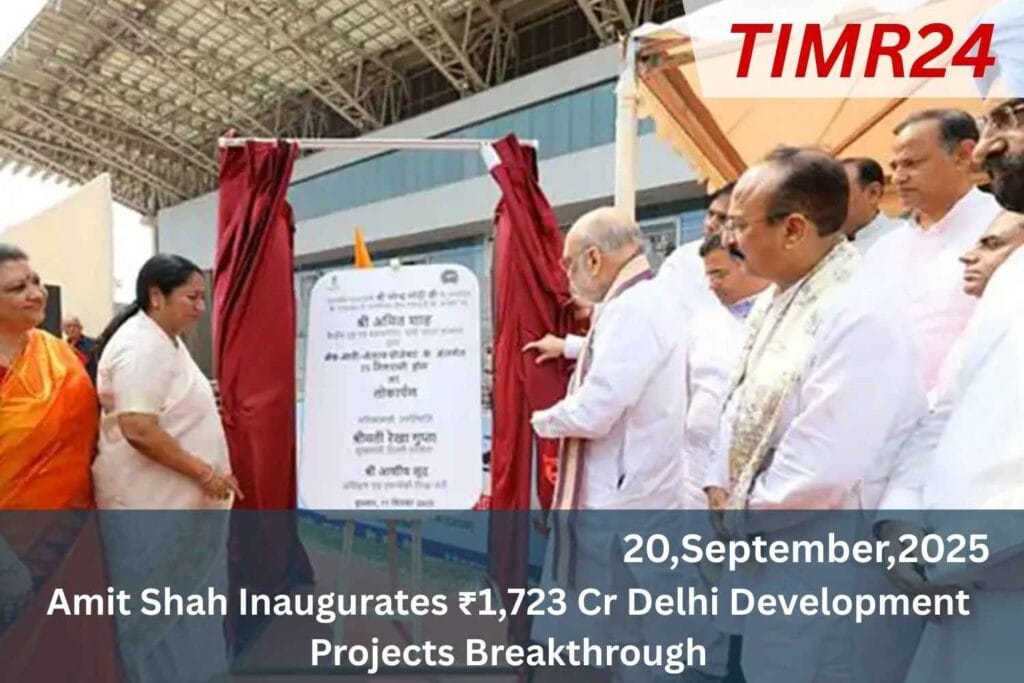
Union Home Minister and Minister of Cooper Shri Amit Shah inaugurated development projects worth ₹1,723 crore under the ‘Seva Pakhwada’ in New Delhi, highlighting PM Modi’s vision of building a developed, secure, and prosperous India. He announced the inauguration of the Narela-Bawana Waste-to-Energy Plant and the Okhla plant, strengthening Delhi’s green energy and circular economy drive. Shri Shah also highlighted the government’s reforms, including slashed GST on essential items and promoting indigenous products. The Union Home Minister Amit Shah has once again underlined the government’s commitment to transforming India’s capital into a global city by.
Inaugurating a landmark package of development works worth ₹1,723 crore in Delhi. These projects are not just infrastructure upgrades; they reflect a broader vision of urban transformation under the Delhi Master Plan 2041 and the national mission of Viksit Bharat @2047. With roads, housing, drainage networks, and public facilities forming the core, the package is expected to provide long-term benefits for millions of citizens who rely on civic systems on a daily basis. The announcement also comes at a time when India is witnessing a rapid pace of urbanization, making Delhi’s role as a showcase city even more crucial A large part of the new projects focuses on strengthening.
Delhi’s road and transport network, which has long been under stress due to the city’s rising population and vehicle density. Congestion at key intersections, lack of smooth connectivity between East and North Delhi, and bottlenecks on arterial roads have been major issues for years. The newly announced projects include road widening, construction of underpasses, and building of flyovers that will ease the burden on existing roads. This move is in line with Delhi’s Smart City Mission and complements similar urban infrastructure works taking shape across the country. A similar example can be found in which aims to address traffic jams at one of the city’s busiest junctions.
Housing and Smart City Development
For Delhi, these new interventions are expected to reduce commuting time, bring down vehicular emissions, and improve connectivity across economic and residential hubs. The ₹1,723 crore package dedicates a significant portion of funds to housing and neighbourhood redevelopment. With Delhi being a magnet for migrants from across India, the pressure on housing continues to grow every year. The new projects aim to provide affordable housing, especially for economically weaker sections and middle-class families, while also redeveloping older colonies into sustainable living spaces. The integration of technology into urban management such as digital platforms for civic.
Services, smart lighting, and waste management systems will further bring Delhi on par with international standards. This mirrors the kind of large-scale planning seen in other parts of India, such as (Adani Cement’s) where innovation and long-term sustainability were prioritized. For Delhi, housing combined with smart utilities will help improve liveability while ensuring inclusiveness in urban growth Delhi’s drainage system has often failed to withstand the heavy monsoon rains, leading to recurring flooding, traffic disruption, and even damage to property. Recognizing this, the new development package includes projects dedicated to constructing robust underground drainage networks.
Upgradation of Public Facilities
Stormwater Management Facilities, and waterbody rejuvenation. By incorporating both traditional and modern methods such as channeling rainwater into storage systems and reviving old ponds the city aims to create climate-resilient infrastructure. This aligns with the country’s broader environmental and climate strategies as seen in where long-term climate adaptation is being planned across multiple sectors. For Delhi, better drainage systems will directly impact public health, reduce economic losses during floods, and provide more reliability to urban life Beyond the big-ticket items like roads and housing, the new package also gives equal importance to everyday civic facilities.
Public parks, healthcare centers, and educational infrastructure are part of the development plan. The government has emphasized the need for open green spaces to combat pollution levels in Delhi, while healthcare centers are being upgraded with digital systems to ensure easier access for citizens. The availability of recreational facilities, improved civic spaces, and stronger healthcare networks will together create a healthier environment for residents. These initiatives are not just upgrades but investments in human well-being. If we compare, similar approaches were taken when where the emphasis was on improving connectivity while ensuring regional development.
Linking with National Development Goals
Union Home Minister Amit Shah stressed during the inauguration that these projects are in line with the national mission of Viksit Bharat @2047. This vision focuses on making India a fully developed nation by the 100th year of independence, and cities like Delhi are expected to serve as role models in this journey. The integration of smart technologies, sustainability goals, and inclusive housing policies show how Delhi’s projects are not just for immediate needs but for long-term national objectives. Moreover, they also reflect the government’s push towards regional balance, as similar infrastructure efforts are being rolled out in other parts of India.
For instance, (NHAI’s) is designed to raise funds for nationwide road expansion, which indirectly complements Delhi’s transport modernization The success of these projects lies not only in their execution but also in their ability to change how people experience Delhi as a city. Reduced travel time, affordable housing, safe drainage, green zones, and upgraded healthcare collectively transform daily life in ways that directly impact productivity, health, and happiness. With an investment of ₹1,723 crore, the government is signaling that Delhi’s urban renewal is central to India’s growth story. The city, which often struggles with the image of congestion and pollution, now has the opportunity to rebrand itself as a city of efficiency and sustainability.
The inauguration of ₹1,723 crore worth of projects by Amit Shah represents a milestone in Delhi’s development path. Roads and flyovers will provide relief to commuters, housing projects will open doors for thousands of families, drainage works will minimize the annual nightmare of waterlogging, and upgraded civic facilities will enrich community life. These are not isolated initiatives but part of a continuous cycle of urban modernization that ties Delhi’s growth with India’s ambition of becoming a developed nation by 2047. To follow updates on such government-led initiatives, readers can also refer to and the both of which provide regular updates on infrastructure and urban policies.
In this sense, the projects are not just about numbers or budgets but about creating a capital city that mirrors India’s aspirations. For Delhiites, the future now looks brighter, greener, and more connected, with the promise of a city that finally matches its status as the heart of the nation.
Q1. What projects were inaugurated by Amit Shah in Delhi worth ₹1,723 Cr?
The projects include urban infrastructure, road connectivity, drainage, housing, and public facility upgrades.
Q2. How will these projects impact Delhi residents?
They will improve traffic management, reduce waterlogging, provide better housing, and enhance public amenities.
Q3. Which areas of Delhi will benefit from the new projects?
Key areas like East Delhi, North Delhi, and newly developing zones will benefit through upgraded infrastructure.
Q4. Are these projects part of the Central Government’s Smart City Mission?
Yes, many align with Smart City and Delhi Master Plan 2041 goals.
Q5. When will the projects be completed?
Most projects are targeted for completion between 2025–2027 in phases.