













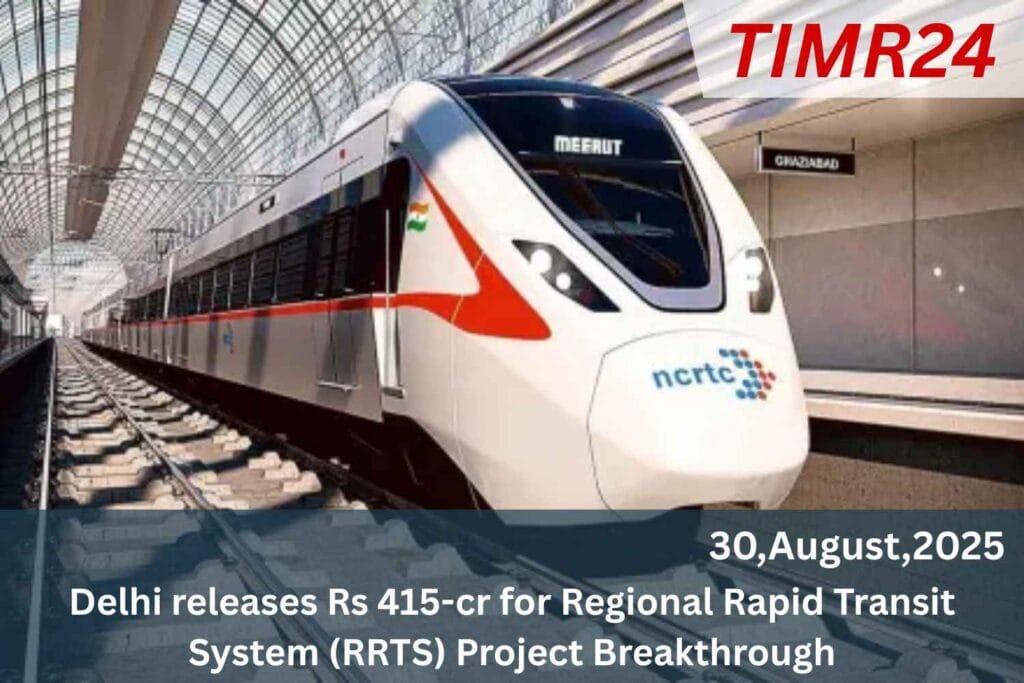
The Delhi government has allocated Rs 415 Crore for the Regional Rapid Transit System (RRTS) project, a 82.15 km mass rapid transit network connecting Delhi to Ghaziabad and Meerut, with ongoing construction budgeting Rs 30,000 crore. The government’s decision to release ₹415 crore for the Regional Rapid Transit System (RRTS) project marks a significant milestone in the journey toward reshaping urban mobility across the National Capital Region (NCR). This financial breakthrough has not only boosted the morale of the executing agency, the National Capital Region Transport Corporation (NCRTC), but also assured commuters that a new era of sustainable and high-speed connectivity is closer than ever.
The RRTS project, which is a semi-high-speed rail corridor planned to integrate Delhi with its surrounding NCR cities, stands as one of the largest transport initiatives in India. With this fresh allocation, the long-awaited Delhi–Meerut stretch takes centre stage, showing that the government is keen to prioritize rapid completion of critical phases The idea of the RRTS system originated from the need to address the twin challenges of congestion and pollution in Delhi. Unlike the Delhi Metro, which focuses on urban intra-city connectivity, the RRTS has been designed to serve as a regional high-speed commuter service connecting multiple NCR cities with Delhi. The Delhi Meerut corridor, being the first under implementation, promises to bring down.
Travel time between the two cities to under an hour, compared to the three hours typically required by road. This will not only improve the efficiency of daily commutes but also open up employment and educational opportunities across the region. For a clearer understanding of how Metro works in parallel with RRTS, readers can explore the (Delhi Metro Rail) where details about integration and interchanges have been highlighted. The release of ₹415 crore is not just a fiscal exercise; it demonstrates political willpower and recognition of the project’s importance. Land acquisition, station development, tunnelling, and utility shifting are some of the most resource-heavy activities in Delhi’s portion of the RRTS alignment.
Delhi–Meerut Corridor as the Flagship Route
This funding will specifically aid in ensuring there are no bottlenecks in civil construction within the capital territory. Earlier, delays were often attributed to a lack of timely financial contributions by state governments, but with this latest infusion, the project timeline looks far more achievable. As per the NCRTC’s official updates, available at the project continues to move at record speed, with significant civil structures and track laying already underway. Among all the proposed RRTS corridors Delhi Meerut, Delhi Panipat, and Alwar the Meerut corridor is the flagship line and the first one expected to be commissioned. The corridor spans 82 kilometres, with 22 stations spread across Delhi, Ghaziabad, and Meerut.
The trains will be designed to run at 180 km/h with an operational speed of 160 km/h, making them among the fastest commuter services in the country. The importance of this corridor cannot be overstated since it connects high-density zones with industrial hubs, thereby reducing dependency on road transport. Similar to our coverage of the which aims to modernize intra-city transport, the RRTS project sets a new benchmark by expanding the horizon to intercity regional connectivity. The success of RRTS lies not only in its ability to save time but also in its potential to transform NCR’s environment and social fabric. Currently, the Meerut highway corridor is one of the busiest stretches, carrying lakhs of vehicles every day.
Environmental and Social Benefits
This results in traffic jams, rising vehicular emissions, and longer travel hours. By shifting a significant share of daily commuters to RRTS, the project is expected to reduce air pollution drastically and cut carbon emissions, aligning with India’s sustainability goals. At the same time, the comfort of air-conditioned, energy-efficient trains will bring relief to passengers who otherwise face chaotic road conditions. For further insights into India’s sustainable transport vision, (Delhi) A critical strength of the RRTS is its planned integration with existing transit systems. The Delhi–Meerut corridor has been designed to interconnect with the Metro, Indian Railways, and inter-state bus terminals, thereby enabling seamless travel.
Stations like Anand Vihar are being developed as major hubs where passengers can switch modes conveniently. This mirrors integration efforts in other projects such as multi-modal connectivity is seen as the future of urban mobility. By ensuring smooth transfers, RRTS aims to offer a holistic travel experience rather than just serving as a standalone corridor. Beyond transportation, the RRTS has far-reaching implications for economic growth. Areas along the corridor, especially towns in Ghaziabad and Meerut, are likely to experience rapid urbanization, with improved real estate prospects and business opportunities. Commuters will be able to live in more affordable suburban areas while working in Delhi, creating a balanced urban sprawl.
Industrial clusters in Meerut, known for manufacturing and small-scale industries, will benefit significantly from faster connectivity, potentially attracting greater investments. Similar ripple effects were seen during the execution of the which boosted urban infrastructure and surrounding development. While the Meerut corridor is the first step, the long-term vision of RRTS is far grander. The Alwar corridor, covering the southern stretch of NCR, and the Delhi Panipat corridor, covering the northern side, are also under various stages of planning and approval. Together, these corridors will create a network that reduces dependence on private vehicles and long-haul buses.
The Delhi government has released ₹415 crore for the Regional Rapid Transit System (RRTS) project, a transformative step to enhance high-speed connectivity between Delhi and surrounding NCR cities. This funding boost accelerates the Meerut RRTS corridor, which will reduce travel time to just under an hour. The project aims to ease traffic congestion, improve environmental sustainability, and enhance economic opportunities across the region. With the government’s financial backing, the RRTS project is expected to meet critical deadlines, ensuring efficient and reliable public transport. The corridor will provide high-frequency, energy-efficient, and commuter-friendly services, connecting key hubs of Delhi, Ghaziabad, and Meerut.
Q1. What is the RRTS project in Delhi?
The Regional Rapid Transit System (RRTS) is a semi-high-speed rail network that connects Delhi with NCR cities for faster, sustainable travel.
Q2. How much funding has Delhi released for the project?
The Delhi government has released ₹415 crore to support the project’s progress.
Q3. Which corridor is being prioritized?
The Delhi–Ghaziabad–Meerut RRTS corridor is the first priority, expected to cut travel time significantly.
Q4. What are the key benefits of RRTS?
It will reduce travel time, ease traffic, promote eco-friendly transport, and enhance regional development.
Q5. When will the RRTS corridor be operational?
The Delhi Meerut section is targeted for full operation by 2025–26.