













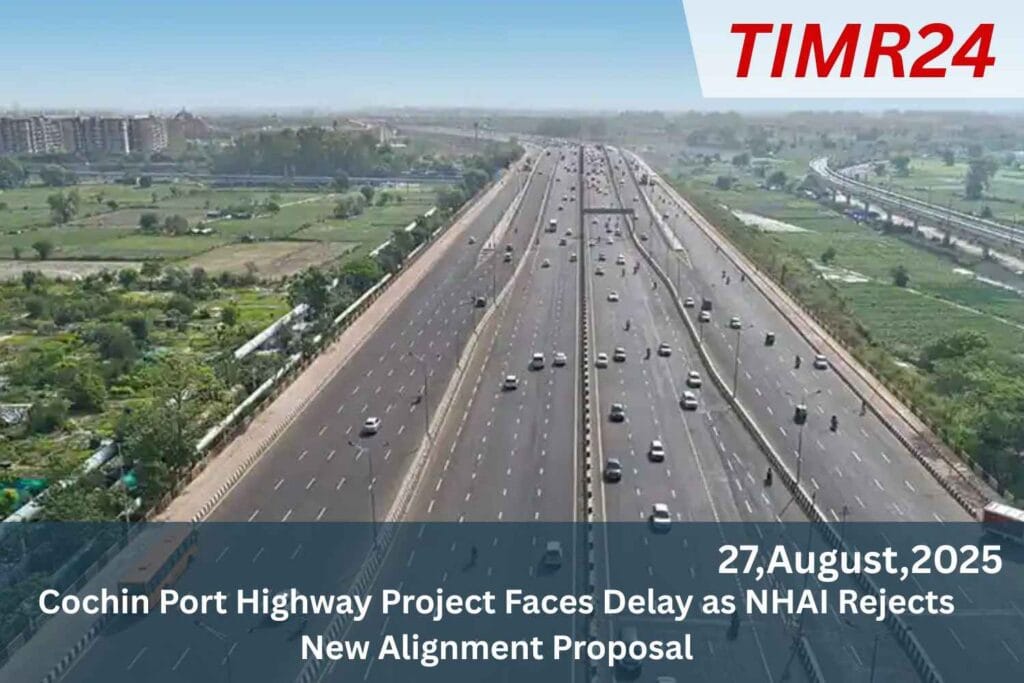
The National Highways Authority of India (NHAI) has deemed the proposed 45-m wide NH 966-B port connectivity highway from Nettoor to CIFT Junction in Willingdon Island technically unfeasible. The revised proposal, proposed by the Cochin Port Authority, would cross Vembanad Lake, pass through Thevara Ferry, and then move towards Nettoor. The project aims to bypass traffic bottlenecks. The development of major highway connectivity in Kerala has always been a subject of close public attention, especially when it concerns the port infrastructure that fuels both trade and industrial growth in the region. The Cochin Port (Road Highways) considered a crucial link for enhancing cargo movement between the Cochin and the National Highway network, has recently hit a roadblock
After the National Highways Authority of India (NHAI) rejected the proposed new alignment plan. This setback has sparked concerns among stakeholders, from exporters to logistics companies, as the delay is expected to impact both the economic momentum of Kerala and its role in India’s maritime trade expansion strategy. The Cochin has always been a pivotal hub for Kerala’s trade activities. With its strategic location on the Arabian Sea and deep-water capacity, the port handles a significant volume of India’s container traffic. To maximize its potential, a dedicated highway connectivity project was envisioned, linking the port directly to the arterial national highways while easing congestion in the urban pockets of Kochi.
This proposal was not only expected to reduce logistics costs but also to integrate seamlessly with the National Infrastructure Pipeline (NIP) that focuses on improving transport corridors. According to reports, the NHAI rejected the fresh alignment proposal citing concerns related to land acquisition complexities, higher costs, and the impact on environmentally sensitive zones. The agency pointed out that the earlier alignment, though challenging, offered a more balanced approach in terms of feasibility and long-term sustainability. For infrastructure projects of this scale, land acquisition remains one of the most contentious hurdles, as seen earlier in Kerala’s NH66 six-laning project and other regional initiatives. The Cochin Highway Project is no exception, and the rejection underscores
Economic Implications of the Delay
The pressing need for a practical middle ground that balances development with ecological and social considerations. Every delay in highway infrastructure has a ripple effect on the economy. For the Cochin, which competes with other western coast ports such as Mangalore Port and JNPT Mumbai, efficient hinterland connectivity is critical to attract larger shipping lines and exporters. The delay may shift traffic towards competing ports that already enjoy better last-mile connectivity. Exporters dealing in seafood, spices, and industrial goods have voiced concerns that the lack of seamless road infrastructure could affect delivery timelines and raise logistics costs. This scenario is not isolated; similar challenges were witnessed in the Vizhinjam Port project where connectivity delays hampered early-stage cargo movement.
While the rejection of the new alignment has caused temporary uncertainty, both the Kerala state government and the Union Ministry of Road Transport and Highways are expected to revisit the project framework. Officials have hinted that alternative alignments or modifications to the original plan could be evaluated. In this context, lessons can be drawn from the Delhi-Mumbai Expressway, where multiple rounds of alignment changes were considered before arriving at a balanced solution. The Kerala government is likely to push for a solution that addresses both local concerns and the national objective of boosting port-led development under the Sagarmala Programme.
Like most large infrastructure ventures in Kerala, the Cochin Port Highway Project faces resistance from local communities and environmental activists. The rejected alignment reportedly cut through residential and ecologically sensitive zones, raising fears of displacement and biodiversity loss. Such resistance has also been visible in projects like the Silverline semi-high-speed rail, where public protests significantly slowed progress. Balancing community welfare and infrastructure requirements remains one of the toughest challenges for planners in the state.
Despite the setback, the project is unlikely to be shelved altogether, given its strategic importance. Experts suggest that a stakeholder consultation approach could help in identifying a compromise alignment. The state government may also explore the possibility of integrating the highway project with upcoming urban infrastructure developments around Smart City Kochi and the Villupuram Container Terminal. By aligning the project goals with broader urban development plans, the government can create a more sustainable and acceptable blueprint.
Conclusion
The rejection of the new alignment proposal for the Cochin Port Highway Project highlights the complexities of executing large-scale infrastructure in a densely populated and environmentally sensitive state like Kerala. While delays are inevitable in such projects, the key lies in ensuring that decisions balance feasibility, economic growth, and community interests. As stakeholders await the next move from (NHAI) and the Kerala government, the project remains a critical test case for India’s commitment to improving its connectivity under ambitious schemes like Sagarmala. Much like the Kochi Metro expansion and other ongoing transport initiatives, its eventual success will depend on transparent planning, public consensus, and a long-term vision that prioritizes both growth and sustainability.
Q1. Why has the Cochin Highway Project been delayed?
The delay occurred because NHAI rejected the new alignment proposal due to land acquisition and environmental concerns.
Q2. What is the purpose of the Cochin Highway Project?
It aims to improve port connectivity, reduce congestion in Kochi, and strengthen Kerala’s trade infrastructure.
Q3. How will the delay affect Kerala’s economy?
The delay could slow down logistics, raise project costs, and affect industries dependent on timely cargo movement.
Q4. What are the main challenges in the project?
Land acquisition disputes, environmental clearance, and cost escalations are the key hurdles.
Q5. When is the project expected to resume?
Discussions are ongoing, but a clear timeline depends on alignment approval and resolution of land issues.