



















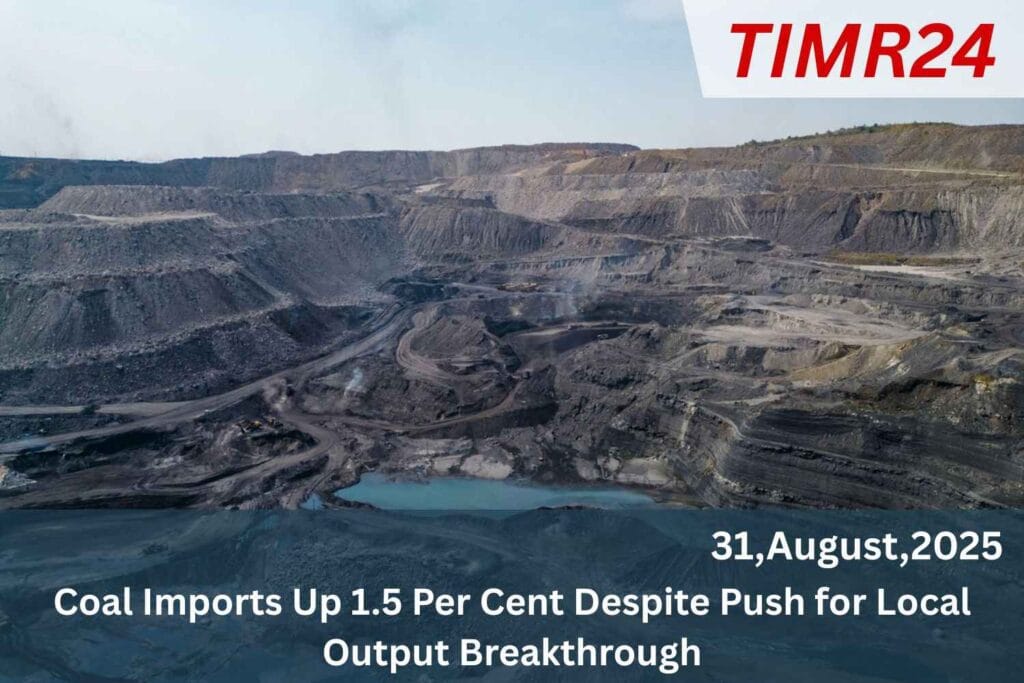
India’s coal imports increased by 1.5% YoY to 76.40 million tonnes in the April-June quarter of FY26, despite the government’s efforts to boost domestic coal output and reduce import dependency. In June 2025, imports totalled 23.91 MT, up from 22.97 MT in June 2024. Coal India Ltd (CIL), which accounts for over 80% of India’s coal production, reported an 8.5% decline in output for June 2025 due to seasonal disruptions during the monsoon. Despite these challenges, Coal Minister G Kishan Reddy assured no coal shortage during the monsoon, highlighting the government’s commitment to sustainable growth and enhanced domestic coal availability.
India’s energy sector is once again under the spotlight as coal imports recorded a 1.5 per cent increase this year, despite the government’s ongoing efforts to strengthen domestic coal production and reduce dependence on foreign supply. This rise may look marginal in numbers, but it carries significant implications for energy security, industrial growth, and the broader economic roadmap. Coal has long been the backbone of India’s power generation, accounting for more than 70 per cent of electricity supply, and remains critical for industries like steel, cement, and heavy manufacturing. While reforms and policies have been directed toward expanding local production, the fact that imports have edged up indicates a structural gap between demand and domestic capacity.
The State of Domestic Coal Production
Understanding this balance is vital to grasping India’s complex energy transition India has made notable progress in boosting local coal output. Over the last few years, state-run enterprises such as (Coal) and Signarama Collieries have expanded production through technological upgrades, better mining efficiency, and new block allocations. The Ministry of Coal has emphasized auction reforms and opened opportunities for private players to engage in commercial mining. The government’s initiatives under have also been directed at enhancing self-reliance, and several coal-rich states have increased exploration activities. Despite these positive strides, logistical challenges, infrastructure bottlenecks, and transport inefficiencies.
Continue to restrict coal availability in power plants across different regions. This means that even when production levels improve, last-mile delivery constraints prevent industries from relying solely on domestic supply, leaving space for imports The 1.5 per cent rise in imports can be explained by a mix of industrial and technical needs. India’s power plants and industries demand specific grades of coal, particularly high-calorific value thermal coal and coking coal used in steel production, which are not available in sufficient quality or quantity domestically. The cement sector, too, often blends imported coal to meet operational standards. Another factor is demand seasonality.
During the summer months when electricity consumption peaks, the gap between supply and demand widens, making it necessary to turn to foreign suppliers. In some cases, global prices have been favourable, encouraging companies to import rather than depend entirely on local mines. Thus, imports are not merely a matter of insufficient domestic production, but of the complex requirements of India’s growing industries Sectors such as power, steel, and cement are the primary drivers of coal imports. Thermal power stations, which contribute a major share of India’s electricity, often mix domestic coal with imported coal to maintain energy efficiency and reduce emissions. The steel industry is heavily reliant on coking coal, which India produces in very limited amounts.
Industrial Dependence and Energy Needs
forcing companies to import from countries like Australia, Indonesia, and South Africa. Cement production also demands a mix of different coal types to sustain kilns and ensure product quality. These sectoral dependencies demonstrate why coal imports remain essential, even when domestic supply expands. For a closer look at how these industries are evolving, you can explore our analysis of The government recognizes that import dependence poses a challenge to India’s economic resilience. The Ministry of Coal has therefore taken multiple steps to accelerate local production, including streamlining environmental clearances, fast-tracking block auctions, and encouraging private sector investment. Strategic reserves are being built to reduce supply
Shocks, and new railway corridors are under construction to ease coal transportation from mines to power plants At the same time, policy focus is also shifting toward cleaner energy solutions, as India works to align its growth ambitions with global climate goals. More details on these initiatives can be found through the (Ministry of Coal) and related India’s long-term vision includes achieving net-zero carbon emissions by 2070, which means gradually reducing dependence on coal while scaling up renewable energy sources. Solar, wind, and hydropower are growing rapidly and contributing an increasing share to the national grid. Yet, given the scale of India’s energy demand, coal continues to provide critical base-load power that renewables alone cannot currently match.
Economic and Trade Implications
Policymakers therefore face the dual challenge of ensuring reliable energy supply through coal while investing heavily in renewables to prepare for a sustainable future. For readers interested in this broader transition, you may refer to our detailed guide Coal imports are not just about energy, they are also deeply tied to international trade and economic policy. Global price volatility, freight charges, and geopolitical factors influence the cost and availability of imported coal. For instance, fluctuations in Indonesian coal exports or shipping disruptions in global trade routes directly impact India’s energy balance. This adds to the importance of building a secure and diversified energy portfolio. At the same time, imports also put pressure on India’s foreign exchange reserves.
Making self-reliance in coal and renewable energy even more urgent. For global trade perspective Energy Agency offers valuable insights into shifting energy markets The 1.5 per cent rise in coal imports, though small in percentage terms, underscores the structural challenges India faces in aligning its domestic production with industrial demand. The government’s strategy will likely continue to focus on scaling domestic coal output, improving logistics, and diversifying energy sources. However, industries will still depend on imports for certain grades of coal in the near future. The transition toward renewables is expected to reduce this dependence over time, but coal will remain an unavoidable part of India’s energy mix for at least the next two decades.
The path forward lies in balancing self-sufficiency with international partnerships while ensuring that sustainability goals are not compromised. Coal imports rising by 1.5 per cent despite a major push for local output reflects the reality of India’s energy ecosystem. Domestic reforms are driving production upward, but industrial demand, especially for specific coal grades, continues to fuel imports. This interplay of domestic progress and global dependence highlights both challenges and opportunities for India’s future. To secure its energy future, India must not only expand local coal output but also invest aggressively in renewables, strengthen supply chains, and maintain strategic reserves. As the country moves toward its 2070 net-zero goal.
Q1. Why did coal imports rise despite increased domestic production?
Because of demand for specific coal grades and rising power needs.
Q2. Which sectors rely most on imported coal?
Power, steel, cement, and heavy industries.
Q3. How is the government addressing coal import dependency?
By boosting mining capacity, renewable integration, and logistics upgrades.
Q4. Will coal imports keep rising in 2025?
Imports may stabilize if local output matches industry demand.
Q5. How does coal import impact India’s energy security?
It increases costs and dependency on global markets.