


















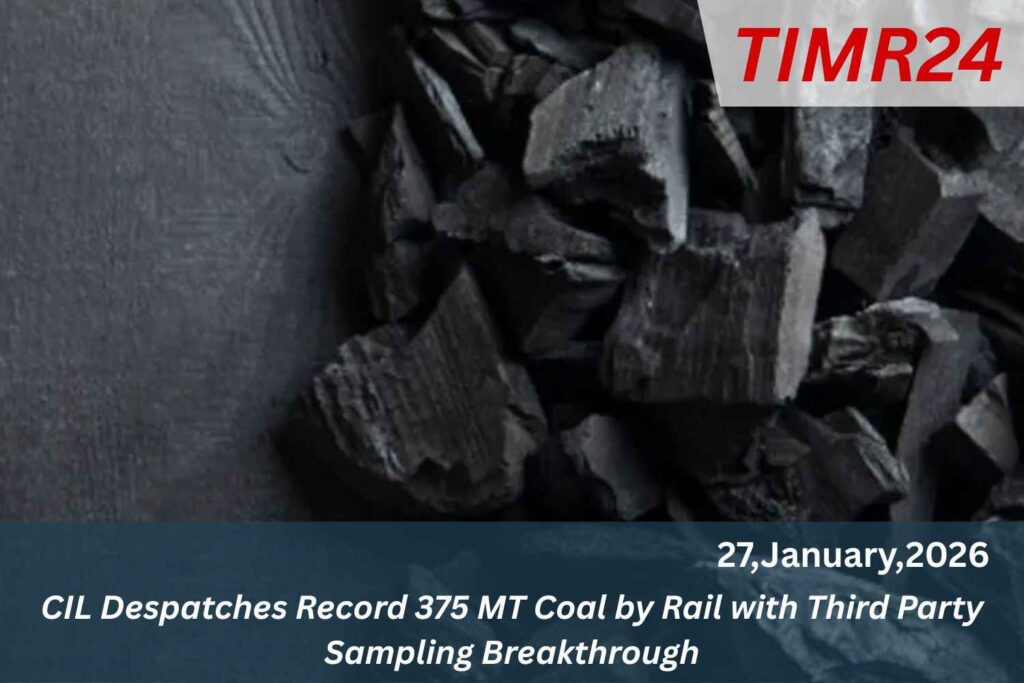
State-owned Coal India (CIL) has dispatched approximately 375 million tonnes (MT) of coal via rail, the highest in its history, with independent third-party sampling (TPSA) until December of the current financial year. This milestone reflects CIL’s focus on quality assurance and transparency amid rising domestic coal demand. Half of the coal was loaded through automated mechanical samplers at silos, with plans to increase this to 80% this fiscal year through enhanced infrastructure and connectivity projects. CIL is also implementing online coal quality analysis to improve real-time monitoring and transparency. The company currently accounts for over 80% of India’s domestic coal production Coal India Limited has once again demonstrated its central role in India’s energy.
Third Party Sampling To Ensure
Security by achieving a historic milestone of despatching 375 million tonnes of coal by rail in a single financial year, supported by the introduction of third party sampling to ensure transparency and quality assurance. This achievement reflects not only the operational strength of the country’s largest coal producer but also the growing integration between mining operations, railway logistics, and power sector demand. At a time when electricity consumption in India is rising steadily due to industrial growth, urbanisation, and digital expansion, the ability of CIL to maintain uninterrupted coal supply becomes a strategic necessity for the nation’s economic stability The scale of this record despatch highlights how coal transportation has evolved from a conventional movement process.
Into a highly coordinated logistics system involving multiple stakeholders. Indian Railways plays a crucial role in this transformation by providing dedicated rakes, improved scheduling, and faster turnaround times. Over the last few years, investments in railway infrastructure such as dedicated freight corridors, mechanised loading systems, and digital freight monitoring have significantly reduced transit delays. These improvements have directly contributed to CIL’s capacity to move larger volumes efficiently, ensuring that power plants and industrial consumers receive coal on time. You can read more about India’s freight modernisation in our internal report on railway freight corridors A defining feature of this record despatch is the implementation of third party sampling.
Scientific Sampling And Testing
Which has introduced a new level of credibility to coal quality assessment. Traditionally, disputes between coal suppliers and consumers often arose over grade slippage, moisture content, and calorific value. With independent agencies now conducting scientific sampling and testing at loading points, the scope for disagreement has reduced substantially. This system protects both producers and buyers by ensuring that billing is based on verified quality parameters. The move aligns with global best practices in mining governance and reflects the government’s push for transparency in public sector operations. Detailed policy updates related to mining reforms can be explored in our internal analysis on coal mining reforms in India From the perspective of the power sector.
This record coal movement comes at a critical time. India’s peak electricity demand continues to break new records each year, driven by expanding manufacturing, infrastructure development, and household electrification. Thermal power plants remain the backbone of base-load generation, and their performance is directly linked to fuel availability. Any disruption in coal supply can quickly translate into power shortages, affecting industries and households alike. By ensuring consistent rail despatch, CIL has strengthened the reliability of thermal power generation, supporting grid stability across multiple states. Our detailed coverage on Indian power sector growth explains how fuel security underpins long-term energy planning Beyond power generation, industries such as steel.
Industrial Consumers To Customise
Cement, aluminium, and fertilisers also depend heavily on coal as a primary input. The steady movement of coal by rail helps maintain production cycles, stabilise input costs, and improve supply chain predictability. In recent years, CIL has worked closely with large industrial consumers to customise rake movement plans and reduce idle inventory. This collaborative approach has improved overall logistics efficiency and reduced congestion at loading and unloading points. Such coordination demonstrates how public sector enterprises can adopt market-oriented practices while fulfilling national objectives The role of technology in achieving this milestone cannot be overlooked. Digital tracking of rakes, GPS-enabled monitoring, and integrated command centres have transformed how coal despatch is managed.
Real-time data allows planners to anticipate bottlenecks, reroute shipments, and respond quickly to disruptions caused by weather or infrastructure issues. The adoption of automated loading systems (India) at major sidings has further reduced manual errors and improved loading accuracy. These operational improvements form part of a broader digital transformation agenda across India’s mining and transport sectors, which you can explore in our energy infrastructure India section Environmental considerations are also increasingly shaping coal logistics. While coal remains essential in the medium term, CIL has taken steps to reduce its environmental footprint through better dust suppression systems, covered wagons, and improved mine reclamation practices. Efficient rail transport itself is more environmentally.
Towards Cleaner Energy Transitions
Friendly than road-based movement, as it reduces fuel consumption and emissions per tonne-kilometre. The integration of sustainability into large-scale logistics operations reflects India’s balanced approach of meeting development needs while progressing towards cleaner energy transitions. Global perspectives on energy transitions can be reviewed through institutions like the International Energy Agency From a policy standpoint, this record despatch aligns with the government’s broader objective of strengthening domestic energy self-reliance. Reducing dependence on imported coal saves valuable foreign exchange and shields the economy from volatile international prices. At the same time, quality assurance through third party sampling improves investor.
Confidence and reinforces India’s reputation as a reliable energy supplier. Official policy directions and sectoral updates are regularly published by the Ministry of Coal and the Ministry of Power, which remain key reference points for industry stakeholders CIL’s focus is expected to remain on expanding mechanisation, improving mine-to-port connectivity, and further integrating digital quality management systems. As renewable energy capacity grows, coal’s role will gradually shift towards providing balancing power and industrial fuel rather than dominating electricity generation. In this transition phase, efficient and transparent coal logistics will remain crucial. The success of the 375 MT despatch demonstrates that with the right combination of infrastructure, governance, and technology.
Third Party Sampling
Large public sector operations can achieve world-class performance standards the record despatch of 375 million tonnes of coal by rail, supported by third party sampling, is more than just a numerical achievement. It represents a mature logistics ecosystem, improved governance, and a strategic commitment to national (India) energy security. By strengthening coordination between mines, railways, power plants, and quality agencies, CIL has set a benchmark for operational excellence. This milestone not only supports India’s present energy needs but also lays the foundation for a smoother transition towards a diversified and sustainable energy future.
Q1. What is the record achieved by CIL?
CIL despatched 375 million tonnes of coal by rail in a single year.
Q2. Why is third party sampling important?
It ensures quality, transparency, and fair billing of coal supplies.
Q3. How does rail despatch help power plants?
It ensures faster, bulk, and reliable coal movement to power stations.
Q4. Which sector benefits most from this record?
The power generation sector benefits directly from stable coal supply.
Q5. What is CIL’s future focus?
Improving logistics, digital monitoring, and quality assurance.