











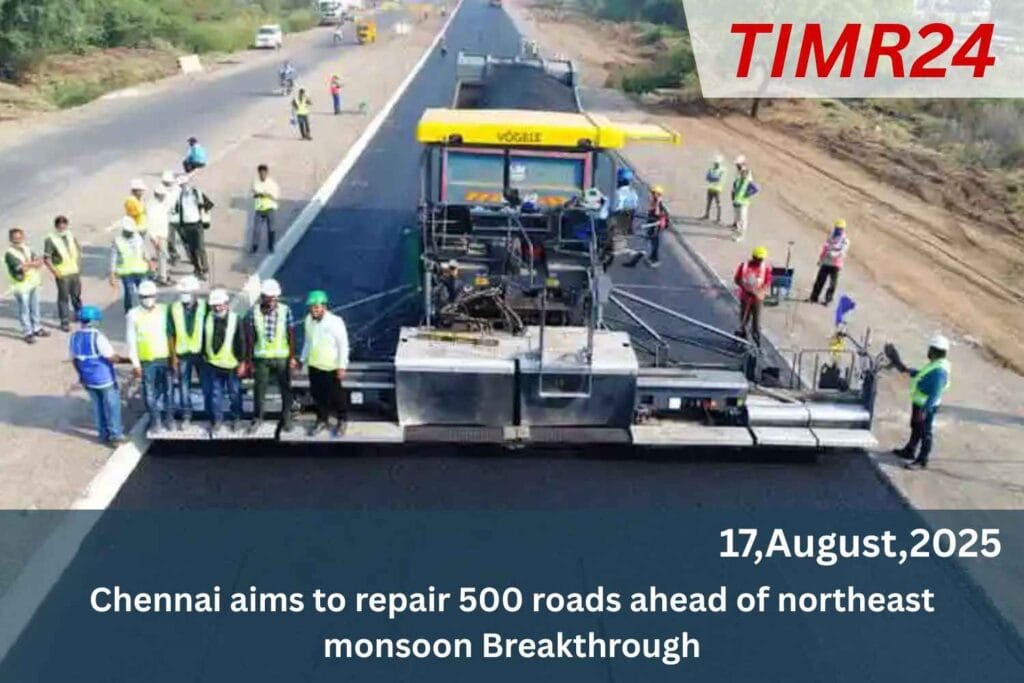
The Aims Greater Chennai Corporation is repairing 500 roads in the city before the Northeast monsoon, providing relief to residents in areas with potholes and road damage. Around 100 roads have been re-laid since September 20. The corporation is also removing abandoned vehicles and conducting patchwork. As the northeast monsoon looms, Chennai finds itself racing against time to fortify its infrastructure and protect its residents from the perils of flooding, potholes, and traffic chaos. The Greater Chennai Corporation (GCC) is steering an ambitious initiative to refurbish 500 roads across the city a mission that melds urgency with strategy to ensure smoother,
Safer urban mobility and efficient drainage. In an aggressive timeline, the corporation aims to complete these road repairs by October 10 Leveraging the remaining dry days before the monsoon arrives. Since September 20, nearly 100 stretches have already been re-laid, including critical corridors like Chowdary Nagar Main Road, Kadamban Street, Kattabomman Street in Valasaravakkam, and Wireless Cross (Road Development) in Pour This push reflects a broader synergy of civic planning, infrastructure funding, and field execution Yet, the path is strewn with challenges. Sporadic pre-monsoon rains disrupt the transportation of hot-mix asphalt, especially in core city areas where heavy.
Compounding this, residents have long decried the poor quality of road work where inconsistent milling depths and compaction techniques from different Engineers undermine durability Urban infrastructure experts have voiced concerns that these ad hoc variations jeopardize long-term resilience, urging uniform standards This drive to repair roads unfolds alongside safe-guarding civic amenities. The road-cutting ban imposed by the corporation aims to halt new disruptions caused by utility trenches, especially in zones like Teynampet, Kodambakkam, and Sholinganallur areas where restored roads could be immediately negated by further digging GCC is also orchestrating a desilting offensive,
These include desilting major arteries like the Buckingham Canal, Coolum, and Adyar, clearing suburban encroachments, and reinforcing. However, repairing roads is only part of the puzzle. Flooding remains a persistent threat due to incomplete or clog-prone stormwater drains (SWDs), particularly in newly expanded areas such as Perugia and Sholinganallur. To mitigate this, GCC is deploying 500 tractor-mounted pumps an interim but vital measure available from mid-September to mid-January at a cost of ₹32 crore. These pumps will offer rapid drainage capacity in zones struggling with water stagnation due to ongoing metro or flyover works The situation reflects wider infrastructural gaps.
Since 2021, despite a considerable allocation of ₹2,221 crore and ₹1,692 crore spent on road projects, over 900 roads. (Chennai Corporation) aligned with the Water Resources Department (WRD)‘s ₹38 crore flood-prevention projects. vehicles face restrictions during the day, and unrelenting showers at night further stall progress.
Remain unaddressed many in North Chennai or newly added wards. Delays often stem from overlapping utility Works by agencies like Metro water or Metrorail that prevent the relaying of roads. GCC officials estimate that ongoing works worth another ₹486 crore are set for completion by August 2025 yet residents lament that funds are underutilized and planning remains weak. Further compounding frustration, interior stretches particularly in localities like Madhavaram—remain mud-ridden and impassable during rains. Residents report decades of neglect, citing missing roads, absent sewage systems, and lack of basic infrastructure. Ambitious solutions like twin stormwater drains have been proposed but await approval, while jurisdictional confusion with the State.
Highways Department delays road laying In light of these challenges, local stakeholders advocate for GCC’s Such as the 20-km stretch between Kathipara and Moolakadai. Currently under the state highways department, these roads suffer from neglect, absent stormwater drainage, and prolonged disruptions from utility digs. Constituents argue that GCC’s more responsive approach in interior zones demonstrates their capability to manage these corridors better This integrated narrative underscores how Chennai’s road-repair campaign blends reactive measures—like road relaying and pump deployment with longer-term strategies such as drain desilting, jurisdictional reforms, and coordinated planning. The collaboration between GCC, WRD, and local authorities,
combined with resident advocacy, forms the backbone of the city’s resilience strategy in the face.
Q1. Why is Chennai repairing 500 roads before the monsoon?
To prevent flooding, improve drainage, and ensure smoother traffic flow.
Q2. When will the road repair works be completed?
The repairs are targeted to be completed before the northeast monsoon begins.
Q3. Which areas of Chennai are prioritized for road repairs?
Flood-prone and high-traffic zones are given priority.
Q4. How will the road repairs benefit residents?
They will reduce waterlogging, improve safety, and enhance daily commutes.
Q5. Who is overseeing the Chennai road repair project?
The Greater Chennai Corporation is managing and monitoring the works.