
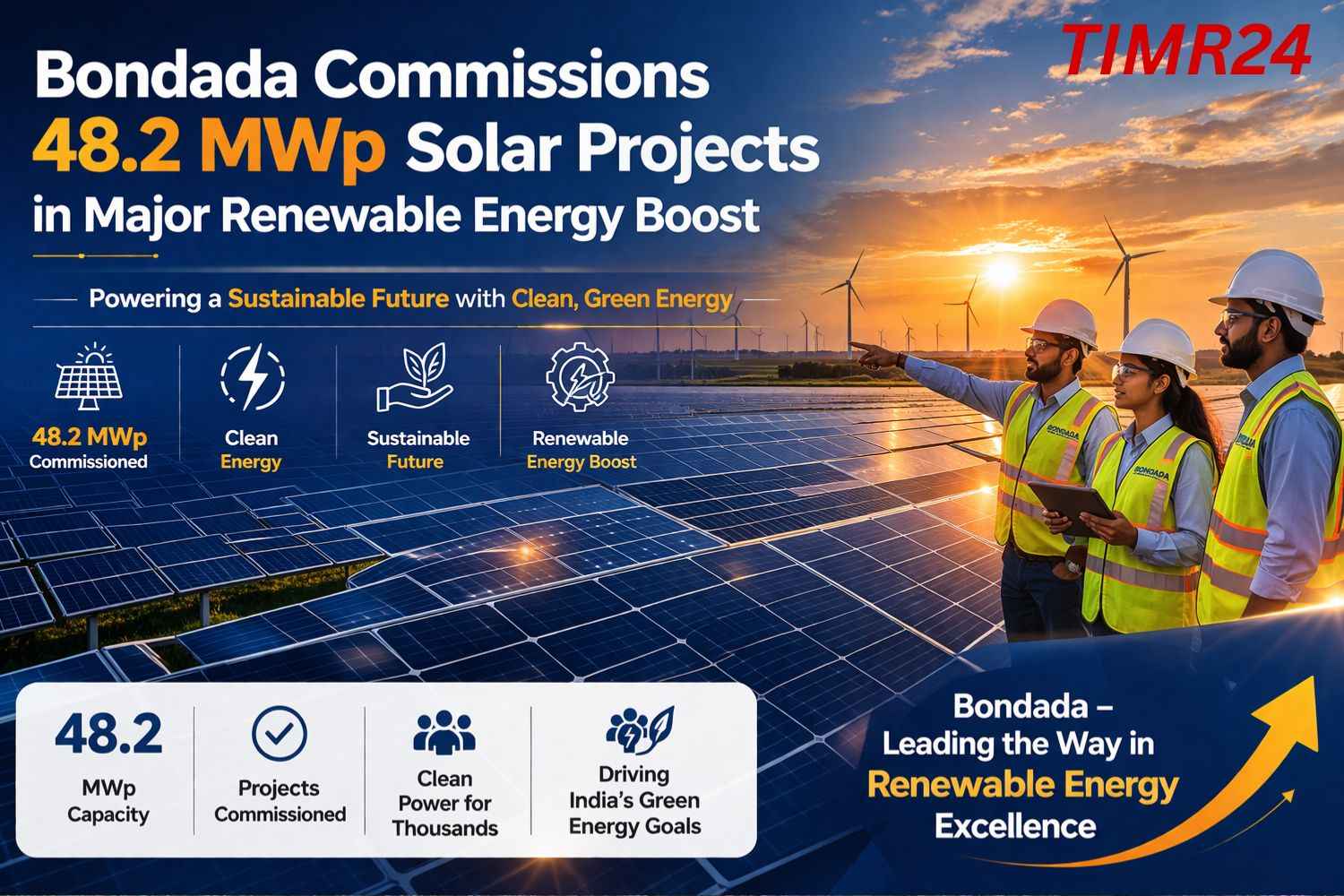













Power utility CESC Ltd announced that its subsidiary, Purvah Green Power Pvt Ltd, received a Letter of Award from the Solar Energy Corporation of India to develop a 300 MW solar power project with an energy storage system. The LoA, issued on 27 October, recognizes Purvah Green Power’s acceptance. This project is part of SECI’s initiative to establish 2,000 MW of solar PV projects and 1,000 MW/4,000 MWh of energy storage capacity to improve India’s renewable energy infrastructure and grid stability The renewable energy sector in India has reached a new milestone with the announcement that the renewable arm of CESC Limited has secured a major tender from.
The Solar Energy Corporation of India (SECI) for a 300 MW solar-plus-storage project. This win positions CESC as one of the leading private players driving India’s transition toward sustainable and reliable power generation. The project is part of SECI’s continuous effort to accelerate the deployment of renewable energy with integrated storage systems, an essential step toward ensuring round-the-clock clean power availability for industrial and domestic users across the country This project win by CESC highlights the evolution of India’s energy sector where traditional utilities are now transforming into clean energy leaders. The 300 MW capacity will be backed by an.
Advanced Battery Energy Storage System (BESS) that will allow energy storage during sunlight hours and its release during peak demand periods or low generation intervals. Such innovations have become critical in India’s energy roadmap as the country pursues its target of achieving 500 GW of renewable energy capacity by 2030. The project is expected to play a pivotal role in stabilizing the grid, reducing dependency on fossil fuels, and strengthening India’s commitment to clean energy transition under the National Solar Mission The Solar Energy Corporation of India, a nodal agency under the Ministry of New and Renewable Energy (MNRE), has been central to shaping India’s solar revolution.
Through competitive bidding and transparent project allocation, SECI has fostered trust and efficiency within the renewable market. The inclusion of storage elements in this bid signifies a paradigm shift where the focus is not only on capacity addition but also on ensuring grid reliability and energy security. For CESC, a company that has historically operated in the distribution and conventional generation space, this win marks a new era of transformation and innovation. The renewable subsidiary of the RP-Sanjiv Goenka Group is expanding aggressively into clean energy, showing strategic intent to diversify beyond traditional power generation methods and become a strong contributor to India’s.
Green infrastructure ecosystem This success aligns closely with the growing emphasis on where hybrid projects those combining solar, wind, and storage are becoming increasingly common. As renewable integration deepens, storage solutions will define the next frontier of energy stability. To understand the broader impact of such developments, it’s important to consider the nation’s focus on how large-scale investments and policy support are transforming the renewable sector landscape The SECI tender reflects how the Indian government.
Continues to build a favorable environment for private sector participation. SECI’s model of transparent auctions and clear project structuring has made it possible for developers like CESC to participate in large-scale, commercially viable renewable projects. Through these auctions, SECI encourages innovation and the integration of advanced technologies such as BESS, which are vital for managing intermittency in solar power generation. These technologies contribute to that combine digitalization, automation, and clean energy technologies to make India’s cities and industries more energy-efficient and sustainable.
Q1. What is the capacity of CESC’s new project?
The project has a capacity of 300 MW solar power with energy storage, awarded by SECI.
Q2. Why is this project significant for India’s energy transition?
It combines solar power and storage, helping stabilize the grid and enabling 24×7 renewable supply.
Q3. Who conducted the tender for this project?
The tender was conducted by Solar Energy Corporation of India (SECI) under the Ministry of New & Renewable Energy.
Q4. When will the project be operational?
The commissioning is expected within 24 to 30 months from the award date.
Q5. How does this project contribute to sustainability?
It reduces carbon emissions, boosts renewable capacity, and supports India’s net-zero commitment.