









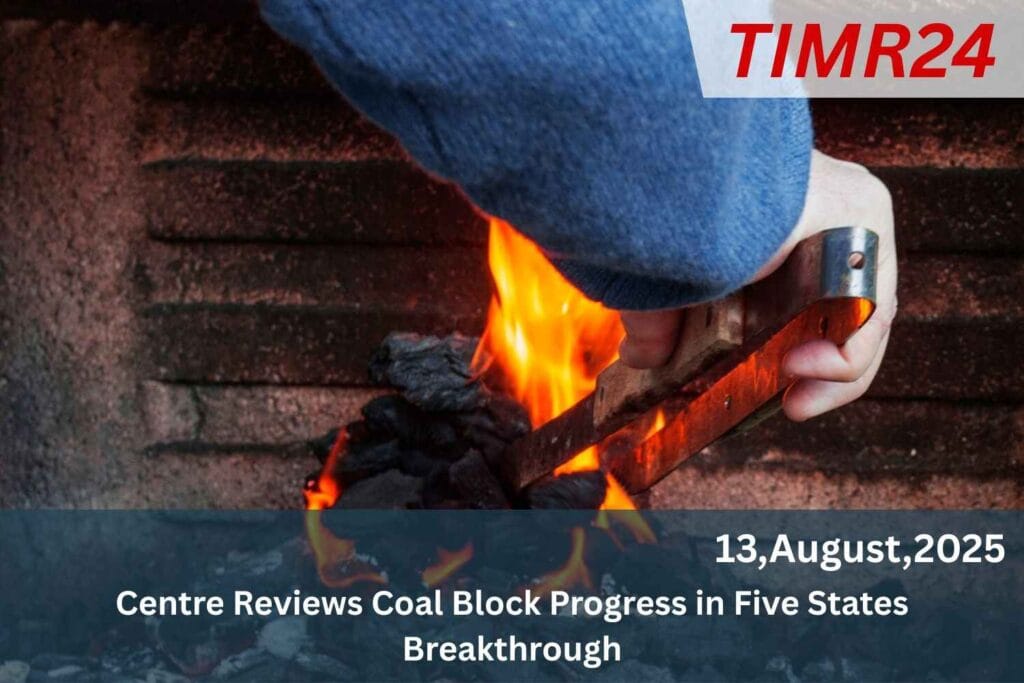
The Ministry of Coal held a review meeting to assess the status of coal blocks in Madhya Pradesh, Assam, Arunachal Pradesh, Telangana, and Gujarat. The meeting involved block allottees, Central Government officials, and state representatives. The review found that 33 blocks were operational in Madhya Pradesh, with nine currently producing. The Ministry called for expedited operationalisation of the remaining 25 blocks to enhance domestic supply and meet rising energy demand. The Government of India has intensified its monitoring of block development in five key states Chhattisgarh,
Odisha, Jharkhand, Madhya Pradesh, and Maharashtra. This review aims to ensure that coal production targets are met, project delays are addressed, and the country’s energy security remains strong. remains the backbone of India’s energy mix, contributing to over 70% of power generation. Delays in coal block operations directly impact electricity supply, forcing India to rely on costly imports. By reviewing progress, the Centre aims to fast-track production and ensure uninterrupted power to industries and households. The five states Chhattisgarh, Odisha, Jharkhand, Madhya Pradesh, and Maharashtra hold the majority of India’s reserves. These regions are home to both public and private sector coal blocks, making them crucial for meeting national demand. (Coal)
- Chhattisgarh & Odisha: Rich in high-quality thermal coal.
- Jharkhand: A long-time mining hub with established infrastructure.
- Madhya Pradesh & Maharashtra: Emerging production states with growing investment.
3. Challenges Hindering Coal Block Development
While India has abundant coal reserves, several roadblocks slow down production:
- Land Acquisition Delays — Disputes over compensation and land rights.
- Environmental Clearances — Lengthy approval processes impacting timelines.
- Infrastructure Gaps — Poor road and rail connectivity for transportation.
- Local Opposition — Concerns over displacement and ecological impact.
4. Government Initiatives to Speed Up Projects
To tackle these issues, the Centre has launched a mix of policy reforms and operational measures:
- Simplified Approval Processes — Faster environmental and forest clearances.
- Public-Private Collaboration — Encouraging private investment in mining.
- Technology Integration — Use of drones and digital monitoring for project tracking.
- State-Level Task Forces — Ensuring quick dispute resolution.
5. Impact on India’s Energy and Economy
Faster block development has multiple benefits:
- Energy Stability — Reduced dependence on imports.
- Job Creation — Direct and indirect employment in mining areas.
- Industrial Growth — Affordable and steady fuel supply for manufacturing.
- Revenue Boost — Increased royalty and tax collection for states.
- The Centre’s review signals a strong commitment to meeting India’s growing energy needs. With rising demand for electricity, will remain a critical resource in the near future, even as the country expands its renewable energy capacity. Ensuring timely execution of coal block projects will be key to balancing economic growth and environmental responsibility. (India’s Energy).
The Government of India has intensified its monitoring of coal block projects in Chhattisgarh, Odisha, Jharkhand, Madhya Pradesh, and Maharashtra states that collectively account for a major share of the country’s coal reserves. The Ministry of recently convened high-level review meetings to assess production status, resolve bottlenecks, and ensure that coal output aligns with India’s growing electricity demand. remains the backbone of India’s electricity generation, contributing over 70% of total power production. Despite ongoing investments in renewable energy, coal is expected to remain a significant part of the energy mix for at least the next two decades. Delays in coal block development risk triggering shortages, forcing higher imports that strain the economy.
Q1. Why is the Centre reviewing block progress in five states?
To monitor production, resolve delays, and ensure energy security.
Q2. Which states are involved in the block progress review?
Chhattisgarh, Odisha, Jharkhand, Madhya Pradesh, and Maharashtra.
Q3. What are the main challenges in block development?
Land acquisition issues, environmental clearances, and logistical hurdles.
Q4. How will faster production benefit India?
It reduces imports, boosts local jobs, and ensures a steady power supply.
Q5. What steps is the government taking to speed up projects?
Introducing policy reforms, technology adoption, and better state coordination.