














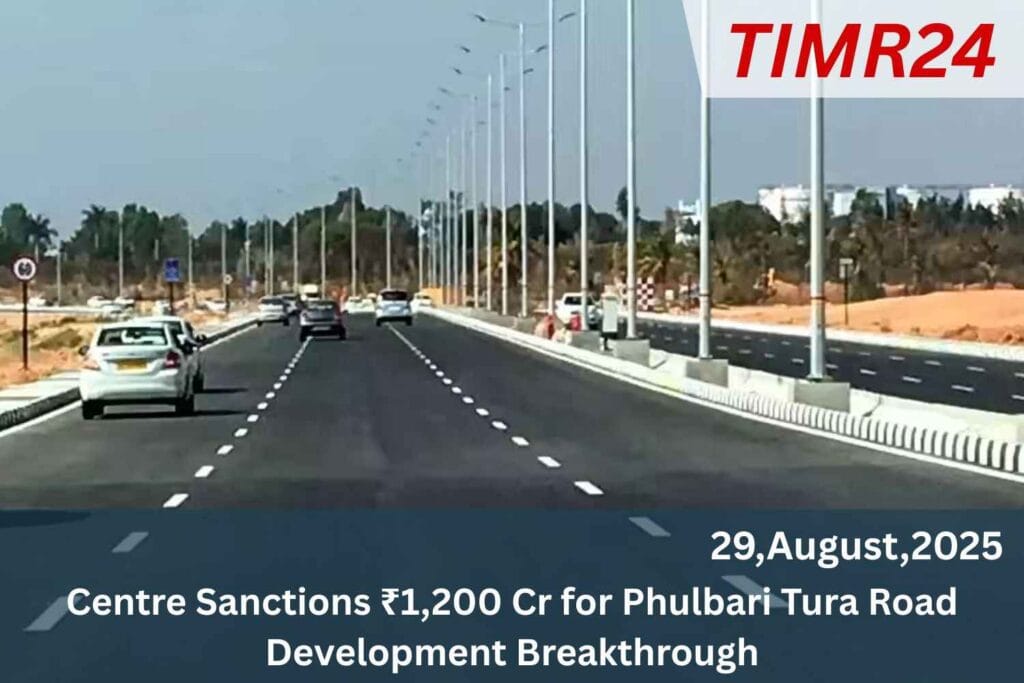
The Centre has sanctioned over ₹1,200 crore for the development of a 63 km stretch from Phulbani to Tura in West Garo Hills district, divided into two packages, with completion expected by 2027. The Government of India has taken yet another significant step toward transforming the connectivity and infrastructure of the Northeast by sanctioning an ambitious ₹1,200 crore Phulbari–Tura Road development project in Meghalaya. This initiative is being seen as a breakthrough not only in terms of road expansion but also in boosting socio-economic development, improving accessibility, and promoting cross-border trade with Bangladesh. The sanctioned project will modernize one of the most crucial.
Stretches that links the western part of Meghalaya with its regional hubs, bringing new opportunities for growth and addressing long-standing transportation bottlenecks The Phulbari–Tura corridor is considered a lifeline for thousands of residents in Garo Hills and neighbouring regions (Cabinet Approves) Currently, travel between these towns is riddled with delays due to poor road conditions, narrow pathways, and seasonal disruptions caused by monsoon rains. The newly sanctioned project promises to upgrade this route into a modern, four-lane highway with better drainage, safety measures, and wider carriageways, ensuring year-round connectivity. For Meghalaya, a state that has been battling infrastructural isolation for decades.
Such projects resonate deeply with the vision of the North East Infrastructure Development Plan. It also ties into broader initiatives like Bharatmala Pariyojana, which aims to create seamless highway networks across the country. Better road infrastructure has a direct bearing on the economy, and the Phulbari–Tura project is expected to significantly enhance trade, tourism, and local business opportunities. Farmers in rural Meghalaya often struggle to transport their produce to nearby markets due to poor road access; once this project is complete, perishable goods can reach markets faster, ensuring better prices and reducing wastage. Similarly, small businesses will gain access to larger supply chains, fuelling entrepreneurship in towns and villages.
Connectivity with Bangladesh and Regional Trade
Improved connectivity will also attract investors to sectors like agro-processing, logistics, and eco-tourism, opening up jobs for youth and reducing outmigration to metro cities. One of the most critical aspects of this project is its potential to strengthen cross-border trade between India and Bangladesh. The Phulbari region lies close to international trading points, and a high-quality road network will facilitate smoother movement of goods across the border. Given that Meghalaya already has significant trade with Bangladesh in coal, limestone, and agricultural products, this road upgrade will act as a catalyst for expanding bilateral trade ties. The project also complements India’s Act East Policy, which focuses on building stronger trade and connectivity with Southeast Asian countries through the Northeast.
Tourism is another sector poised to benefit immensely from the road development. The Garo Hills, with attractions like Nokrek National Park, Balarama, and the cultural richness of the Garo tribes, has long been a hidden gem for travellers. However, poor accessibility has restricted large-scale tourism. With the ₹1,200 crore project, the region will soon witness an influx of domestic and international tourists, similar to the positive changes seen in Shillong after road improvements. This not only boosts hospitality and transport sectors but also provides locals with new livelihood opportunities.
While infrastructure expansion brings growth, it also raises environmental concerns, especially in eco-sensitive regions like Meghalaya. Authorities have announced that the project will integrate green construction practices, advanced drainage systems, and minimal deforestation measures to ensure sustainability. The National Highways and Infrastructure Development Corporation (NHIDCL), which is expected to execute this project, has also emphasized the use of advanced materials and climate-resilient designs. This aligns with India’s larger commitment to sustainable infrastructure and the adoption of environmentally responsible engineering practices.
Government Vision for the Northeast
The sanctioning of the Phulbari–Tura road is part of a broader narrative where the Central Government has been prioritizing infrastructure growth in the Northeast. Over the last few years, mega projects like the Sambalpur Bypass, the Silchar Aizawl corridor, and railway modernization projects have underscored the government’s push for balanced development across states. For Meghalaya in particular, such projects are expected to bridge the gap with mainstream India, offering people better connectivity not just within the state but also to Guwahati, Assam, and beyond. Internal transport integration is essential for the success of schemes like Digital India and Make in India, since physical connectivity forms the backbone of economic progress.
Another key benefit of the ₹1,200 crore investment is employment generation. Road construction projects are labour-intensive and will create thousands of direct jobs during the construction phase. Beyond that, indirect employment will rise in logistics, trucking, hospitality, and service sectors. Moreover, the government has also highlighted skill development programs under initiatives like Skill India, ensuring that local youth are trained in modern construction techniques and engineering practices, making them employable in future infrastructure ventures.
Despite the enthusiasm, experts caution that road projects in the Northeast often face delays due to challenging terrain, heavy rainfall, and land acquisition hurdles. For the Phulbari Tura project to stay on schedule, strong coordination between the state and central governments will be necessary. Compensation and rehabilitation for displaced families must also be handled with sensitivity to avoid local resistance. However, with a clear roadmap, advanced technology, and stakeholder collaboration, these challenges can be mitigated effectively.
Linking with Broader Infrastructure Initiatives
This project also ties into other major infrastructure developments in the region. For example, the Epiroc R&D facility in Nashik, the Texmaco–RVNL railway partnership, and the Gainwell PROMAN collaboration on crushing and screening solutions are all part of India’s robust focus on industrial and infrastructure innovation. By linking highways with industrial hubs, the government ensures that projects like Phulbari–Tura are not isolated but instead integrated into a comprehensive economic development framework. Looking ahead, the Phulbari–Tura road project is expected to be a landmark transformation for Meghalaya and a model for other Northeastern states.
Once operational, it will reduce travel time drastically, encourage investments, and strengthen cultural and economic integration. More importantly, it sends a clear message that the government is committed to uplifting regions that were once considered geographically and economically disadvantaged the ₹1,200 crore sanction for Phulbari–Tura road development is more than just an infrastructure announcement it is a breakthrough for Meghalaya’s future. It promises faster trade, better connectivity, thriving tourism (RVNL) employment growth, and regional empowerment, all while aligning with India’s vision of inclusive and sustainable development. By ensuring careful execution and community involvement.
Q1. What is the cost of the Phulbari–Tura Road Development project?
The project is sanctioned at ₹1,200 crore by the Central Government.
Q2. How will this road project benefit Meghalaya?
It will reduce travel time, boost trade, tourism, and provide better connectivity to rural areas.
Q3. Is the Phulbari–Tura road linked to India’s Act East Policy?
Yes, the road will strengthen cross-border trade with Bangladesh under the Act East Policy.
Q4. Which towns will benefit the most from this project?
Tura, Phulbari, and nearby rural villages in the Garo Hills will benefit significantly.
Q5. When will the project be completed?
The official timeline is yet to be announced, but work is expected to start soon after approval.