












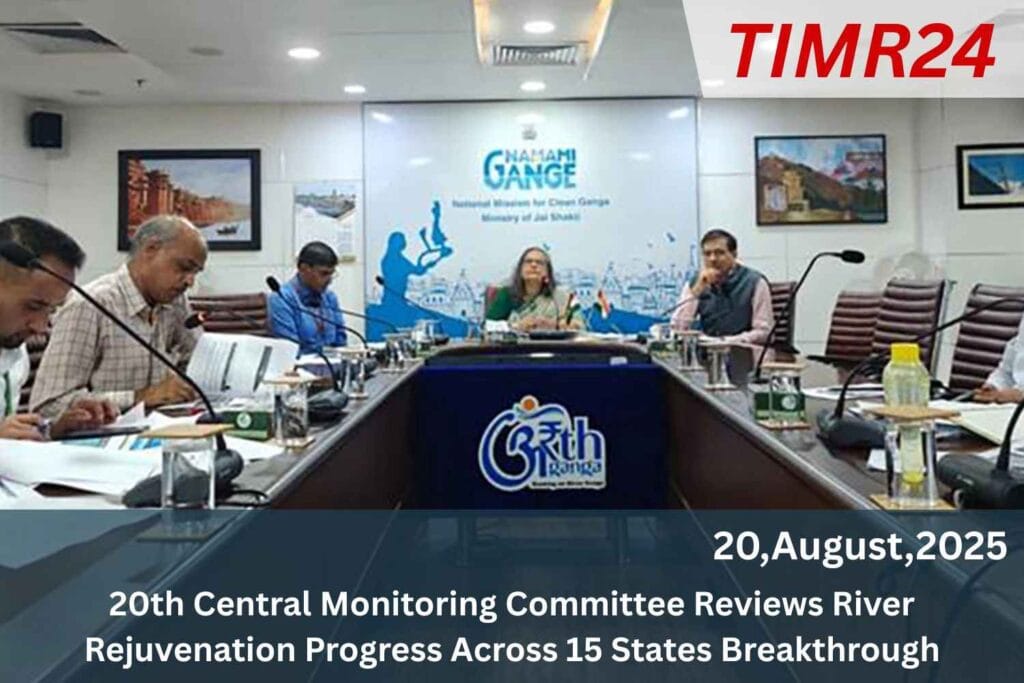
The Central Monitoring Committee (CMC) reviewed the progress of river rejuvenation initiatives across 15 states, under the chairpersonship of Smt. Debate Mukherjee. The committee highlighted the importance of advancing floodplain zones, completing sewage and solid waste management projects, enforcing compliance of sewage treatment plants, and adopting innovative measures for wastewater reuse. The committee noted encouraging trends in the reduction of polluted river stretches between 2018 and 2022, with Sikkim emerging as a state with no polluted River stretches. However, the committee also urged addressing persistent gaps in sewage treatment capacity, non-complying plants, and inadequate progress in industrial pollution management projects.
The meeting concluded with a call for collective responsibility from all participating states to work towards a pollution-free and resilient river ecosystem. The 20th meeting of the Central Monitoring Committee (CMC) marked a significant milestone in India’s continuing efforts to restore and rejuvenate its rivers, bringing together representatives from 15 states to evaluate progress under the National River Rejuvenation Programme (Cooperation) Convened under the Ministry of Jal Shakti, this high-level review created a platform for states to share their initiatives, challenges, and innovative solutions in line with the broader goals of the National River Conservation Plan (NRCP). The session underscored
The growing realization that river health is not just an ecological issue but also a cornerstone of sustainable economic growth, agriculture, drinking water security, and biodiversity preservation. Rivers in India have long been the lifeline of its civilization, yet rapid urbanization, industrialization, and unregulated waste discharge have left several stretches critically polluted. Programmes like the Namami Gange Mission have shown how concentrated efforts, when coupled with central monitoring, can transform river basins. Drawing inspiration from such initiatives, the Central Monitoring Committee is tasked with ensuring accountability and coordination among states.
This recent review focused on 15 states where rejuvenation projects are underway, assessing sewage treatment infrastructure, industrial effluent regulation, solid waste management, and biodiversity conservation measures. Each state presented updates on the progress made so far, highlighting both achievements and areas of concern. For example, states such as Uttar Pradesh and Bihar reported advancements in setting up sewage treatment plants along river stretches under the National Mission for Clean Ganga (NMCG), while Maharashtra and Karnataka showcased integrated watershed management approaches that combined soil conservation with river flow
Restoration The committee emphasized knowledge-sharing, where successful models such as in-situ bio-remediation techniques or decentralized wastewater treatment units could be adapted by other states. This cross-pollination of ideas is considered crucial for achieving measurable improvements across river systems that are as diverse as the Yamuna, Godavari, Krishna, and Mahanadi. Another important dimension of the review was the role of technology in monitoring river health. The CMC highlighted the increasing use of real-time water quality monitoring stations, GIS mapping, and satellite-based assessments to track pollution levels and encroachments.
States have been encouraged to integrate such technologies with local administrative systems to create data-driven decision-making models. These tools not only provide transparency but also enable corrective actions at an early stage. To further strengthen this approach, the committee suggested collaboration with agencies like the Central Pollution Control Board (CPCB) and academic institutions engaged in environmental research.
Policy Framework and Financial Support
The meeting also evaluated the alignment of state projects with national policies such as the National Water Policy 2012, Atal Bhujal Yojana, and AMRUT 2.0 Mission. Financial support mechanisms were discussed, with emphasis on convergence of central schemes and state budgets to ensure long-term sustainability. For instance, river rejuvenation projects are increasingly being tied with urban sewage management plans, enabling cities to reuse treated wastewater for industrial and agricultural purposes. The integration of these policies reflects a shift from fragmented interventions to holistic river basin management, where water availability, quality, and ecological balance are treated as interdependent priorities.
The review also stressed the importance of community participation, recognizing that lasting river rejuvenation cannot be achieved without local involvement. States shared examples of public awareness campaigns, eco-clubs in schools, and river festivals that foster a sense of ownership among citizens. The CMC recommended scaling up such initiatives and linking them with Swachh Bharat Mission campaigns for greater impact. Additionally, capacity building workshops for municipal officials, engineers, and river management committees were proposed to ensure technical and administrative preparedness.
Despite visible progress, the review highlighted persistent challenges such as delays in sewage infrastructure projects, insufficient enforcement of industrial compliance, and funding gaps for smaller municipalities. Climate change-induced variability in rainfall patterns also complicates river flow restoration, requiring adaptive strategies like rainwater harvesting and aquifer recharge programmes. The committee emphasized that future reviews would place greater focus on outcome-based indicators—such as improved water quality indices and biodiversity revival—rather than just infrastructure creation.
The 20th Central Monitoring Committee meeting served as a reminder that rejuvenating India’s rivers is not a short-term goal but a generational responsibility. By aligning state-level actions with national missions, leveraging technology, and promoting community engagement, India is gradually moving towards restoring the ecological balance of its river systems. With consistent monitoring and collaborative governance, the vision of cleaner, healthier rivers supporting both human and natural ecosystems is becoming increasingly achievable. Readers can explore related developments (NRCP) for further insights into the government’s long-term strategy.
Q1. What was the main focus of the 20th Central Monitoring Committee meeting?
The meeting focused on reviewing river rejuvenation progress across 15 states.
Q2. Which states were part of the review?
The review covered 15 states under the National River Rejuvenation initiative.
Q3. Why is river rejuvenation important?
It ensures clean water, ecosystem balance, and sustainable use of natural resources.
Q4. What role does the Central Monitoring Committee play?
The committee monitors progress, provides guidance, and ensures implementation of action plans.
Q5. What are the expected outcomes of these reviews?
Improved river health, better waste management, and enhanced water quality across states.