














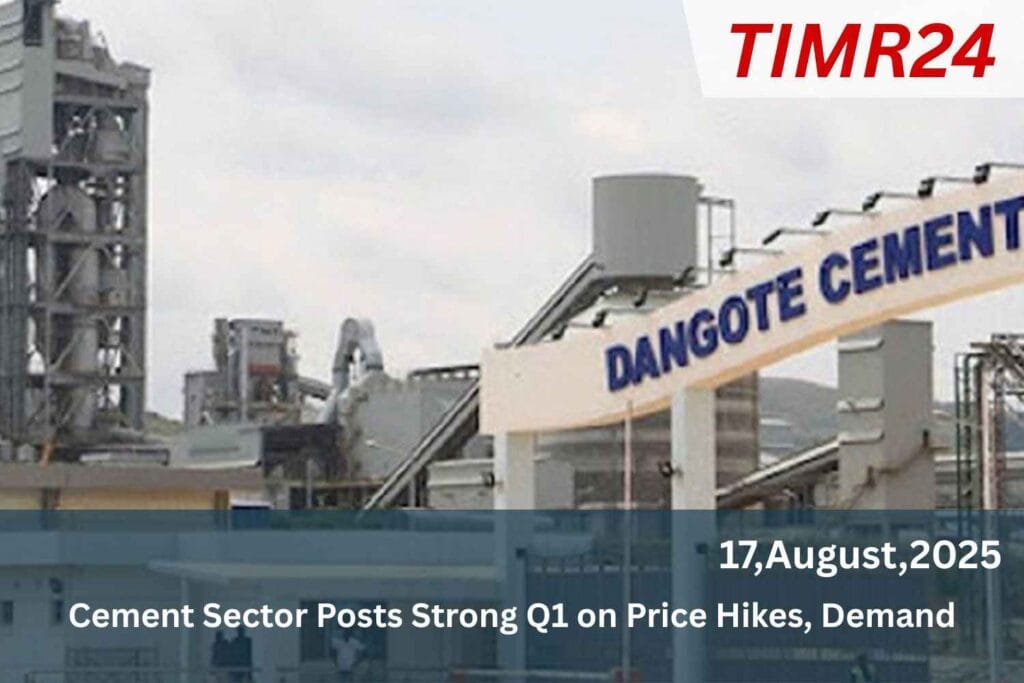
Cement companies ended the June quarter with strong performance, driven by higher realisations from price hikes and robust volume growth. Most players reported double-digit gains in volumes, aided by last year’s low base during the election period, rising commercial activity, and faster execution of government projects. Lower operating costs also lifted EBITDA per tonne sharply. Volume growth was led by Ambuja, UltraTech Cement, JK Cement, and Sagar Cements, reflecting a rebound in demand. Companies under the brokerage’s coverage saw realisations rise 6% year-on-year and 5% sequentially, largely driven by price increases in southern markets. This pushed EBITDA per tonne up 35% year-on-year and 17.8% sequentially.
The cement sector has begun the financial year on a robust note, reporting a strong Q1 performance largely driven by strategic price hikes and sustained demand across construction and infrastructure segments. Analysts observed that the sector’s resilience during this quarter was a result of multiple factors converging simultaneously. Urban infrastructure projects, including road expansions and metro constructions, continued to spur demand, while the real estate segment saw renewed activity as developers pushed forward with delayed residential and commercial projects. This combination of government-backed infrastructure initiatives and private sector construction contributed significantly to the overall uptick in cement consumption, reinforcing the industry’s optimistic outlook for the rest of the year.
Price adjustments implemented by leading cement manufacturers played a crucial role in supporting revenue growth. Despite rising costs of raw materials like clinker, limestone, and fuel, companies were able to pass on a portion of these expenses to end consumers through incremental price hikes. The increase in average selling prices mitigated margin pressures and helped maintain profitability, (Manufacturers). even amid a backdrop of fluctuating input costs. Internal linkages between cost management strategies and sales performance have become more evident, as firms adopting modern production techniques and energy-efficient practices demonstrated better resilience compared to peers with older operational models.
Regional trends also shaped the quarter’s results. Demand in tier-1 cities was bolstered by large-scale commercial developments, while tier-2 and tier-3 cities witnessed growth driven by affordable housing projects and local infrastructure investments. The geographic diversification of demand has emerged as a stabilizing factor for cement companies, enabling them to offset slower activity in certain markets with stronger performance in others. The interplay between urban construction hotspots and emerging regional markets highlights the sector’s dynamic nature, underlining how companies strategically align supply chains and logistics to meet localized requirements efficiently.
Moreover, sustainability initiatives and green cement production have begun influencing investor sentiment and consumer preferences. Several Manufacturers reported that their eco-friendly product lines gained traction in Q1, as environmentally conscious developers increasingly seek low-carbon alternatives. Internal linkages between sustainability measures and market positioning were evident, with companies leveraging green credentials to differentiate themselves and justify premium pricing. This trend aligns with the global push for greener construction practices and is likely to shape future investment and growth patterns within the cement industry.
Financial performance metrics further underscored the sector’s strong start. Revenue growth, supported by higher average selling prices, was complemented by stable operating margins and improved cash flow positions. Analysts noted that prudent cost management, along with strategic distribution and production planning, helped companies absorb input cost inflation without eroding profitability significantly. Additionally, the emphasis on efficiency, through modernization of plants and optimized logistics networks, allowed manufacturers to strengthen supply reliability and meet rising demand consistently. These internal links between operational efficiency, cost control, and market responsiveness contributed to the overall positive sentiment surrounding the sector.
Looking ahead, industry experts anticipate that demand drivers such as affordable housing, rural development schemes, and urban infrastructure projects will continue to sustain momentum. While external risks like fluctuating raw material prices, energy costs, or macroeconomic uncertainties remain, the cement sector’s ability to adapt through strategic pricing, operational enhancements, and targeted market expansions provides confidence in medium-term growth. Internal coordination across production, sales, and distribution channels will remain key to navigating potential headwinds while capitalizing on emerging opportunities.
In conclusion, the cement sector’s strong Q1 performance reflects a confluence of well-timed price adjustments, resilient demand, and operational efficiency. The synergy between urban and regional demand, sustainable production practices, and strategic cost management has enabled companies to weather market challenges effectively. As infrastructure development continues (Residential) to accelerate and private sector construction activity picks up, the cement industry is poised for sustained growth, underscoring its critical role in India’s broader economic development trajectory. Companies that continue to innovate, adopt green practices, and optimize operational linkages are likely to maintain a competitive edge, reinforcing the sector’s promising outlook for the remaining quarters.
q1. What drove the cement sector’s strong Q1 performance?
Price hikes and increased demand boosted revenue and profitability.
q2. Did cement demand rise across all regions?
Yes, both urban and rural construction demand contributed to growth.
q3. How did pricing affect Q1 results?
Strategic price increases offset rising raw material costs.
q4. Which companies led the growth in Q1?
Leading cement manufacturers reported higher sales and improved margins.
q5. Is the sector expected to sustain growth?
Analysts expect continued demand, supported by infrastructure and housing projects.