













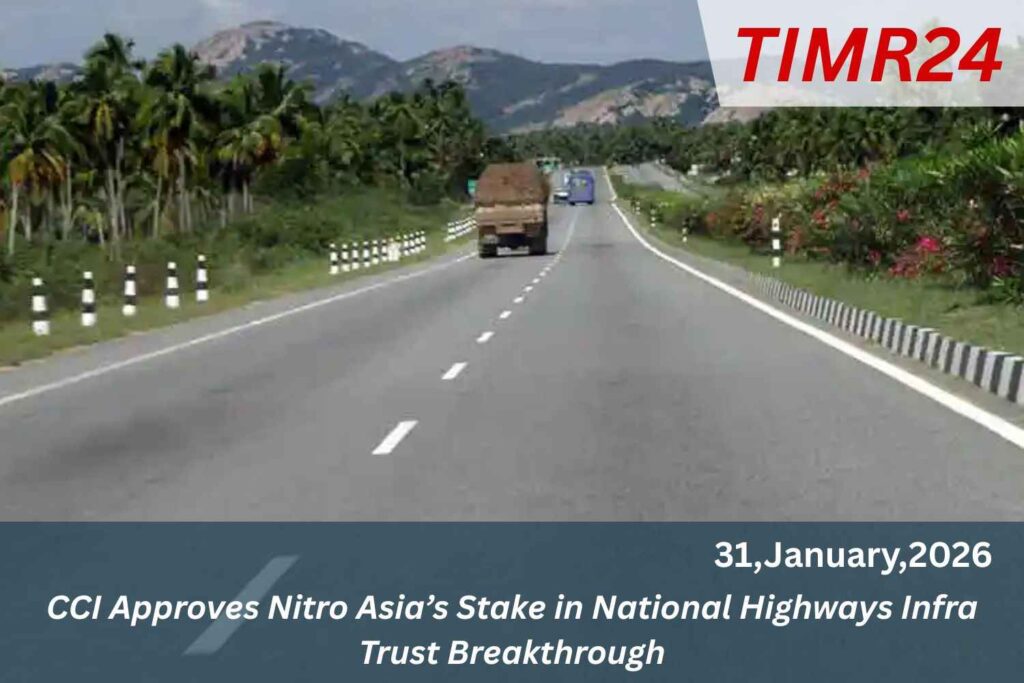
The Competition Commission of India (CCI) has approved Nitro Asia Holdings II Pte. Ltd.’s acquisition of certain units of National Highways Infra Trust through on-market deals on a registered stock exchange. Nitro Asia Holdings II, based in Singapore, is a special purpose vehicle for holding various equity and non-equity assets. National Highways Infra Trust, registered with SEBI, operates as an infrastructure investment trust (InvIT) with the objective of investing in Indian SPVs as permitted by the SEBI (Infrastructure Investment Trusts) Regulations, 2014.
The Competition Commission of India (CCI) has given a green light to Singapore‑based Nitro Asia Holdings II Pte. Ltd. to acquire a strategic unitholding in the National Highways Infra Trust (NHIT), a major move that underscores both the maturation of India’s InvIT market and the regulator’s balanced approach toward facilitating foreign investment while upholding competitive integrity. This development signals that India’s infrastructure investment trusts are becoming increasingly attractive to global capital and that the regulatory ecosystem is able to manage complex combinations without disrupting market dynamics.
What Exactly Happened?
In late January 2026, the CCI approved a proposal whereby Nitro Asia, operating through its Singapore‑registered special purpose vehicle, would acquire certain units of NHIT. These acquisitions are being conducted via on‑market transactions on a registered stock exchange, meaning Nitro Asia will buy existing NHIT units from current holders rather than injecting fresh capital directly into the trust The approval is significant because NHIT is not a typical company it is an Infrastructure Investment Trust (InvIT) registered with the Securities and Exchange Board of India (SEBI) under the InvIT Regulations of 2014. InvITs were introduced to facilitate institutional and retail.
Investment into infrastructure assets such as roads, highways, transmission lines, and other revenue‑producing projects, allowing them to be pooled and traded like securities For Nitro Asia, this move represents a calculated bet on the long‑term value of India’s transportation infrastructure and revenue streams deriving from national highway assets. For NHIT, which already boasts a robust and diversified portfolio of toll road projects, this approval means a reshaped ownership mix with sustained foreign investor participation.
Why CCI Approval Was Necessary
Under Indian competition law, certain mergers and acquisitions are classified as “combinations” and require regulatory clearance when they cross specified financial thresholds or could have potential implications for market competition. The CCI’s mandate is to prevent market concentration that could harm consumer welfare while still enabling legitimate business growth and capital flows. Regulatory assessment determines whether a combination could lead to dominant positions that stifle competition or unfairly disadvantage smaller players In this case, even though the transaction involves unit purchases rather than control of operational assets, the size of the investment.
What National Highways Infra Trust Does
Nitro Asia’s potential influence over NHIT’s governance warranted scrutiny. After evaluating the transaction, CCI concluded that Nitro Asia’s acquisition of an NHIT unitholding did not raise competition concerns significant enough to block or modify the transaction.NHIT was established as an irrevocable trust in 2020 and registered as an InvIT under SEBI’s regulatory framework. Its core objective is to own and manage revenue‑producing highway assets, particularly toll roads developed under concession agreements with the National Highways Authority of India (NHAI) and other government entities One of the milestones in NHIT’s evolution has been its role in NHAI’s.
InvIT monetisation programme, which has raised significant capital to fund highway asset acquisitions and support national infrastructure scaling. By monetising operational road assets, these trusts provide a mechanism for the government and original project developers to recycle capital while offering investors access to stable cash flows. In 2024, NHIT successfully completed its third round of InvIT monetisation, raising over ₹16,000 crore through a mix of domestic and international investor commitments. This round expanded NHIT’s portfolio to include nearly 1,525 km of operational highway assets across several states.
The Role of International Capital in NHIT
NHIT’s investor base has historically included large pension funds and institutional investors such as the Ontario Teachers’ Pension Plan Board and Canada’s CPP Investments, each taking sizeable stakes during early fundraising rounds. These institutions not only bring capital but also global expertise in infrastructure investing However, in late 2025, some of these long‑standing institutional holders decided to sell a large block of units totaling around 19.56 crore units, or about 10.1% of NHIT’s total issued units as part of a coordinated exit strategy. Singapore‑based Nitro Asia emerged as the purchaser of these units, marking a shift in ownership dynamics and reaffirming.
Continued foreign appetite for Indian infrastructure trusts. The block deal was valued at approximately ₹2,905 crore and had an immediate positive impact on NHIT’s market price The fact that such large investors can exit and new ones can come in through structured, compliant mechanisms demonstrates the liquidity and scalability of listed InvITs as an asset class in India. It also highlights the role that orderly market transactions play in maintaining investor confidence and price stability CCI’s approval is a step that recognizes both the macro‑economic importance of infrastructure financing and the micro‑regulatory safeguards needed to preserve competition.
By allowing Nitro Asia’s stake acquisition to proceed without imposing onerous conditions, CCI has signaled that it sees sponsored InvIT transactions as inherently different from traditional mergers in operating businesses where market dominance could be abused In parallel, (India) SEBI’s InvIT Regulations ensure that trusts operate transparently, maintain governance standards, and distribute yields to unitholders regularly, thus protecting investor interests while promoting the growth of the asset class. This progressive regulatory ecosystem supports the broader investment environment, encouraging both domestic and international participants to engage in India’s infrastructure journey with confidence.
Implications for Investors and the Infrastructure Sector
For investors, Nitro Asia’s move into NHIT reinforces the viability of InvITs as long‑term income assets. Unlike typical equities, infrastructure trust units generate cash flows derived from highway toll revenues or annuity payments under concession agreements, making them attractive for yield‑oriented strategies. Given the underlying assets’ long concession periods (often spanning multiple decades), such investments can offer predictable returns with downside cushioning The deal also brings more visibility to India’s infrastructure asset monetisation strategy. With the government actively promoting InvITs and other monetisation models.
These instruments are attracting a broader range of capital from pension funds and sovereign wealth vehicles to global asset managers and strategic investors, This trend complements ongoing policy initiatives to unlock value from public infrastructure, streamline financing channels, and reduce fiscal burdens on state budgets. By enabling private capital to take meaningful positions in revenue‑producing assets while enforcing competitive safeguards, the Indian regulatory framework is fostering a dynamic, investor‑friendly environment that can accelerate infrastructure development The NHIT case could set a precedent for how future InvIT transactions involving.
Significant unitholding changes are handled from a regulatory standpoint. Observers in financial and infrastructure sectors will likely watch how Nitro Asia engages with NHIT’s governance, distribution policies, and future asset acquisitions. Furthermore, as NHAI and other (India) sponsors continue to explore additional rounds of monetisation and perhaps even public InvIT offerings, the role of foreign and domestic institutional investors will remain pivotal in shaping the sector’s growth trajectory Beyond NHIT, similar CCI approvals involving infrastructure trusts and asset transfers are steadily becoming part of the broader landscape where competition law intersects with economic growth imperatives.
Q1. What exactly did CCI approve?
CCI approved Nitro Asia Holdings II Pte. Ltd.’s acquisition of a unitholding in National Highways Infra Trust (NHIT) via on‑market transactions on a registered stock exchange.
Q2. Who is National Highways Infra Trust (NHIT)?
NHIT is a SEBI‑registered infrastructure investment trust that owns and manages national highway assets and related infrastructure projects in India.
Q3. Why does an acquisition like this need CCI approval?
Under the Competition Commission of India (Combinations) Regulations, acquisitions crossing certain financial thresholds must be reviewed to guard against market dominance and anti‑competitive outcomes.
Q4. What does Nitro Asia do?
Nitro Asia Holdings II Pte. Ltd. is a Singapore‑incorporated special purpose vehicle holding equity, securities, and other investment assets across regions.
Q5. How does this impact investors or the Indian infrastructure market?
The approval conveys confidence in InvITs as viable investment vehicles and may encourage increased capital flows, including from foreign investors, while maintaining regulatory checks.