












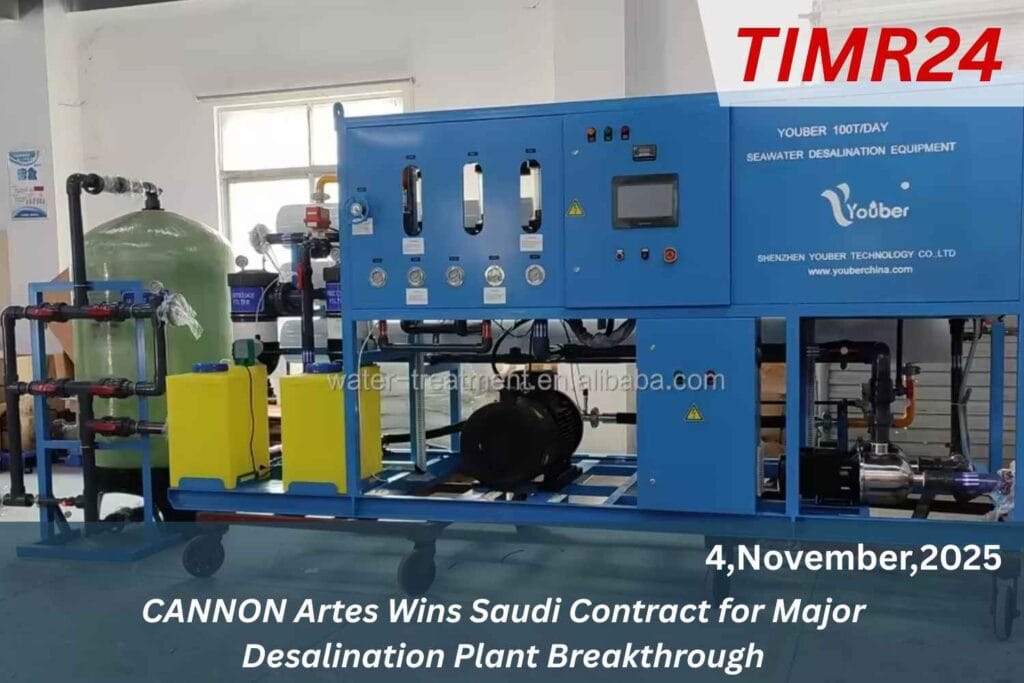
CANNON Artes has secured a contract to engineer and supply a seawater desalination plant for the Hajr Expansion CCGT IPP Project in Saudi Arabia, part of a USD 2.6 billion initiative. This facility will produce 34,000 cubic metres of treated seawater daily for various uses, including steam generation and potable water. The plant features advanced Ultrafiltration (UF) and Reverse Osmosis (RO) technologies, ensuring compliance with local regulations and emphasizing CANNON Artes’ commitment to sustainability. Mauro Monti, Area Manager of CANNON Artes, stated that this project demonstrates their capability in addressing complex water treatment challenges.
CANNON Artes maintains its position as a leader in industrial water treatment, with operations showcased at ADIPEC 2024 in Abu Dhabi In a strategic milestone for global water infrastructure, the Italian specialist firm CANNON Artes has secured a significant contract in Saudi Arabia, reinforcing the accelerating synergy between power generation and seawater desalination in the Middle East. The deal comes in conjunction with the Hajr Expansion project, a 3 GW combined-cycle gas-fired power plant being developed by ACWA Power, Saudi Electricity Company and Haji Abdullah Alireza & Co., with Orascom Construction and Technical Reunites as EPC partners.
At its core the contract covers engineering and supply of a large-scale seawater desalination treatment plant, designed to produce roughly 34,000 m³ of treated water each day. That output will address several needs: de-mineralised water for steam generation in the power plant, potable water for internal plant use, and service water for utilities What makes this project noteworthy is not just its scale but the technological ambition. The plant will integrate ultrafiltration (UF) and reverse osmosis (RO) membrane systems boasting nearly 22,000 m² of active membrane area, followed by electrode ionisation (EDI) to polish the output, and finally a remineralisation section.
CANNON Artes’ Broadened Global
With calcite filters to restore calcium and alkalinity vital for water stability and reduction of corrosivity From a business-perspective, this contract underscores CANNON Artes’ broadened global footprint in industrial water treatment and desalination. Their offering spans process design, manufacturing, commissioning and full plant delivery a turnkey capability that suits the increasingly demanding environment of power-generation and petrochemical complexes. As noted in a company statement, “This project highlights CANNON Artes’ ability to manage highly complex and large-scale water treatment challenges, meeting the most demanding efficiency and environmental standards.
For Saudi Arabia, the project aligns with a broader national imperative. Water scarcity, reliance on desalination and the need for efficient integration of water and power infrastructure remain central themes in the Kingdom’s development agenda. In fact, according to the Saudi Water Authority, about 60 % of the country’s water supply comes from desalination, with ambitions to increase capacity Within the power-plant context, the synergy is clear: the plant will utilise water for steam generation in the combined-cycle gas turbines, making high-quality de-mineralised water essential. By co-locating desalination and power infrastructure, developers achieve.
Economies of scale, reduced logistic complexity and improved resource efficiency. The contract’s inclusion of potable and service water components further reinforces the integrated nature of modern industrial infrastructure Another dimension worth emphasising is sustainability. While desalination remains energy-intensive, technology advances such as high-efficiency membranes, energy recovery devices and process optimisation help bring down the environmental footprint. With Saudi Arabia and other Gulf states pursuing renewable-energy-driven desalination and green-hydrogen ambitions, projects like this one become part of a larger strategic ecosystem.
Membrane Footprint Signals
For example, analyses of water treatment in the Middle East highlight the push to pair desalination with renewable assets to cut emissions and manage freshwater resources more sustainably Within this contract, the choice of UF, RO and EDI technologies and the large membrane footprint signals a high-efficiency design tailored to handle high‐salinity seawater and ensure long-term reliability in harsh coastal conditions. CANNON Artes’ integrated approach (from process design through manufacturing and commissioning) ensures tighter control over the quality and performance of each plant module In terms of risk and execution, large-scale desalination coupled.
With power infrastructure brings multiple challenges: marine-intake quality, membrane fouling, brine management, energy consumption, integration with plant (Tourism) utilities, local regulatory compliance, and long-term operation and maintenance. The fact that this contract covers engineering and supply implies that CANNON Artes must deliver not only equipment but design packaged for the client’s operational context in Saudi Arabia’s Eastern Province From a market vantage point, the contract is timely. The Gulf region is witnessing expanding investment in desalination capacity to meet growing water demand, industrial expansion (including petrochemical and hydrogen-value-chain infrastructure.
And resilient infrastructure for power and utilities. By participating in this project, CANNON Artes strengthens its positioning in a competitive field of global water-treatment suppliers For industry observers and stakeholders, several take-aways are clear. First: integration of desalination with power projects is increasingly a “must” in large industrial complexes, not an option. Second: technology choices (membranes, energy recovery, modular solutions) are converging toward “standardised high-efficiency” models rather than bespoke one-offs. Third: suppliers that offer full-chain delivery (design, manufacturing, commissioning) gain competitive advantage.
Fourth sustainability considerations (energy consumption, brine discharge, renewable coupling) are no longer “nice to have” but central to project viability and financing It is worth noting that earlier this year in Egypt, CANNON Artes secured a contract with the Suez Oil Processing Company (SOPC) to build an integrated desalination and demineralisation plant for refinery use an indicator of the company’s rising capability across multiple geographies In terms of impact, the new Saudi facility will supply de-mineralised water for the power plant, potable water for the plant site and service water for utilities meaning that the water infrastructure.
Global Scale Provider of High Technology Industrial
Underpins both the core power generation asset and ancillary services. Operational reliability of the water supply will contribute directly to the stability of the power plant and thereby to broader grid and industrial security Ultimately, this contract represents more than just a single project for CANNON Artes: it signals the company’s evolution into a global-scale provider of high-technology industrial water solutions, especially within the energy and water nexus in the Middle East. For Saudi Arabia and the Hajr Expansion project partners, the deal exemplifies how major power-water infrastructure is now conceived as integrated and inter-dependent.
As next steps, attention will likely focus on project milestones: detailed engineering, procurement and manufacture, shipment of modules, site assembly, commissioning, and hand-over. For stakeholders, monitoring how the plant meets performance targets (34,000 m³/day, membrane performance, water quality, energy consumption) will be critical. Also, performance in operation (maintenance, fouling, long-term reliability) will shape future contracts and reputation of the supply chain In closing, the contract showcases how rapidly.
The global water-treatment industry is evolving in the face of rising demand, technological innovation and sustainability constraints. For organisations such as (Middle) CANNON Artes, the ability to deliver techno-industrial solutions at scale is becoming a differentiator. And for regions such as the Middle East, the integration of desalination and power infrastructure is a strategic imperative one in which the water treatment supplier becomes a critical partner in the energy transition.
Q1. What contract has CANNON Artes secured?
CANNON Artes has been awarded the engineering and supply contract for a large-scale seawater desalination facility associated with the ACWA Power-led Hajar Expansion CCGT IPP project in Saudi Arabia’s Eastern Province.
Q2. What capacity will the desalination plant have?
The facility is designed to treat approximately 34,000 m³ of high-salinity seawater per day.
Q3. What technologies will be used in this project?
The system will integrate advanced ultrafiltration (UF) and reverse osmosis (RO) membrane technologies (with nearly 22,000 m² of membrane area) followed by electrode ionisation (EDI) polishing and a remineralisation stage with calcite filters.
Q4. What is the relationship between the desalination plant and the power project?
The desalination facility forms part of the broader US $2.6 billion, 3 GW combined-cycle gas-fired power plant project (Hajar Expansion) being developed by a consortium including ACWA Power, Saudi Electricity Company and Haji Abdullah Alireza & Co., with EPC contractors Orascom Construction and Technical Reunites.
Q5. Why is this project significant for CANNON Artes and the water-treatment industry?
Because it highlights CANNON Artes’ ability to deliver large-scale, complex industrial water-treatment solutions in challenging contexts. It bolsters their global leadership in sectors such as power generation, oil & gas, and petrochemicals. It also demonstrates growing demand for efficient water-reuse and desalination infrastructure in the Middle East.