











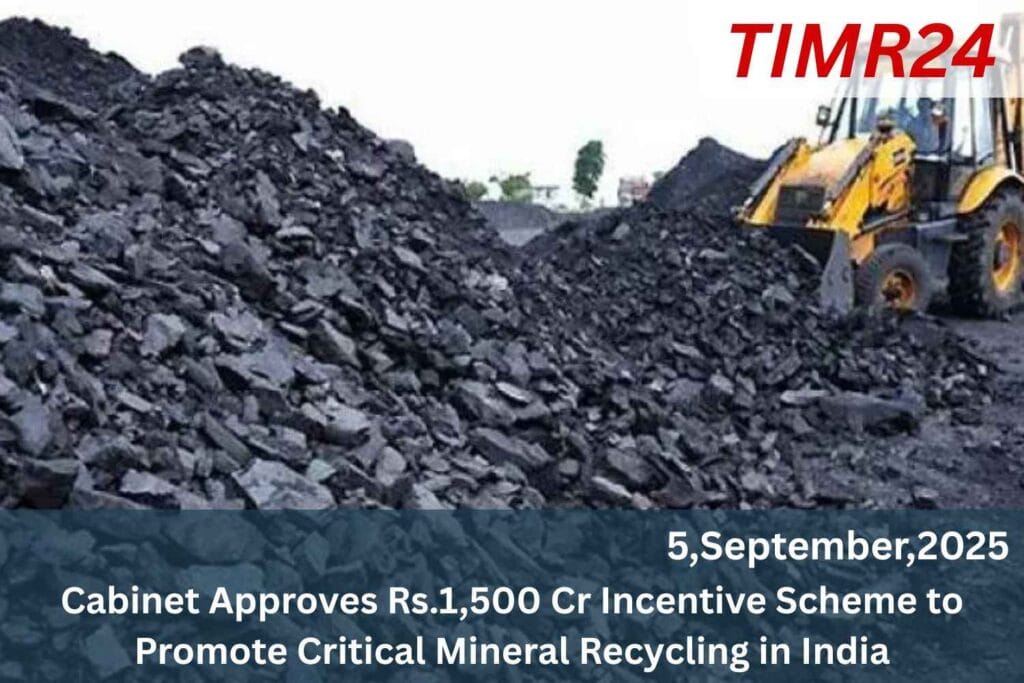
India has Cabinet approved a Rs.1,500 crore incentive scheme to develop recycling capacity for the separation and production of critical minerals from secondary sources. The scheme is part of the National Critical Mineral Mission (NCMM) aimed at building domestic capacity and supply chain resilience in critical minerals. The scheme will have a six-year tenure from FY 2025-26 to FY 2030-31 and will be applicable to investments in new units, expansion of capacity, modernization, and diversification of existing units. The incentives will comprise a 20% Capex subsidy on plant and machinery, equipment, and utilities for starting production within.
A specified timeframe, and an OpenX subsidy on incremental sales. The scheme is expected to develop at least 270 kilo ton of annual recycling capacity, resulting in around 40 kilo ton annual critical mineral production, bringing in about Rs.8,000 crore of investment and creating close to 70,000 direct and indirect jobs. The Indian Cabinet’s decision to approve a ₹1,500 crore incentive scheme to promote critical mineral recycling comes at a time when global demand for clean energy and advanced technologies is at an all-time high. With the rise of electric vehicles, renewable energy systems, and high-tech manufacturing, minerals like lithium, cobalt, nickel, and rare earth elements have emerged.
As the backbone of modern economies. India, which has been heavily dependent on imports for these resources, now aims to create a sustainable domestic ecosystem through recycling. The move aligns with the country’s long-term vision of reducing import dependency, encouraging circular economy practices, and achieving energy security under the broader umbrella of the Atmanirbhar Bharat initiative India’s dependence on imports for critical minerals creates a vulnerability in its supply chains, particularly when geopolitical tensions or global market fluctuations disrupt availability. Reports by (NITI Aayog) have already highlighted that demand for lithium and cobalt will multiply several times by 2030, largely driven by the electric mobility revolution.
Key Features of the Incentive Scheme
Without recycling, the country risks shortages, rising costs, and increased strategic dependence on countries like China and Australia. Recycling provides an opportunity to reclaim valuable resources from discarded batteries, electronics, and industrial waste, ensuring both economic and environmental resilience The ₹1,500 crore scheme is structured to accelerate the establishment of a strong recycling industry in India. It emphasizes three pillars financial incentives for private and public players, research and development support for innovative recycling technologies, and infrastructure creation for large-scale facilities. One of the core objectives is to promote urban mining, where valuable minerals are extracted from end-of-life electronics.
EV batteries, and industrial waste. This approach not only conserves resources but also addresses the growing challenge of electronic waste management. The Indian EV industry is expanding rapidly, driven by government programs such as the rising consumer demand for affordable green mobility. However, the sector has remained heavily reliant on imported lithium-ion batteries, making it vulnerable to global price fluctuations. With the new recycling initiative, EV manufacturers can tap into domestically recovered lithium, cobalt, and nickel, reducing import dependency while also lowering production costs. This strengthens the Make in India mission and helps Indian manufacturers compete on the global stage.
Renewable Energy and Grid Storage Benefits
Recycling critical minerals is equally important for India’s renewable energy push. Solar panels, wind turbines, and large-scale battery storage systems all rely on minerals like rare earths and nickel. By ensuring a stable domestic supply through recycling, India can accelerate its goal of reaching 500 GW of renewable capacity by 2030. The scheme also complements global commitments such as the (Solar Alliance), positioning India as a leader in sustainable energy technologies. Mining for critical minerals is resource-intensive and environmentally damaging, often causing deforestation, groundwater contamination, and greenhouse gas emissions. Recycling, on the other hand, offers a greener alternative by reducing the need for virgin mining.
The stressed that circular economy models could cut global resource demand by nearly 25% by 2050. Through this scheme, India not only secures its supply chains but also strengthens its climate commitments under the Paris Agreement. Recycling also aligns with the global shift toward sustainable production and responsible consumption, ensuring that industries grow without compromising ecological balance. The success of this initiative depends on strong collaboration between government, private industry, and global technology leaders. The scheme is expected to encourage startups and established companies to set up recycling facilities while promoting research partnerships with universities and international firms.
Policies supporting extended producer responsibility will push manufacturers to take accountability for end-of-life products, ensuring a continuous flow of recyclable material. This could eventually make India a hub for global recycling of critical minerals, attracting foreign investments and boosting exports of processed resources While the scheme sets a strong foundation, challenges remain in building advanced recycling technologies, managing hazardous waste safely, and scaling operations nationwide. India must also address the informal recycling sector, which currently handles a large share of e-waste but often without proper safety or environmental standards.
With strong policy support, financial backing, and innovation, these gaps can be bridged, making India a self-reliant leader in sustainable mineral management. Over the next decade, this initiative is likely to transform how industries source raw materials, creating a resilient supply chain that supports growth while safeguarding the planet. The Cabinet’s approval of the ₹1,500 crore incentive scheme is more than just an economic policy it is a strategic move for national security, environmental sustainability, and industrial growth. By focusing on recycling, India is turning waste into wealth, reducing its import dependency, and paving the way for a cleaner, greener future.
As the nation scales its renewable energy, EV, and high-tech manufacturing capabilities, this initiative could become the cornerstone of its journey toward resource independence and global leadership in sustainable development
Q1. What is the ₹1,500 crore incentive scheme for critical mineral recycling?
It is a government initiative to promote recycling of minerals like lithium, cobalt, nickel, and rare earths to support clean energy and EV sectors.
Q2. Why is critical mineral recycling important for India?
It reduces import dependence, supports sustainability, and ensures supply security for emerging industries.
Q3. Which industries will benefit from the scheme?
Electric vehicles, renewable energy, electronics, and defense manufacturing sectors will gain significantly.
Q4. How will the scheme support environmental goals?
It promotes circular economy practices, reduces mining-related damage, and cuts carbon footprint.
Q5. When will the scheme be implemented?
Implementation will begin in FY 2025-26, with phased investments across recycling infrastructure.