


















The Union Cabinet has approved the Modernization of Command Area Development and Water Management (M-CADWM) scheme, aiming to cover 75,000 hectares of farmland with underground piped irrigation systems. The scheme, which will benefit 80,000 farmers and 4 lakh individuals, aims to boost crop yields, diversify income, reduce energy costs, and improve market access. It will also involve Water User Societies (WUS) in water distribution, infrastructure maintenance, conflict resolution, and capacity building. The scheme aims to transform rural irrigation practices, enhance agricultural productivity, and stimulate the rural economy.
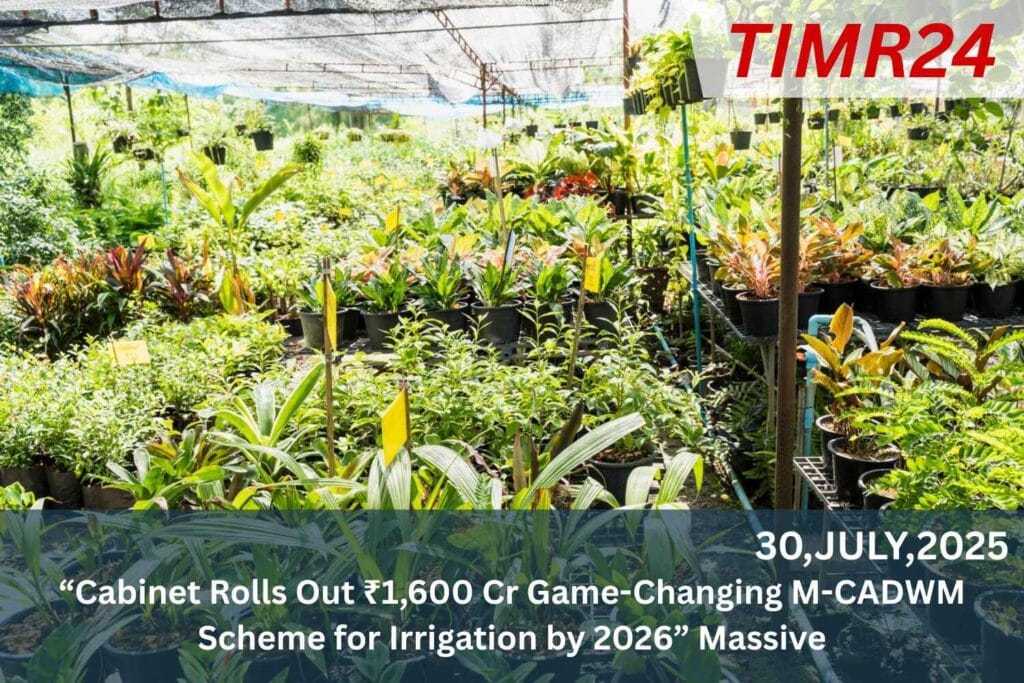
The Union Cabinet has approved an investment of ₹1,600 crore for the Modified Command Area Development and Water Management (M-CADWM) Scheme, a move aimed at improving irrigation systems across India. The scheme will operate under the umbrella of the Pradhan Mantri Krishi Sinkhole Yojana (PMKSY) and will focus on last-mile water delivery to farmers. This investment marks a critical step in India’s goal to improve water-use efficiency and strengthen agricultural resilience by 2026.
Focus on Modernizing Irrigation Infrastructure
The M-CADWM scheme is designed to modernize and expand the irrigation network in command areas, which are regions served by major and medium irrigation projects. The funds will be used for activities such as canal lining, micro-irrigation integration, and automation of control structures to ensure water reaches the tail-end users efficiently. More about the scope of this mission can be explored through the official (Water Management) portal.
Integration with PMKSY for Holistic Development
As a subcomponent of the M-CADWM scheme complements other initiatives like Per Drop More Crop and Accelerated Irrigation Benefit Programme (AIBP). Together, these schemes promote water-saving technologies and expand the area under irrigation. This integrated approach will help bridge the gap between irrigation potential created and irrigation potential utilized (IPU), one of the long-standing challenges in India’s agrarian economy.
Target and Timeline
The government aims to cover around 6.26 lakh hectares of irrigation command area across multiple states by 2026. Priority will be given to drought-prone, water-stressed, and tribal regions where agricultural productivity is directly linked to the availability of irrigation facilities. The scheme also includes provisions for community participation and capacity building of Water User Associations (WUAs), empowering local stakeholders to manage water distribution efficiently.
Sustainability and Digital Monitoring
To ensure transparency and performance tracking, the scheme will leverage satellite monitoring, geotagging, and the National Hydrology Project (NHP) systems for real-time reporting. This aligns with India’s larger push towards Digital Agriculture and smart water management. You can read more about these digital efforts on the (Digital India portal))
Expected Impact on Agriculture and Rural Livelihoods
The M-CADWM scheme is expected to significantly improve agricultural yields by providing timely and equitable water access, thereby reducing dependence on erratic monsoon rainfall. Enhanced irrigation will support the government’s efforts to double farmers’ income and ensure food security. It also aligns with the goals of the National Water Mission, which advocates for increased water-use efficiency in all sectors. The Cabinet’s approval of ₹1,600 crore for the M-CADWM scheme is a progressive move toward creating a water-secure and farmer-friendly India. With strong institutional mechanisms, digital integration, and a people-centric approach, the initiative is set to become a cornerstone of sustainable agricultural development by.
q1. What is the M-CADWM Scheme?
The Modified Command Area Development and Water Management (M-CADWM) Scheme aims to improve irrigation infrastructure and water-use efficiency in command areas.
q2. How much funding has the Cabinet approved?
The Cabinet has approved ₹1,600 crore for implementing the M-CADWM scheme by 2026.
q3. Which areas will benefit from the scheme?
Around 6.26 lakh hectares across drought-prone, tribal, and water-stressed regions will be prioritized.
q4. How is this scheme linked to PMKSY?
M-CADWM is a component of the Pradhan Mantri Krishi Sinchayee Yojana (PMKSY), focused on enhancing irrigation efficiency.
q5. What technologies will be used for monitoring?
The scheme will use geotagging, satellite tracking, and digital dashboards under the National Hydrology Project for real-time monitoring.