














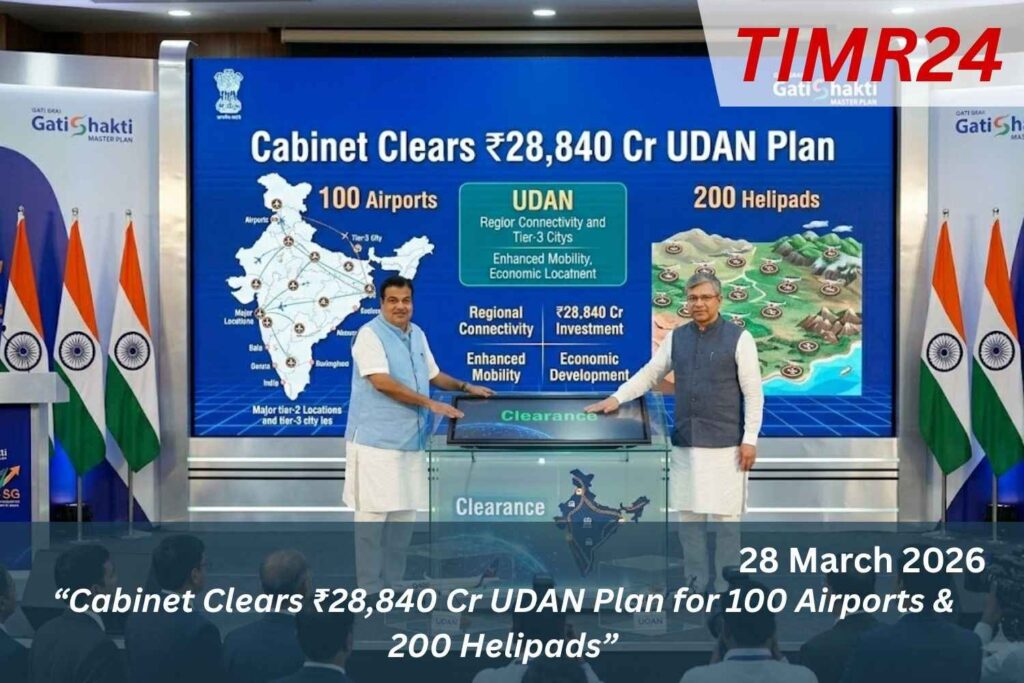
The Union Cabinet, led by Prime Minister Narendra Modi, has approved the Modified UDAN Scheme under the Regional Connectivity Scheme, allocating Rs 28,840 crore for ten years (FY 2026-27 to FY 2035-36). The scheme will develop 100 airports from unserved airstrips with a budget of Rs 12,159 crore and provide operation support for 441 aerodromes, costing Rs 2,577 crore. Additionally, it includes the construction of 200 modern helipads for Rs 3,661 crore and viability gap funding of Rs 10,043 crore for regional airline operations. Overall, these initiatives aim to boost regional connectivity, support tourism and economic growth in Tier-2 and Tier-3 cities, and advance.
Decision Reflects A Strong Commitment
India’s aviation infrastructure in line with the Viksit Bharat 2047 vision The Indian government has taken a major step toward strengthening regional connectivity by approving a massive ₹28,840 crore expansion under the UDAN scheme. This decision reflects a strong commitment to transforming India’s aviation landscape and making air travel more accessible to millions of citizens. The UDAN scheme, short for “Ude Desh ka Aam Nagrik,” was originally launched to make flying affordable and to connect underserved and unserved regions of the country. With this latest expansion, the government is significantly scaling up its vision by planning the development of 100 new airports and 200 helipads across India.
This move is expected to reshape connectivity, especially in remote and tier-2 and tier-3 regions, where transportation infrastructure has traditionally been limited The expansion of the UDAN scheme is not just about building airports; it is about creating a comprehensive ecosystem that supports economic growth and regional development. Improved air connectivity will make it easier for businesses to operate in smaller cities, leading to increased investment opportunities and job creation. Tourism is another sector that stands to gain immensely from this initiative, as easier access to previously hard-to-reach destinations will attract both domestic and international travelers.
Airports And Helipads, More Routes
This aligns closely with India’s broader goal of becoming a global tourism hub while also ensuring balanced regional development A key aspect of this expansion is its focus on affordability. The UDAN scheme has always emphasized making air travel accessible to the common citizen by offering subsidized fares on select routes. With the addition of new airports and helipads, more routes will be introduced, increasing competition and further driving down costs. This democratization of air travel is expected to bring a new segment of travelers into the aviation market, many of whom are first-time flyers. Such inclusivity not only boosts passenger numbers but also strengthens the overall aviation ecosystem.
Another important dimension of the scheme is its emphasis on last-mile connectivity. While airports are crucial, the inclusion of 200 helipads highlights the government’s intent to provide flexible and efficient transportation options, especially in hilly and remote terrains. Helicopter services can play a vital role in connecting regions that are difficult to access by road or rail, thereby ensuring that no area is left behind in the development journey. This approach reflects a holistic understanding of connectivity, where different modes of transport complement each other to create a seamless travel experience The economic impact of this initiative is expected to be far-reaching.
Smoother Movement Of Goods And Services
Infrastructure development on this scale will generate employment opportunities at multiple levels, from construction and engineering to operations and maintenance. Additionally, improved connectivity will facilitate smoother movement of goods and services, thereby enhancing trade and commerce. This is particularly significant for small and medium enterprises (SMEs) located in remote areas, as better access to markets can help them expand their reach and increase profitability. From a strategic perspective, the expansion of the UDAN scheme also strengthens India’s position in the global aviation market. As the country continues to witness rapid economic growth.
The demand for air travel is expected to rise significantly. By investing in infrastructure now, the government is preparing to meet this future demand while also ensuring that growth is inclusive and sustainable. The development of new airports will also help decongest existing major hubs, leading to more efficient operations and better passenger experiences Environmental considerations are also being integrated into the planning and execution of these projects. Modern airport infrastructure is increasingly focusing on sustainability, with features such as energy-efficient buildings, renewable energy usage, and improved waste management systems.
By adopting such practices, the UDAN expansion aims to balance growth with environmental responsibility, ensuring that development does not come at the cost of ecological well-being In addition to economic and environmental benefits, the scheme also has (India) significant social implications. Improved connectivity can enhance access to essential services such as healthcare and education, particularly in remote areas. For instance, faster transportation can make it easier for patients to reach advanced medical facilities in urban centers, potentially saving lives. Similarly, students from smaller towns can access better educational opportunities, contributing to overall human capital development.
Digitalization Efforts And Reinforces
The role of technology in this expansion cannot be overlooked. Digital tools and advanced systems will play a crucial role in managing operations, ensuring safety, and enhancing passenger experiences. From online ticketing to real-time flight tracking, technology will be at the core of this transformation. This aligns with India’s broader digitalization efforts and reinforces the vision of a connected and technologically advanced nation The government’s collaboration with various stakeholders, including private players, will also be critical in the successful implementation of this scheme. Public-private partnerships can bring in additional expertise, innovation, and investment, further accelerating the pace of development.
The Cabinet’s approval of the ₹28,840 crore UDAN expansion marks a significant milestone in India’s journey toward enhanced connectivity and economic growth. By focusing on inclusivity, affordability, and sustainability, this initiative has the potential to transform the (India) aviation sector and bring widespread benefits to the country. The development of 100 airports and 200 helipads is not just an infrastructure upgrade; it is a strategic investment in India’s future, aimed at bridging gaps, creating opportunities, and ensuring that the benefits of growth reach every corner of the nation.
Q1. What is the UDAN scheme?
UDAN (Ude Desh ka Aam Nagrik) is a government initiative launched to make air travel affordable and improve regional connectivity.
Q2. What has the Cabinet approved?
The Cabinet approved ₹28,840 crore to expand the scheme, including 100 airports and 200 helipads.
Q3. Who will benefit from this scheme?
People in tier-2, tier-3 cities and remote areas will benefit from better air connectivity.
Q4. How will this impact the economy?
It will boost tourism, trade, job creation, and regional development.
Q5. When will the expansion be implemented?
Implementation will happen in phases over the coming years.