
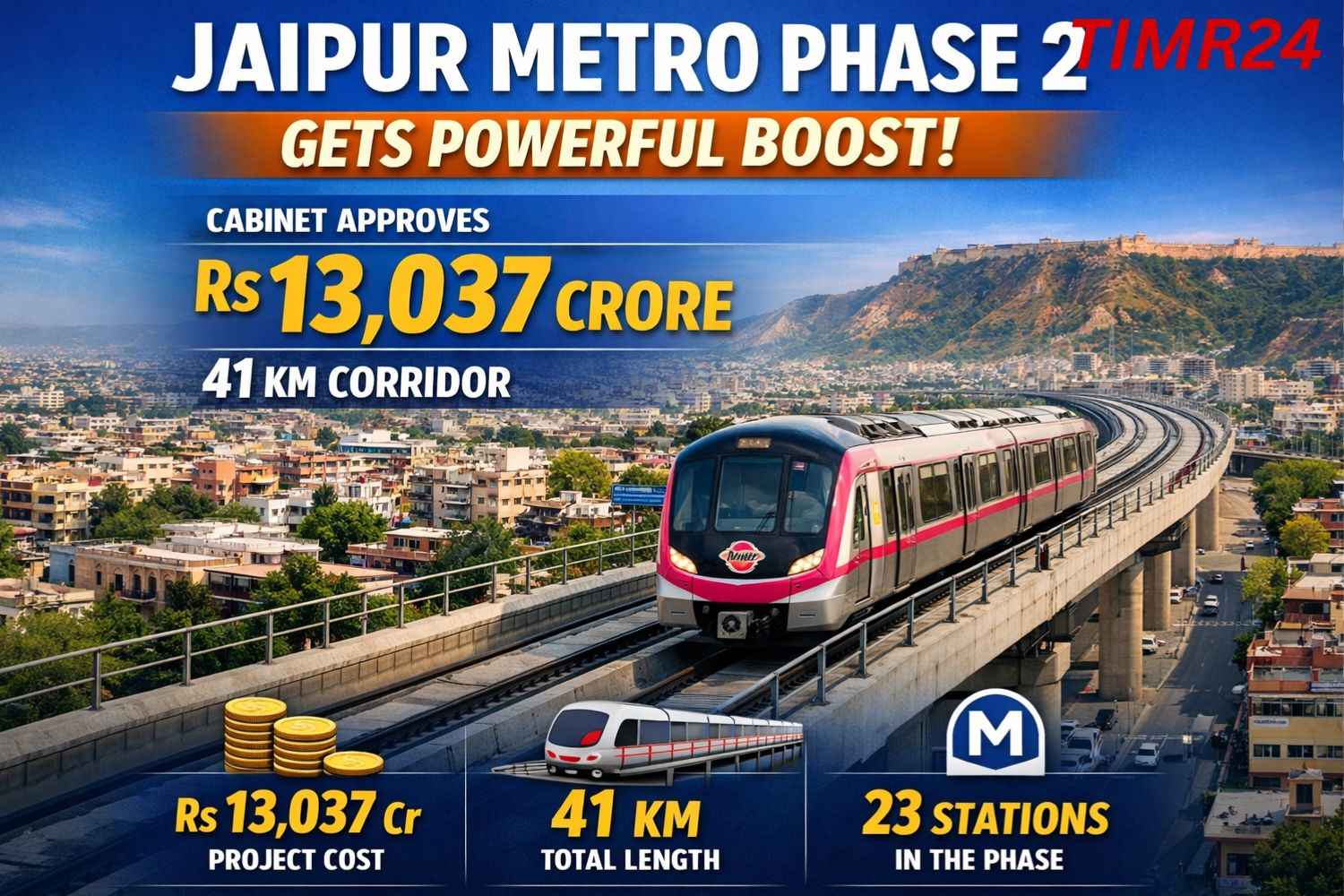


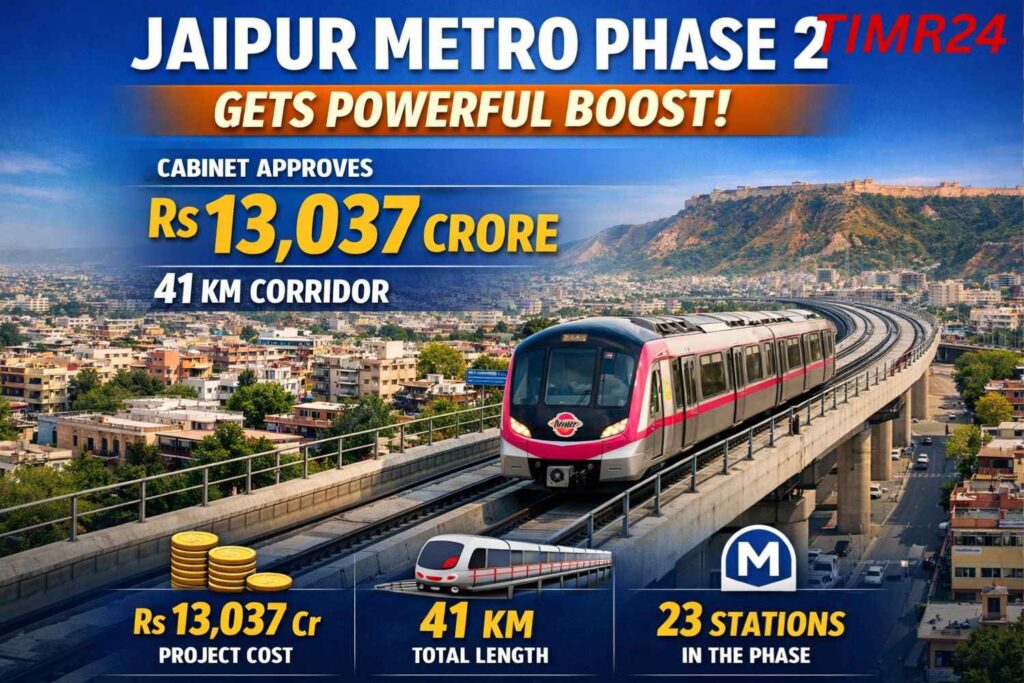
Jaipur Metro Phase-2, approved by the Union Cabinet and led by Prime Minister Narendra Modi, will comprise a 41 km North–South corridor from Prahladpura to Todi Mod, featuring 36 stations at a project cost of Rs 13,037.66 crore. Developed by the Rajasthan Metro Rail Corporation Limited, it will enhance connectivity to key areas such as the Sitapura Industrial Area and Jaipur Airport. The project is expected to significantly increase metro ridership, currently at 60,000 daily on Phase-1, while promoting public transport use and reducing reliance on private vehicles. With thorough evaluations confirming its socio-economic viability, Phase-2 aims to open by.
Ambitious Jaipur Metro Phase 2 Project
September 2031, aligning with sustainable urban transport goals and changing urban mobility dynamics in Jaipur The Union Cabinet has approved the ambitious Jaipur Metro Phase 2 Project with an estimated investment of Rs 13,037 crore, marking one of the most significant urban transport infrastructure upgrades for Rajasthan’s capital in recent years. This transformative metro expansion will introduce a 41-kilometre North-South corridor aimed at improving public transportation, reducing traffic congestion, and supporting sustainable urban growth across Jaipur. The approval reflects the central government’s continued focus on strengthening metro rail networks in emerging.
Metropolitan cities and modernizing India’s urban transit ecosystem. According to official project details, the Jaipur Metro Phase 2 corridor will stretch from Prahladpura to Todi Mod, significantly enhancing north-south connectivity in the Pink City while integrating with the existing Phase 1 network to create a more seamless and efficient metro transportation system This major infrastructure project is expected to reshape Jaipur’s transportation landscape by connecting key residential, industrial, institutional, and commercial hubs. Once operational, the new metro corridor will provide direct and faster access to important city locations including.
Sawai Mansingh Stadium, Ambabari, And Vidhyadhar Nagar
Sitapura Industrial Area, Vishwakarma Industrial Area (VKI), Jaipur International Airport, Tonk Road, SMS Hospital, Sawai Mansingh Stadium, Ambabari, and Vidhyadhar Nagar. Such strategic connectivity is expected to improve commuting efficiency for lakhs of residents, office-goers, students, industrial workers, and tourists traveling across the city every day. The project will especially benefit those commuting from rapidly developing suburban and industrial zones where road congestion has become a major concern over the last decade.
The Jaipur Metro Phase 2 Project will reportedly include 36 metro stations along the 41 km corridor, with a mix of elevated and underground sections depending on urban density and route feasibility. Underground stations are proposed around the airport zone to facilitate better airport access while minimizing land disruption in sensitive areas. This advanced metro planning approach aligns Jaipur with modern urban transit standards being adopted in major Indian cities such as Delhi, Mumbai, Bengaluru, and Hyderabad. The metro expansion is also expected to support the Rajasthan Transit Oriented Development Policy 2025 by encouraging mixed-use urban growth around metro corridors.
Historically, Metro Rail Projects In India
Reducing dependence on private vehicles From an economic perspective, the approval of Jaipur Metro Phase 2 is likely to act as a catalyst for large-scale real estate and commercial development along the proposed corridor. Historically, metro rail projects in India have significantly boosted property values, commercial investments, and retail expansion in nearby locations. Areas around Tonk Road, Sitapura, VKI, and Vidhyadhar Nagar are expected to witness fresh interest from developers and businesses due to improved accessibility and transport convenience. Better metro connectivity often translates into increased land values, faster urban expansion, and stronger demand for residential as well as.
Office spaces. Investors and real estate stakeholders will likely monitor the project closely as construction progresses Beyond economic growth, Jaipur Metro Phase 2 also carries substantial environmental and social benefits. The expansion of reliable public (India) transportation infrastructure is expected to reduce dependency on personal vehicles and two-wheelers, helping decrease traffic congestion on major arterial roads across Jaipur. Lower vehicular usage will directly contribute to reduced carbon emissions, better air quality, and less fuel consumption. In a city experiencing rapid population growth and urban sprawl, metro rail infrastructure becomes increasingly critical for.
Maintaining sustainable and livable urban conditions. The project therefore supports broader national goals related to green mobility and climate-conscious infrastructure development Implementation of the project will be handled by Rajasthan Metro Rail Corporation Limited (RMRCL), the joint venture between the Government of India and the Government of Rajasthan. Funding for the project is expected to be shared through a combination of central-state equity, subordinate debt, and multilateral financing structures under the Metro Rail Policy framework. This financing model has been widely used in other metro projects across India to ensure long-term financial viability and effective project execution.
Modern Urban Mobility And Improved Quality
The targeted completion timeline for Jaipur Metro Phase 2 is around 2031, although execution schedules may be refined further as detailed implementation planning begins For Jaipur residents, the project represents a major leap toward modern urban mobility and improved quality of life. Travel times between key northern and southern zones of the city are expected to reduce significantly once the corridor becomes operational. Daily commuters who currently spend long hours navigating congested roads may benefit from predictable, faster, and safer transit options. Students, professionals, airport travelers, and business owners alike stand to gain from enhanced citywide accessibility.
Moreover, the integration of Phase 2 with the existing Jaipur Metro network will strengthen the overall viability and utility of the city’s metro system, creating a more connected and efficient public transport backbone The approval of Jaipur Metro Phase 2 also sends a strong signal about Rajasthan’s growing infrastructure ambitions. Alongside highway expansions, industrial corridor investments, logistics parks, and smart city initiatives, metro rail expansion reinforces Jaipur’s position as one of India’s fastest-modernizing Tier-2 urban centres. The city’s infrastructure trajectory increasingly mirrors that of larger metros, with coordinated investments across mobility, housing.
Urban planning, and industrial development. This integrated growth model can help Jaipur emerge as a stronger economic and tourism hub over the next decade As construction begins in the coming months, stakeholders across transportation, real estate, (India) manufacturing, and retail sectors will closely monitor execution milestones. Timely delivery and efficient project management will be crucial to maximizing economic returns and public benefits. If completed as planned, Jaipur Metro Phase 2 could become one of Rajasthan’s most impactful urban infrastructure achievements and a benchmark for transit-led development in emerging Indian cities.
Q1. What is Jaipur Metro Phase 2 Project?
Jaipur Metro Phase 2 is a new 41 km North-South metro corridor approved by the Union Cabinet to improve Jaipur’s public transport.
Q2. What is the total cost of Jaipur Metro Phase 2?
The approved cost of Jaipur Metro Phase 2 is Rs 13,037 crore.
Q3. How many stations will Jaipur Metro Phase 2 have?
The corridor is expected to include 36 metro stations.
Q4. Which areas will Jaipur Metro Phase 2 connect?
It will connect Prahladpura to Todi Mod and major hubs like Airport, Sitapura, VKI, SMS Hospital, and Tonk Road.
Q5. When will Jaipur Metro Phase 2 be completed?
The project is targeted for completion by 2031.