









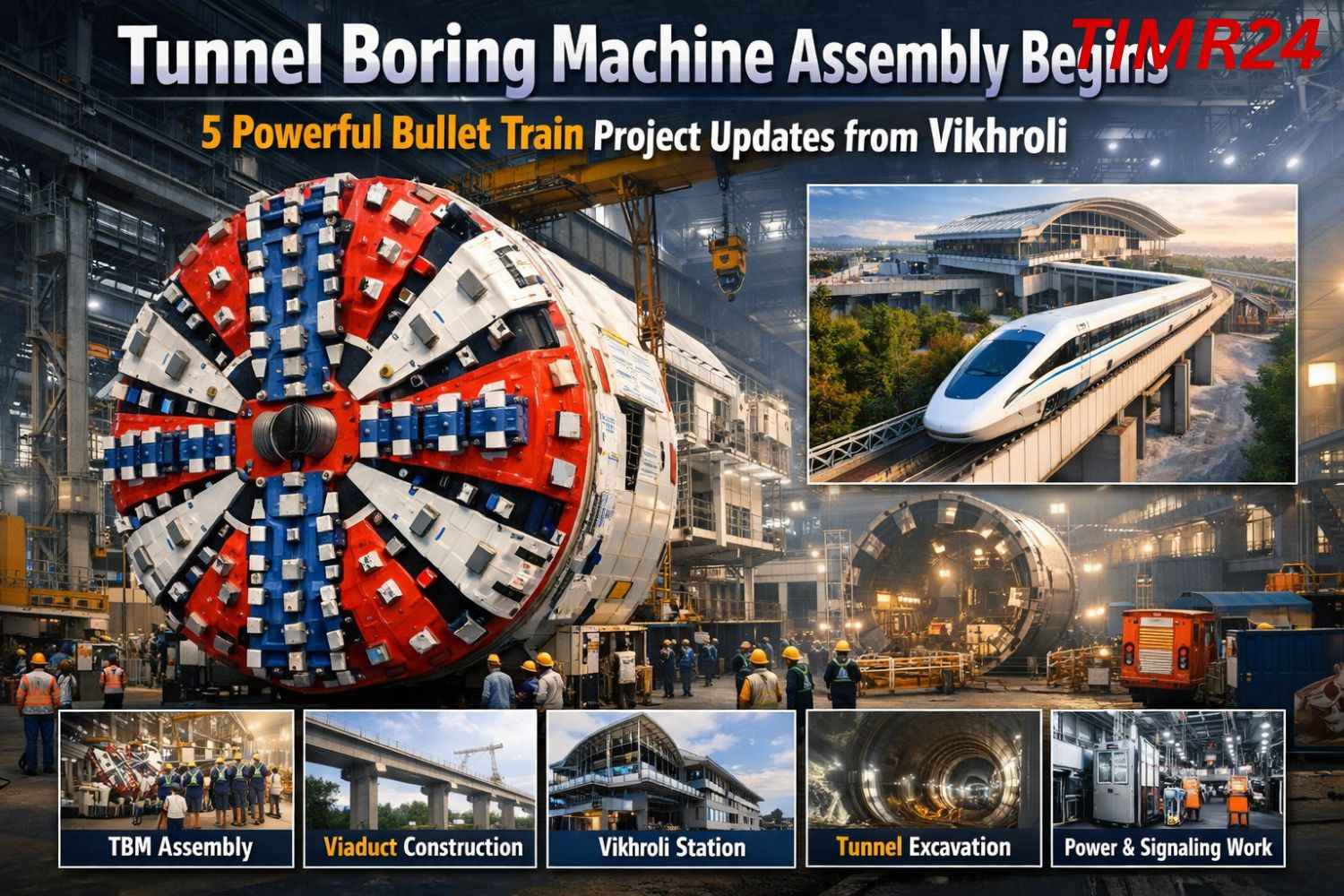




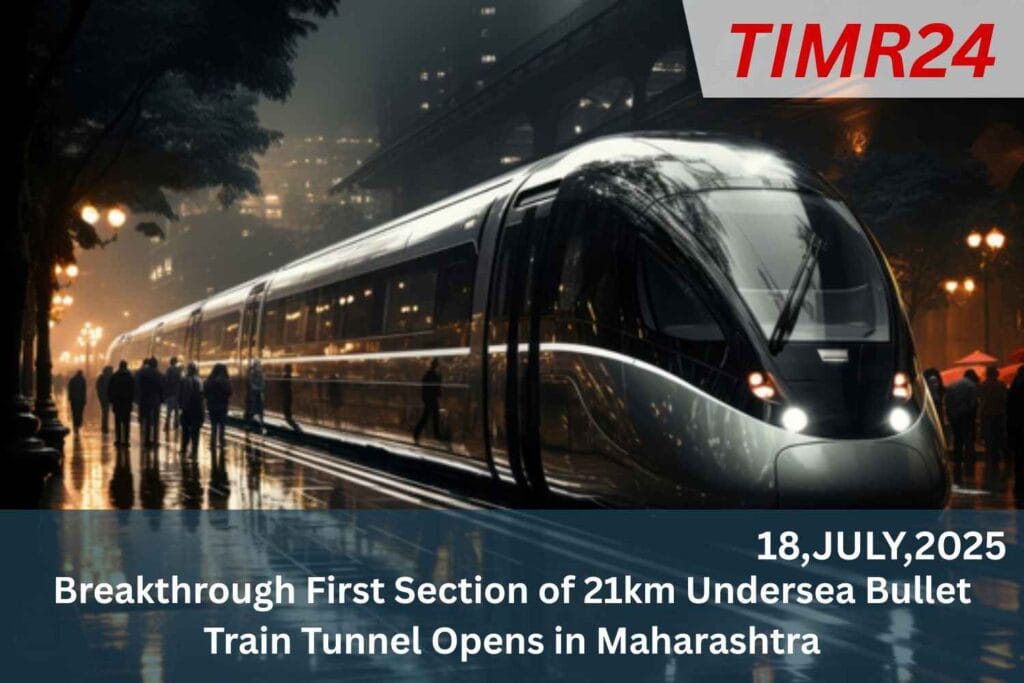
The Mumbai-Ahmedabad Bullet Train project has completed the first section of a 21-km undersea tunnel between Bandra-Kurla Complex (BKC) and Thane, marking a significant milestone in India’s first high-speed rail corridor. The project has also completed 310 km of viaduct construction and is advancing with other critical works. The Japanese government has agreed to introduce E10 Shinkansen trains in the project, reflecting strategic cooperation between India and Japan. Civil works are progressing rapidly, with 310 km viaducts constructed, 15 river bridges completed, and 12 stations nearing completion. The project’s success is laying the foundation for future bullet train corridors in India.
The Mumbai–Ahmedabad High-Speed Rail Corridor has reached a significant landmark: the opening of the first section of the 21 km undersea tunnel between Ghansoli and Shipmate in Maharashtra. The tunnel, part of the country’s debut bullet train route, includes a 7 km stretch under Thane Creek, designed to protect the sensitive mangrove ecosystem. (Times of India+15The New Indian Express)
Engineering Milestone & Construction Update
On July 14, 2025, officials confirmed that excavation work had completed a continuous tunnel segment, creating a seamless passage between entry and exit points. This follows the recent breakthrough of a 2.7 km NATM section using the New Austrian Tunnelling Method, while the bulk of the 21 km will be constructed via Tunnel Boring Machines (TBMs)—16 km by TBMs and 5 km by NATM An Additionally Driven Intermediate Tunnel (ADIT), spanning about 394 meters, was completed in mid-2024 to enable simultaneous excavation from both ends, expediting progress.
Ecological Considerations & Environmental Protection
The undersea alignment was chosen to avoid cutting into Thane Creek’s mangroves, preserving nearly 12 hectares of critical coastal habitat. Geotechnical studies and controlled blasting protocols were implemented to safeguard the ecosystem and minimize disruption. Safety systems—including seismic sensors, settlement markers, and ventilation structures—have been installed throughout the project.
Progress Across the Corridor
Civil works are progressing rapidly across the wider corridor: 310 km of viaducts have already been constructed, in addition to 15 river bridges. Among 12 planned stations, five are complete and three more are in the final stages. The BKC underground station is being built 32.5 m below ground and engineered to support a 95 m-high structure above—a testament to India’s ambitious engineering standards.
Future Technology Integration
Once operational, the corridor will be served by Japan’s next-generation E10 Series Shinkansen trains, with initial trial runs set to begin on the E5 series. This marks the first dual rollout of E10 trains in both India and Japan.
Strategic Significance & Path Ahead
The 21 km tunnel is a critical component of the larger 508 km Mumbai–Ahmedabad corridor, expected to reduce travel time to about two hours. At ₹1.08 lakh crore, the corridor is backed by Japanese funding and technology, with completion projected by the end of 2028. This engineering achievement, paired with strong environmental safeguards, positions the project as a model for future high-speed rail initiatives. For more on high-speed rail developments and bullet train planning, see our Bullet Train Projects and sections.
Q1. What is the total length of the undersea tunnel?
The tunnel spans 21 kilometres, with a 7-kilometer stretch under the sea.
Q2. Where is the undersea tunnel located?
It connects Mumbai and Thane as part of the Mumbai-Ahmedabad Bullet Train project.
Q3. What method is being used for Tunnelling?
Tunnel Boring Machines (TBMs) and New Austrian Tunnelling Method (NATM) are being used.
Q4. Who is executing the construction?
National High-Speed Rail Corporation Limited (NHSRCL) is overseeing the project.
Q5. When is the bullet train expected to become operational?
The first phase is targeted for completion by 2026.